center> Important News Iran stars: MEK PMOI
div style="margin: 15px 0px 0px; display: inline-block; text-align: center; width: 200px;">
Showing posts with label MEK PMOI. Show all posts
A 1988 MASSACRE AND THE TRUTH ABOUT ‘MODERATE’ ROUHANI Created: 28 September 2017
Iran
NCRI
Human rights
Political Prisoner

By Dr. Majid Rafizadeh
Iran’s president Hassan Rouhani is making a tactical shift once again. This time he is appeasing the hard-liners publicly and revealing the actual agenda of his administration after achieving the Supreme Leader’s economic objectives.
Rouhani used the UN pedestal last week to shower praise on Tehran’s theocracy. His stale slogans smack of desperation and deception.
Isolated and generally regarded as a pariah, the regime and its familiar figures try to stick to the same plot and project an image of a powerful and rational player.
Bob Blackman MP: Securing international inquiry into the 1988 massacre will win over the Iranian people
Written by:
Bob Blackman MP
House of Commons
Posted On: 28th September 2017
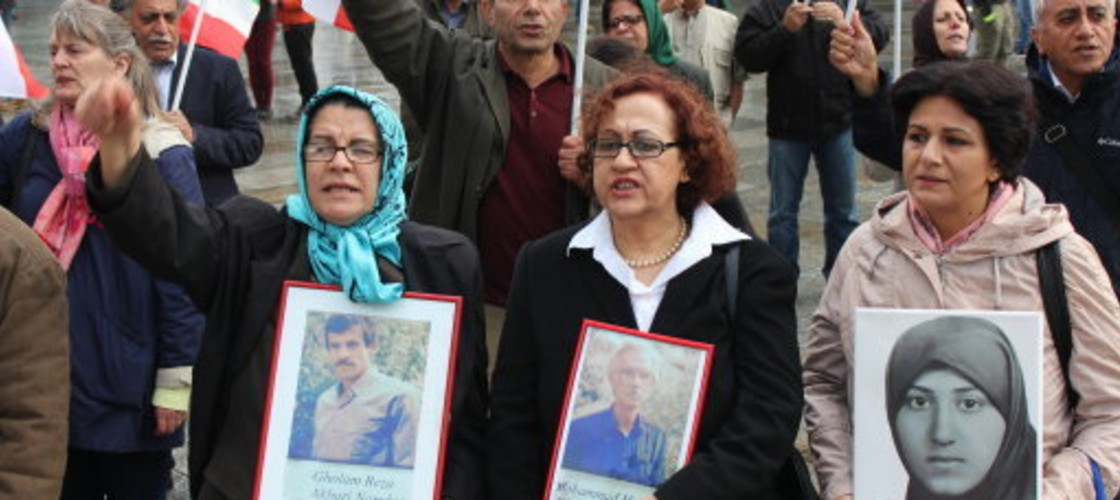
Conservative MP Bob Blackman writes that securing an international inquiry into the 1988 massacre of thousands of political prisoners will win over the Iranian people.Protest against executions in Iran.
Credit: PA Images
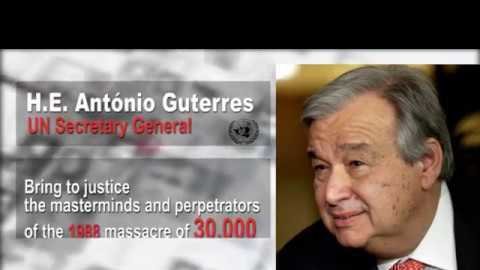
Earlier in September, the UN Secretary General sent the latest report of the Special Rapporteur on Iran’s human rights to the General Assembly for discussion. The August 14 report provides a detailed account of a series of serious abuses that were carried out by the Iranian authorities in the past year year.

IRAN REGIME'S OFFICIALS EXPRESS THEIR FEAR ABOUT PMOI/MEK ACTIVITIES IN PROPAGATING INFORMATION ON 1988 MASSACRE

NCRI - In response to “the justice seeking Movement for victims of 1988 massacre” and along with the three-day Iranian Resistance Satellite TV ‘Simay Azadi's’ event on the anniversary of the Massacre, state run Basij News writes," The People's Mojahedin of Iran (MEK/PMOI) has organized the maximum propagandas and military activities against the Islamic Republic of Iran."
Basij News added," The unresolved issue is that how some of the political circles support the MEK’s measures in the current situation and they question the events of the 80s while trying to call the hangman as a martyr."
Basij News also refers to MEK’s disclosures concerning the bomb constructions in Iran, writing, "Disclosing regime's nuclear activities was the pretext for imposing the most extensive sanctions against the Iran regime."
The Head of Regime's Research Center also referred to the advancement of the Justice Seeking Movement, stating, "Some of the regime's enemies have been seriously involved in the Justice Seeking Movement of 1988 during the past two or three years and the number of those executed is rising exponentially by each year."
Mohammad Hossein Zarifian expressed concern about the release of evidence about Khomenei's order on MEK’s genocide in 1988, and stated, "The foreign channels broadcast different documentaries on this matter. The summer is the peak of such broadcasts and these executions are named as a holocaust for MEK."
An expert on political issues, Foad Yazidi in a meeting entitled with "The Islamic Human Rights' Conference" referred to the great gathering of MEK in Paris. He stated," France hosts Iran's enemies whereas it established economic relations with Iran after the Joint Comprehensive Plan of Action (JCPOA)."
Foad Yazidi also stated, "We had a lot of sanctions before Iran Nuclear Deal. However, the question is that who is left out of sanctions after this deal? According to this law even The President could be sanctioned, The U.S. has enlisted us as the enemy country. Consequently it doesn’t make much of difference to give or not to give concessions as long as we are on this list."

A LOOK AT IRAN'S HOSPITALS AND QUALITY OF THEIR SERVICES

NCRI - As part of each country’s infrastructures, hospitals and quality of their services indicate in some ways how developed each country and its healthcare services are. In Iran, however, hospitals and the quality of their services are in a horrible state, a fact acknowledged by regime’s own officials as well.
A serious problem in this regard is related to hospital buildings.
Many of Iran’s hospital buildings have fallen into disrepair, so much so that in some cases there’s a danger of them collapsing so that it would be quite unsafe to stay inside.The situation is so terrible that even regime officials and media are forced to acknowledge parts of this reality.
“Many hospitals built over the past years lack even the basic structural design requirements. Many of them were not supposed to be hospitals, but are now used for presenting healthcare services. Well, it’s no surprise to see them lacking even the least engineering standards for hospitals”, confesses Amir Saki, Construction Manager in Rouhani’s Healthcare Ministry, in his interview with state TV last month
Also in this regard, a member of regime Parliament’s Social Committee ‘Mohammad Vahdati’ pointed out in his interview with Parliament’s news agency that many of country’s healthcare centers and hospitals have reached the end of their useful life years ago, adding “unfortunately, most hospitals are dilapidated and their renovation is an absolute necessity. Besides, such healthcare centers lack the necessary safety measures.” (Parliament’s news agency, June 28, 2017)
Earlier, regime’s Deputy Healthcare Minister ‘Mohammad Aghajani’ had said “60 percent of our hospitals are in a state of disrepair, which should be regarded as a serious threat.”
The critical conditions of Iran’s dilapidated hospitals are despite the fact that Iran is a natural-disaster-prone country, with more than 90 percent of its population being subject to earthquake and widespread flooding.
Regime’s Health Minsiter ‘Seyed-Hassan Ghazizadeh-Hashemi’ recently acknowledged that the capital’s hospitals are not resistant to earthquake. While confirming the minister’s remarks, Homayoun Hashemi, member of Parliament’s Healthcare Committee, pointed out that the studies show that many public hospitals date back to 1950’s and 60’s, adding “renovation of such hospitals must be put on the agenda as soon as possible. Besides, many of such hospitals need to be completely wrecked and rebuilt.” (Parliament’s news agency, August 14, 2017)
In addition to dilapidated hospitals, the conditions of hospital beds are also not appropriate, so that many of them are out of service.
“We are short of 46 thousand hospital beds”, says Health Ministry’s Construction Manager ‘Amir Saki’, adding “and of the available beds, 50 thousand are out of service, meaning we need somewhat between 90 to 100 thousand hospital beds so we can replace the outdated ones and develop our healthcare services. (Regime’s Khabar TV network, July 14, 2017)
The average age of a hospital bed in developed countries, European ones for instance, is 7-10 years. In Iran however, with age of hospitals being 35 and higher, hospital beds are in such terrible conditions that even regime officials have been forced to acknowledge part of this mess. Currently, Iran is ranked among the lowest in the Middle East in terms of the number of hospital beds, with its situation being catastrophic even compared to such countries as Tajikistan and Kazakhstan.
While Iranian patients have to spend their times of illness in such places, the mullahs’ regime is plundering country’s wealth, pouring them right into the pockets of regime leaders and officials or spending them over regime’s warmongering policies and exporting terrorism and reactionarism to regional countries.

JORDAN: IRAN BACKED MILITIA NEAR BORDER IS MAJOR THREAT

AMMAN, ANSA, Aug. 14, 2017 - Jordan said Sunday it will not tolerate the presence of Shiite militia on its borders, just days after pro-Iran militias took a stretch of land near the country's borders.During a press conference late Sunday, government spokesman Mohammad al Moumani said having the militia on its borders was 'unacceptable and rejected'.'We consider this a strategic threat.
We will take measures necessary to ensure the stability and security of our borders,' said Moumani.
 The Jordanian official also hinted that the US and Israel, strong allies of the kingdom, would not accept the presence of these groups near the kingdom's northern border, but fell short of directly naming Washington and Tel Aviv.
Rebel sources told ANSA that Jordan-backed rebels evacuated about 30 km of border land with Syria, leading Iran-backed militia to capture the land.
Rebels have exchanged accusations of shirking responsibility in protecting the border area, which fell into the hands of rebels in 2011.
The US has stopped providing rebels with weapons and other types of support, which is believed to have contributed to the advancement of militias.
Jordan, a Sunni nation, considers Iran and its Shiite groups a major threat to its borders.

IRAN REGIME ECONOMIC EXPERT: FAILURE OF THE NUCLEAR AGREEMENT TO SOLVE ECONOMIC PROBLEMS

NCRI - An Iranian economist regarding the U.S. Congressional resolution to strengthen the sanctions against the Iranian regime, said: “One of the largest banking systems is in the United States, which is capable of sanctioning even the Iranian domestic banks under the new agreements such as the FATF.”According to the state-run Basij Rouz news agency on 18 August 2017, Ibrahim Razzaghi, an Iranian economist,
recalling the FATF contract and its consequences, referred to the regime's parliamentary bill as insignificant reaction in response to the recent U.S. sanctions and said: “American banks can exert pressure on Iran and impose sanctions on military institutions, including the Revolutionary Guards (IRGC) through banks inside the country, as we saw a while ago, one of the banks created some problems for a military establishment in the country.”
Emphasizing on America's financial, banking and currency strength, he said: “At the moment, we see that although bank sanctions have been lifted, but in practice, due to the pressure exerted by the American banking system on the world's banks, most large banks have been able to exchange currency with Iran. Even in cases where contracts have been closed, there is no possibility of currency exchange for the the contract to become operational.”
Regarding lack of operational power of the parliament’s legislation, he said: “The parliament has knowingly or unknowingly passed a bill only to take a reciprocal action against the U.S., but in practice it has little operational capability, and even if it is operational, it will have very little effect in relation to U.S. sanctions.”
European banks implement the US directives, not the JCPOA!
Bijan Abdi, another economist, said on 17 August 2017, in a conversation with the state-run Young Journalists Club website about the effects of the intensification of U.S. sanctions on Iran regime, “The economic impact of new sanctions against our country is now heavier than before.”
He added that with these conditions, there is no longer a way to circumvent the sanctions, emphasizing that domestic production has not increased in these years.
Referring to negotiations with the P5 + 1, Abdi said: "As part of this group, whenever the U.S. issues a bill, those 5 other members will unconsciously execute the bill, because they are its subordinate and in fact do not have an independent role vis-a-vis this superpower. For example, because European banks have the greatest banking deals with the United States, they will inevitably pull back when the instructions are issued by the United States.”
He added that due to the missile activities, the circle of sanctions directly and indirectly has become larger.
NCRI - Supporters of the People’s Mojahedin Organization of Iran (PMOI or MEK) inside Iran have filmed themselves carrying out brave acts of openly demanding justice over the 1988 massacre of more than 30,000 political prisoners in Iran.
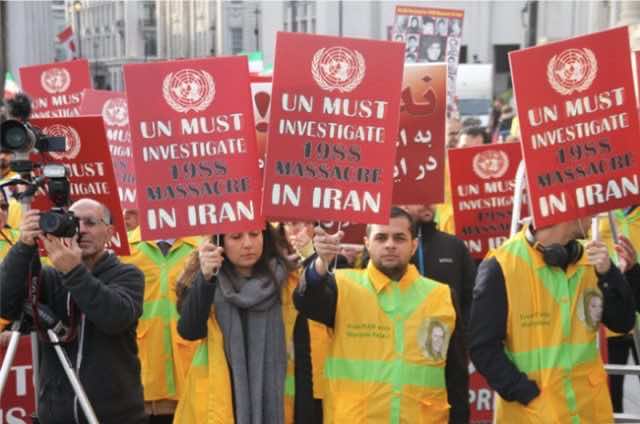
The scenes filmed in various Iranian cities in July 2017 show brave Iranians hoisting banners and distributing fliers about the massacre and calling on the United Nations to launch an independent inquiry and to prosecute the perpetrators of this great crime against humanity.
On the basis of a fatwa by the regime’s Supreme Leader Khomeini in the summer of 1988, more than 30,000 political prisoners were mass executed for refusing to renounce their political beliefs. The overwhelming majority were member of the main Iranian opposition group, the PMOI (MEK).
Young Iranian activists across the country have in recent weeks stepped up their defiant public campaigning for justice over the 1988 massacre.

IRAN REGIME'S OFFICIALS EXPRESS THEIR FEAR ABOUT PMOI/MEK ACTIVITIES IN PROPAGATING INFORMATION ON 1988 MASSACRE

 NCRI - In response to “the justice seeking Movement for victims of 1988 massacre” and along with the three-day Iranian Resistance Satellite TV ‘Simay Azadi's’ event on the anniversary of the Massacre, state run Basij News writes," The People's Mojahedin of Iran (MEK/PMOI) has organized the maximum propagandas and military activities against the Islamic Republic of Iran."
Basij News added," The unresolved issue is that how some of the political circles support the MEK’s measures in the current situation and they question the events of the 80s while trying to call the hangman as a martyr."
Basij News also refers to MEK’s disclosures concerning the bomb constructions in Iran, writing, "Disclosing regime's nuclear activities was the pretext for imposing the most extensive sanctions against the Iran regime."
The Head of Regime's Research Center also referred to the advancement of the Justice Seeking Movement, stating, "Some of the regime's enemies have been seriously involved in the Justice Seeking Movement of 1988 during the past two or three years and the number of those executed is rising exponentially by each year."
Mohammad Hossein Zarifian expressed concern about the release of evidence about Khomenei's order on MEK’s genocide in 1988, and stated, "The foreign channels broadcast different documentaries on this matter. The summer is the peak of such broadcasts and these executions are named as a holocaust for MEK."
An expert on political issues, Foad Yazidi in a meeting entitled with "The Islamic Human Rights' Conference" referred to the great gathering of MEK in Paris. He stated," France hosts Iran's enemies whereas it established economic relations with Iran after the Joint Comprehensive Plan of Action (JCPOA)."
Foad Yazidi also stated, "We had a lot of sanctions before Iran Nuclear Deal. However, the question is that who is left out of sanctions after this deal? According to this law even The President could be sanctioned, The U.S. has enlisted us as the enemy country. Consequently it doesn’t make much of difference to give or not to give concessions as long as we are on this list."

HOW IRAN FEARS MEK AS ITS OPPOSITION


 by Pooya Stone
The regime in Iran has come under immense domestic and international pressure recently. Most vivid are the sweeping sanctions imposed by US Congress and signed into law by President Donald Trump.These developments are sparking an endless stream of reactions from Iran’s senior officials and various media outlets. Over 500 interviews, reports, posts, sessions, book introductions
and others events have been discussed in this regime’s official outlets,
all regarding the opposition People's Mojahedin Organization of Iran (PMOI/MEK).The reason behind this chorus of remarks and attacks aimed at the MEK is obvious. It is crystal clear for Iranian Supreme Leader Ali Khamenei and his entire regime apparatus how the MEK represent the source of all their strategic defeats.
Iran’s Revolutionary Guards (IRGC) has recently been classified as a Specially Designated Global Terrorist entity. This is mainly due to the hundreds of revelations, press conferences, articles, posts and other activities by the MEK and its umbrella group, the National Council of Resistance of Iran (NCRI).
The IRGC blacklisting is considered a strategic setback for Tehran, especially since 40% of the regime’s economy is controlled by the Guards.
The MEK also delivered major blow to Khamenei’s blueprints aimed at unifying his regime through engineering the May 19th presidential election. Conservative cleric Ebrahim Raisi, Khamenei’s preferred candidate, was groomed by the hardliners to replace the incumbent Hassan Rouhani as president.
The MEK’s vast network of activists inside Iran, coupled with a variety of measures abroad, shed light on Raisi’s past as a member of an infamous “Death Commission” in charge of supervising the 1988 massacre of over 30,000 political prisoners across the country who mostly were members of MEK.
As Raisi failed to reach the presidency, the mullahs’ entire apparatus suffered a major defeat, understood best by Khamenei himself.
The MEK best gained international credibility in 2002 after blowing the whistle on Iran’s clandestine nuclear weapons program. In the years since the MEK has maintained a solid record of revealing Iran’s secret and underground nuclear sites, forcing Tehran to succumb to a still highly-flawed agreement with the P5+1 aimed at curbing its nuclear program.
To this day Iran’s human rights violations have also been condemned in 63 resolutions issued in the past four decades by various United Nations organizations. UN special rapporteurs, such as Ahmed Shaheed and Asma Jahangiri, have condemned Iran in numerous texts. Again, the MEK’s role in alarming the world of the mullahs’ atrocities has been crucial.
Amnesty International and other such organizations, alongside numerous parliaments of the United Kingdom, Canada, Australia and the US Congress have also voiced their deep concerns and denounced Iran’s actions.
As our world becomes further connected through the Internet, the MEK and Iranian opposition supporters have taken to social media to enhance their effort against the mullahs.
Iran is known for its media and internet censorship, and yet social media and certain technology are allowing this young population connect with the outside world. This platform has provided means for the MEK and its vast network to express their desires and shed light on the truth about the mullahs’ devastating policies.
Sensing the dangers in this regard, Iran has stepped up its filtering efforts, especially the highly popular Telegram platform that enjoys dozens of millions of users in Iran. Telegram CEO Pavel Durov has recently underscored despite claims made by Tehran his company will not yield to this regime’s demands to censor any political channels.
Topping Iran’s concerns is the medium provided by the MEK and NCRI to realize a policy of successful regime change in Iran. As Washington weighs its comprehensive Iran policy and senior Trump administration officials have voiced support for regime change initiatives, this potential has become extremely concerning for Tehran.
“There are those who say the Islamic Republic will not reach its 40th year and they seek to topple the establishment in the coming years,” said Ahmad Jannati, chair of the ultraconservative Guardian Council in a recent session.
In addition to making remarks, conducting interviews and posting text in media outlets, Iran has also sought practical measures against its opposition.
Iranian Foreign Minister Mohammad Javad Zarif in Paris failed to convince French officials to prevent the MEK from holding its annual convention on their soil.
Kamal Kharrazi, career diplomat and former Iranian foreign minister, also went to Paris following the Iranian opposition rally in an attempt to place limitations on this opposition organization’s activity in France.
Through the years Tehran has reached this conclusion that maintaining its grip on power hinges heavily on eliminating its main opposition. During the past three decades, Khamenei and his regime pursued this path with all their will.
To this end, the MEK and NCRI represent the Iranian people’s true demand ofregime change in Iran. Supporting this opposition is tantamount to standing alongside the Iranian people.

Lights of Liberty on the 30th Anniversary of 1988 Massacre

 July 27, 2017 , 8:58 am
In the summer of 1988, 30,000 Iranian political prisoners, supporters of the People’s Mujahedin of Iran, were massacred. As the 30th-anniversary approaches, the families of the victims and the citizens of Iran still await justice and an international tribune.                 
Thousands of Iranian political prisoners were systematically executed during a state-sponsored, five month-long killing spree in 1988. The prisoners, some as young as 14 years old, were killed in groups—loaded onto trucks and hanged from cranes. Over the past three decades, the regime has blocked all attempts at investigating the extent of the massacre.  They have gone to great lengths to conceal the truth about the murders, including damaging cemeteries with bulldozers and toppling the headstones that mark the martyrs’ graves

Evin Prison: The Iranian regime’s notorious torture factory

By Tony Duheaume:Special to Al Arabiya EnglishSunday, 30 July 2017

Opponents of the Shah

The Iranian regime lives in constant fear of an uprising to overthrow it. Such is its paranoia where opposition groups are concerned it has spent the whole period of its existence, eliminating dissenters.

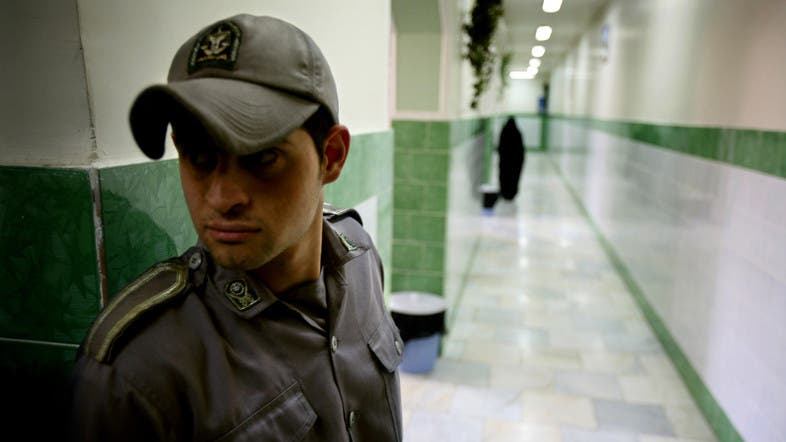
The approach to any form of opposition shows how insecure this regime has become. But as far as extreme brutality is concerned, it could not be more prevalent than that of the regime’s treatment of dissidents at Evin Prison, where guards use torture to humiliate their captives before executing them.
Through the despicable acts taking place here, the lack of humanity shown by the prison authorities toward all those who speak out against the regime, mirrors the insecurities of the entire state.
Located at the foot of the Alborz mountains in northern Tehran, Evin Prison was originally constructed in 1972, under the reign of Mohammad Reza Pahlavi. It was then operated by his infamous security and intelligence service (SAVAK).

MEK'S POPULARITY AMONG IRANIAN YOUTH, REGIME'S NIGHTMARE

Written by Poorang Novak
  Published: 30 July 2017

CONTRARY TO IRAN LOBBY CLAIMS, REGIME CHANGE DOES NOT END IN WAR

One of the great falsehoods of the Iran lobby and the appeasers of the clerical regime in Tehran is that any effort at regime change would inevitably lead to war. This by-line can be seen in every article by the Iran lobby and the appeasers attempting to underscore the growing global support for the Iranian opposition (MEK/PMOI) and the Iranian people’s quest for regime change.
History teaches us though that the longevity of any regime born out of violent conquest is ultimately short-lived.
The Iranian regime that was born out of a revolution overthrowing the Shah, which was in turn hijacked by the mullahs and turned into a religious oligarchy. The original aim of the revolution was the formation of a secular, pluralistic democracy. That dream still exists in the hearts and minds of the overwhelming majority of the Iranian people and resonates in the various forms of protest in Iran, despite the repressive measures by the regime. Therefore, the call for “regime change” is primarily the Iranian people’s demand.

New US Sanctions, Iran and Massacre of 30,000 Political Prisoners


Adoption of a bill by both chambers of the US Congress, imposing new sanctions on Iran, has terrified the Iranian regime. The sanctions includes Iran’s ballistic missile program, terrorism, and violation of Human Rights.
Concerning the violation of Human Rights part of the bill says:
“Not later than 90 days after the date of the enactment of this Act, and annually thereafter, the Secretary of State shall submit to the appropriate congressional committees a list of each person the Secretary determines, based on credible evidence, on or after the date of the enactment of this Act (1) is responsible for extrajudicial killings, torture, or other gross violations of internationally recognized human rights committed against individuals in Iran who seek (A) to expose illegal activity carried out by officials of the Government of Iran; or (B) to obtain, exercise, defend, or promote internationally recognized human rights and freedoms, such as the freedoms of religion, expression, association, and assembly, and the rights to a fair trial and democratic elections; or … “

Lights of Liberty on the 30th Anniversary of 1988 Massacre

 July 27, 2017 , 8:58 am
Rabat – In the summer of 1988, 30,000 Iranian political prisoners, supporters of the People’s Mujahedin of Iran, were massacred. As the 30th-anniversary approaches, the families of the victims and the citizens of Iran still await justice and an international tribune.               
Thousands of Iranian political prisoners were systematically executed during a state-sponsored, five month-long killing spree in 1988. The prisoners, some as young as 14 years old, were killed in groups—loaded onto trucks and hanged from cranes. Over the past three decades, the regime has blocked all attempts at investigating the extent of the massacre.  They have gone to great lengths to conceal the truth about the murders, including damaging cemeteries with bulldozers and toppling the headstones that mark the martyrs’ graves

Iranian Agent of Suppression Returned to Iran


 by : 
Seyyed Mohsen Dehnavi, an Iranian scholar, was deported to Iran on Wednesday from Boston International Airport after being accused of membership in a student mobilization entity in Iran.
Dehnavi is an academic preparing to work at the Boston Children’s Hospital. American media published a story about his past and his active membership in the Student Basij, affiliated to the Iranian Revolutionary Guards Corps (IRGC) being the main reason for his deportation.
Earlier it was said the anti-immigration law was main reason for his arrest and entry denial into the US. He was rejected by airport border authorities.
The Student Basij, known as the Basij-e Daneshjouyi, are deployed to suppress pro-democracy students on campuses and in universities across the country.

A democratic alternative to the Iranian regime – 'Free Iran' rally highlights MEK's role in Iranian resistance


During the 'Free Iran' rally in Paris on July 1, the mood was festive and clearing upbeat, as speakers discussed the movement of MEK members from Iraq to Albania.


But many of the speakers and delegations also spoke of the real possibility of regime change in Iran, as they noted major changes on the international scene. Speaker after speaker from the United States pointed to the new policies of the Trump administration, while others acknowledged the Obama administration for its efforts to remove the MEK from the terrorist list.
Still, the highlight of the event was the keynote address by Maryam Rajavi, the National Council of Resistance of Iran (NCRI) President-elect. She noted that there was an alternative to the current regime and its extremism.

Legacy of a dictator: Iran's 30,000 murdered, then and now Read more: http://www.americanthinker.com/blog/2017/07/legacy_of_a_dictator_irans_30000_murdered_then_and_now.html#ixzz4o0zrBCzN Follow us: @AmericanThinker on Twitter | AmericanThinker on Facebook


In the wake of the 30th anniversary of the massacre of 30,000 political prisoners in summer of 1988 in Iran, the people of Iran and especially families of the victims are still waiting for justice and an international tribune.
In the summer of 1988, the political prisoners were systematically executed in almost two months.  In a barbaric two-month purge, prisoners, including teenagers as young as 14, were loaded onto trucks in groups and hanged from cranes.
During the past three decades, the regime blocked all attempts to investigate the extent of the massacre.  They even went farther to cover up the crimes by toppling and damaging cemeteries and headstones of martyrdom graves with bulldozers

Khamenei's Fear of Public Outrage of Regime Crimes, Especially in 1980s, and Popular Acceptance of Resistance

Praising a film made by IRGC for whitening these crimes, and ordering a film to whitewash the butcher of Tehran
While public outrage and hatred of the massacre of political prisoners in the 80s is growing, the Justice-Seeking movement is advancing, and the PMOI and Iranian Resistance are more welcomed by the Iranian people, Khamenei resorts to a humiliated act to praise the film titled as "Majera-ye Nimrouz". This film was made upon Khamenei’s order by the fascist bands of the Revolutionary Guards and was aimed at whitewashing and justifying the numerous crimes of this regime in the 1980s.

MEK: The Opposition the Iranian Regime Wants to Silence


By Mahmoud Hakamian
For the Iranian regime, staying power means oppressing all voices that challenge their rule, particularly the human rights abuses and strict laws on everything from who you can socialize with to how you dress in public. Yet, one group has been the main focus of the regime’s efforts to suppress and undermine their voice in support of a free Iran. That group is the MEK.
When the MEK was removed from the U.S. list of terrorist groups, Iranian regime House Speaker Ali Larijni said during his speech on June 23, “Now it’s you (the United States) who are sponsor of terrorism and even mother of terrorism, yet you accuse the Iranian regime of sponsoring terrorism. Your accusations are shameful…Today, the Americans removed the MEK from their list of terrorist groups.”

After the liberation of Mosul, what now for Iraq’s Sunnis?


Struan Stevenson
Mosul has been liberated from ISIS (ISIS) at last, after three years of brutal occupation by the pitiless so called jihadists; but at what cost? Like Ramadi and Fallujah before it, Mosul has been reduced to ruins. Barely a single building has been left intact. These great, ancient Iraqi cities have been obliterated. 800,000 people have been rendered homeless from Mosul alone, millions when you count the refugees who fled from Ramadi and Fallujah. Thousands of innocent Sunni civilians have been killed, and tens of thousands among them were injured.
Now sprawling refugee camps and flimsy canvas tents provide a home to families who have lost everything. And what do these people have in common… they are Sunnis. It was their cruel mistreatment and repression by the former Iraqi Prime Minister Nouri al-Malaki that sparked the uprising in al-Anbar and Nineveh provinces four years ago.

US Intelligence Predicts Attack From IranTerrorism 28 September 2018 Iran Focus London, 28 Sep - US intelligence suggests that Iranian-backe...