center> Important News Iran stars: Maryamrajavi
div style="margin: 15px 0px 0px; display: inline-block; text-align: center; width: 200px;">
Showing posts with label Maryamrajavi. Show all posts

Iran ripe for regime change

Hassan Rouhani
BY Ivan Sascha Sheehan

 July 14, 2017, --  The Iran nuclear agreement — officially known as the Joint Comprehensive Plan of Action — has been in effect for a year and a half, during which time the world has been able to assess the impact of its formal implementation. But it has now had two full years to consider the effects of its negotiation, which concluded on July 14, 2015.
The negotiations themselves were promoted by then-U.S. President Barack Obama and his surrogates as a means of creating a new diplomatic status quo between Iran and the West. It was hoped that following the 2013 election of Iranian President Hassan Rouhani , Tehran would moderate its behavior by demonstrating cooperation with former adversaries.
But internal moderation of the Iranian regime has proven elusive, and Tehran has shown no aptitude to reform from within.
The result? Western powers have learned the same lesson from the Rouhani administration that they learned from Mohammad Khatami, Ali Akbar Rafsanjani, and other Iranian officials similarly labeled as reformers worthy of outreach. Moderation is a mirage Tehran uses to seduce their prey.
Executions have skyrocketed under Rouhani's watch, with his administration overseeing an alarming 3,000 hangings during its first four-year term. Analysts expect the human rights violations to continue as the president commences a second term next month.
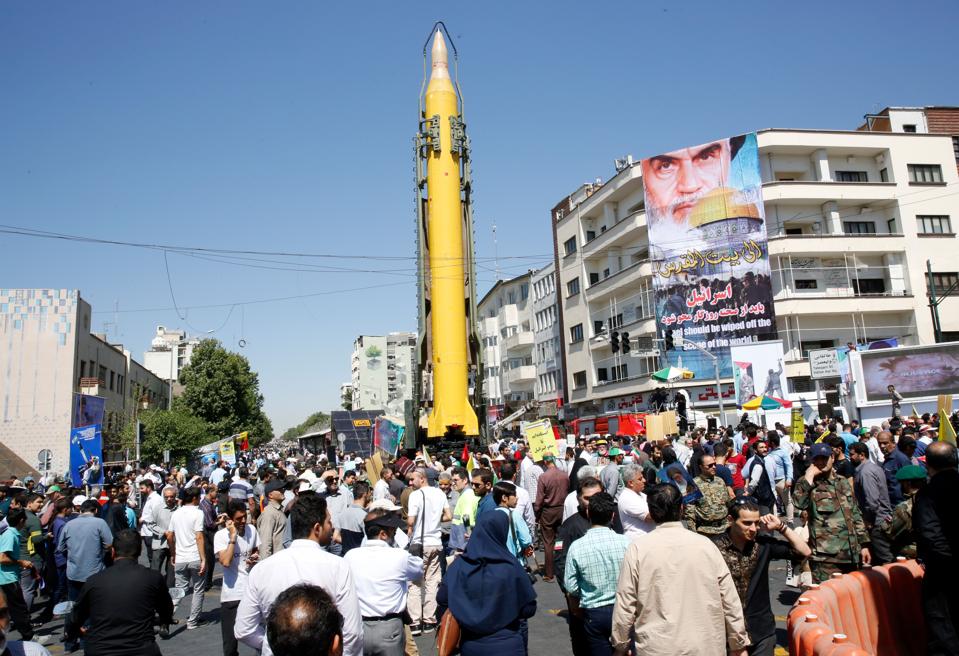
Rouhani's tenure is also distinguished by a dangerous continuation of ballistic missile research, development and testing (including evidence of cooperation with North Korea) and a repressive crackdown by the country’s security forces on activists, artists, academics, journalists and anyone accused of having ties to the West. These unfortunate trends have shown no signs of abatement on the second anniversary of the landmark agreement that granted far-reaching concessions in return for constructive engagement.
Neither has Tehran’s regional behavior demonstrated signs of improvement with the regime serving as a driving force behind sectarian conflict and an active participant in the Syrian and Yemeni civil wars.
As Western powers commemorate the two-year anniversary of the nuclear negotiations, a comprehensive Iran policy that addresses the joint plan’s shortcomings is needed. The U.S. must take the lead — as it did when nuclear negotiations began — but this time it must lead the world in confronting Iran over the nature of its repressive, fundamentalist regime by building a global coalition that supports regime change from within.
To its credit, the Trump administration has taken steps in this direction by increasing sanctions on the country’s ballistic missile program and pursuing the blacklisting of Iran’s hardline paramilitary organization, the Islamic Revolutionary Guard Corps. But the Trump administration's willingness to confront Tehran would benefit from clear, overarching policy that more fully embraces the regime’s collapse and replacement.
Secretary of State Rex Tillerson’s strong statement before the House Foreign Affairs Committee was a first step in this direction: “Our policy towards Iran is to push back on (its regional) hegemony, contain their ability to develop, obviously, nuclear weapons and to work towards support of those elements inside of Iran that would lead to a peaceful transition of that government.”
Now Tillerson's rhetoric needs to be backed with clear statements by U.S. officials — including the President himself — that the false narrative of internal moderation has expired and the aspirations of the Iranian people for regime change are within reach.
It is widely believed that the sanctions and diplomatic pressure employed by the White House and Congress are intended to serve the goal of regime change. If so, this needs to be made clear so that interested parties can coordinate their strategies and address questions about the availability of the “elements inside of Iran” that Tillerson referred to.
The regime’s lobby in Washington would have U.S. officials believe no such elements exist, at least none with adequate organization and resources to oust the clerical regime and replace it with a democratic system of government. Such mischaracterizations are as inaccurate as they are well funded.
The accusations were addressed earlier this month when Tehran’s parliament in exile, the National Council of Resistance of Iran, along with the main Iranian opposition movement, the People’s Mojahedin Organization of Iran, held its annual international gathering for democratic change in Paris. The gathering included tens of thousands of Iranian expatriates and hundreds of politicians and foreign policy experts from around the world who embraced regime change by the Iranian resistance.
In her speech at the event, NCRI President Maryam Rajavi praised the international community for rejecting the failed strategy of “appeasement” that the Joint Comprehensive Plan of Action represents and affirmed her movement’s commitment to the replacement of Iran's religious dictatorship, characterizing it as an absolute imperative and “the ultimate solution to the crises in the region.”
Rajavi noted what Iran scholars have long known: 1) Tehran’s vulnerability, domestic unpopularity and international isolation puts its overthrow within reach; 2) this can be achieved by the organized, democratic resistance that exists in the country and is led on the world stage by the NCRI.NCRI
The White House can mark the second anniversary of the negotiations that resulted in the Joint Comprehensive Plan of Action by turning the page on the failed Obama policy of capitulation in the interest of concessions and supporting the aspirations of the Iranian people for democratic change. By working with the Iranian opposition to realize regime change in Tehran, U.S. officials send a signal that they are preparing for the regime’s collapse and democratic transition and put Iran on notice that a new Iran policy has been embraced.
Sheehan is director of the graduate programs in Global Affairs & Human Security and Negotiations & Conflict Management in the School of Public and International Affairs at the University of Baltimore. Follow him on Twitter @ProfSheehan.

Trump's Iran Policy Review and Regime Change From Within

People hold a banner reading Regime change in Iran during the National Council of Resistance of Iran (CNRI) annual meeting People hold a banner reading Regime change in Iran during the National Council of Resistance of Iran (CNRI) annual meeting


14 Jul 2017 --  A part of Trump’s Iran policy review is the nuclear deal with Iran. This Saturday, July 15, marks the second anniversary of the Iran nuclear deal. Is there a different policy likely under President Trump? Yes: regime change from within, with pro-democracy Iranian oppositionists as core of a new policy.
Last month, Secretary of State Tillerson hinted regime change was the intent of Trump, and both have made no secret of their dislike of the Islamic Republic. At a session of the House Foreign Affairs Committee, Tillerson said the president’s policy toward Iran would be to work toward support of those elements inside of Iran that would lead to a peaceful transition. Outside the administration, Trump’s national security supporters like Amb. John Bolton (ret.), also have spoken favorably about regime change from within.
There’s confusion over the nature of regime change. The CIA-UK intelligence operation to overthrow an Iranian government in 1953 differs from the idea of regime change from within, spearheaded by the National Council of Resistance of Iran ( NCRI NCRI), a coalition of dissident groups. NCRI is best able to lead a broader coalition of opposition organizations that reject clerical rule in Iran and are willing to support regime change from within.
Also, there’s a new “Sheriff in town,” President Trump. He is a deal-maker; for Trump, closing the deal with friends and adversaries alike is important to him. If Europeans are doubtful of the direction of his policies, it is fine with the Sheriff to keep them guessing.

That said, deal-closing is within the context of core principles:


The conflicts we face are barbaric radical Islamist terrorism versus civilization, e.g., stable nation-states respecting traditional universal standards in general and western norms in particular. Trump’s message comes out clearly in his Riyadh address, the theme of which is, “Drive them out. Drive them out of your places of worship,” Trump said, “drive them out of your holy land. Drive them out of this earth.”
The Iranian resistance benefits from aligning with the United States because the resistance is in the camp of civilized states and never has committed acts of barbarism. Hence, Trump is more likely to reach out to pro-democracy Iranian oppositionists during his review of Iran policy than President Obama. He valued the nuclear deal with Tehran too much to jeopardize it by opening up to the resistance.
After a July 1 rally in Paris I attended as a scholar to conduct interviews, Fox News reported the next day the president might defy the regime by signaling his willingness to look kindly on the resistance: “The Trump administration is potentially considering…a strategy to try to topple the regime.”
But the NCRI does not need U.S. forces to change the regime, only American political and economic support to effect regime change from within. Even if not going so far as toppling the regime, Trump could increase his leverage against the Ayatollahs by supporting the resistance, conditioned on its continued eschewing of terrorist tactics.
With respect to missiles, for example, critics hoped in vain the nuclear deal would place explicit limits on ballistic missiles. The burden, however, was left to the UN, rather than on parties to the deal.
Paragraph 3 of Annex B of resolution 2231 (2015) calls upon Iran not to undertake any activity related to ballistic missiles capable of delivering nuclear weapons, including launches using ballistic missile technology. Because the nuclear deal did nothing to address the full range of Iran’s ballistic missile development, weak missile language in this resolution compounded the problem.
Before the July 2015 nuclear deal, Iran was expressly prohibited by UN resolutions from launching ballistic missiles capable of carrying nuclear weapons. Security Council Resolution 1929 states the Council “decides that Iran shall not undertake any activity related to ballistic missiles capable of delivering nuclear weapons.” The term “decides” placed a firm legal obligation on all states to comply.
For Tehran’s agreement with the nuclear deal, the Obama administration unwisely granted Iran flexibility for ballistic missile testing. Security Council Resolution 2231 certified the nuclear deal, replacing the prohibition with weaker language: “Iran is called upon not to undertake any activity related to ballistic missiles designed to be capable of delivering nuclear weapons.” Holes in the missile technology side of the nuclear deal equation would be sealed; on the sanctions side, there should be prohibition of relief in the event of Iran’s continued participation in state-sponsored terrorism and human rights violations.
If not postponed, the policy review for Iran and anniversary of the Iran nuclear deal coincide this coming Saturday. European diplomats say a drawn-out period of the review period could crimp the effectiveness of the nuclear deal. But President Trump, the consummate deal-maker, welcomes their discomfort and takes advantage of their wariness over his next steps.
 
Prof. Raymond Tanter (@AmericanCHR) served as a senior member on the Middle East Desk of the National Security Council staff in the Reagan-Bush administration, Personal Representative of the Secretary of Defense to international security and arms control talks in Europe, and is now Professor Emeritus at the University of Michigan. Tanter is on the comprehensive list of conservative writers and columnists who appear in The Wall Street Journal, Townhall.com, National Review, The Weekly Standard, Human Events, The American Spectator, and now in Newsmax. To read more of his reports 

Lights of Liberty on the 30th Anniversary of 1988 Massacre

 July 27, 2017 , 8:58 am
In the summer of 1988, 30,000 Iranian political prisoners, supporters of the People’s Mujahedin of Iran, were massacred. As the 30th-anniversary approaches, the families of the victims and the citizens of Iran still await justice and an international tribune.                 
Thousands of Iranian political prisoners were systematically executed during a state-sponsored, five month-long killing spree in 1988. The prisoners, some as young as 14 years old, were killed in groups—loaded onto trucks and hanged from cranes. Over the past three decades, the regime has blocked all attempts at investigating the extent of the massacre.  They have gone to great lengths to conceal the truth about the murders, including damaging cemeteries with bulldozers and toppling the headstones that mark the martyrs’ graves

REGIME CHANGE IN IRAN AT REACH WITH THE ONLY ORGANIZED OPPOSITION (PMOI/MEK)

By INU Staff
INU - When confronted with the question of whether the Trump administrations backs regime change in Iran, Secretary of State Rex Tillerson said Washington would work with Iranian opposition groups to reach “peaceful transition of that government.”
The most organized and renowned Iranian opposition group is none other than the National Council of Resistance of Iran (NCRI) with the People's Mojahedin Organization of Iran (PMOI/MEK) being the core member of this coalition.
The MEK enjoys vast support both inside Iran and abroad, especially an unmatched network of activists who dare to show their support for NCRI President Maryam Rajavi and her movement at whatever opportunity.
Sen. John McCain (R-Ariz.) echoed Tillerson’s view, saying “it’s time the Iranian people had a free and open society and a functioning democracy,” effectively a call for regime change.
Just months ago Senator McCain paid a visit to Albania where most MEK members are currently stationed after a long ordeal in Iraq. The MEK was the target of numerous attacks by Iran-backed proxy groups and even the government of former Prime Minister Nouri al-Maliki prior to their departure of this country in 2016.
On July 1, a major convention was held in Paris where hundreds of political dignitaries from across the globe explicitly called for regime change in Iran and supporting the NCRI and MEK.
The MEK’s vast popular base was proven as over 100,000 members of the Iranian Diaspora rushed to Paris to express their support for Maryam Rajavi, the MEK and a free and democratic Iran.
Trump allies, including John Bolton, former U.S. ambassador to the United Nations during the George W. Bush administration were present and voiced their support for the convention’s cause.
“There is a viable opposition to the rule of the ayatollahs, and that opposition is centered in this room today. I had said for over 10 years since coming to these events, that the declared policy of the United States of America should be … to change the regime itself. And that’s why, before 2019, we here will celebrate in Tehran!”
We are currently at a period of analysis as the President’s National Security Council reviews Washington’s Iran policy.
The best and most realistic option before the Trump administration is supporting the pro-democracy coalition of dissidents, the NCRI, which is best able to mobilize other opposition groups into an even broader coalition. This, coupled with the MEK’s vast domestic network inside Iran, pose a major threat for the ruling regime in Tehran.
In his visit to Riyadh, President Trump also expressed strong views about extremist groups, sending a stark message to those supporting such entities.
“Drive them out of your places of worship,” Trump said of extremists, “drive them out of your holy land. Drive them out of this earth.”
After the July 1 convention in Paris, reports seen the next day indicated Trump might defy Tehran by signaling his willingness to consider supporting the Iranian opposition.
Iranian people and their resistance, with the NCRI and MEK at the helm, will bring about the “regime change from within.” And that is where U.S. and international support will help.
Washington benefits from aligning with the Iranian opposition NCRI and MEK because this resistance is seeking regime change to bring about democracy and freedom for the Iranian people, and the region, and merely peace and security for the whole world by rooting out the central exporter of terrorism and Islamic extremism. Which is the religious fascism ruling Iran.
Thus, President Trump has before him the option of reaching out to the Iranian opposition during his review of Iran policy.

New US Sanctions, Iran and Massacre of 30,000 Political Prisoners


Adoption of a bill by both chambers of the US Congress, imposing new sanctions on Iran, has terrified the Iranian regime. The sanctions includes Iran’s ballistic missile program, terrorism, and violation of Human Rights.
Concerning the violation of Human Rights part of the bill says:
“Not later than 90 days after the date of the enactment of this Act, and annually thereafter, the Secretary of State shall submit to the appropriate congressional committees a list of each person the Secretary determines, based on credible evidence, on or after the date of the enactment of this Act (1) is responsible for extrajudicial killings, torture, or other gross violations of internationally recognized human rights committed against individuals in Iran who seek (A) to expose illegal activity carried out by officials of the Government of Iran; or (B) to obtain, exercise, defend, or promote internationally recognized human rights and freedoms, such as the freedoms of religion, expression, association, and assembly, and the rights to a fair trial and democratic elections; or … “

MEK/PMOI Popularity Threat to Iranian Regime's Existance

By: Jubin Katiraie
For many associated with the Iranian lobby and appeasers of the clerical regime in Tehran, the best way to prop up the regime is to discredit any alternative options presented to the international community. In addition, the lobby and appeasers continue to stress that regime change will lead to war. As an example, they point to the struggles of the Iraq government since the removal of Saddam by the U.S. and its allies.
However, history teaches us that any regime’s existence is limited when it begins with a violent upheaval. The current Iranian regime was born out of a revolution to end the rule of the Shah, but that revolution’s goal was to create a secular, pluralistic, and democratic Iran. However, the mullahs hijacked the revolution, creating a theocracy and suppressing any alternative political voices, including the MEK/PMOI.
Instead, to consolidate their power, the Iranian regime has relied on the typical tools of oppression, including the creation of a paramilitary and judiciary system that touches every section of Iranian society. The regime, using its lobby and appeasers, have been quick in attacking any publication or personalities that dare to speak up about the quest of the Iranian people to achieve their original dream of a democratic Iran.
Anyone who dares to talk about “regime change” is targeted for repressive measures. The MEK/PMOI have been high on the regime’s list, since the MEK/PMOI are the most dedicated and organized opposition with extensive routes and support at home, with the ability to materialize regime change.
The people’s Mojahedin Organization of Iran (PMOI/MEK) has been the subject of propaganda campaigns by the Iranian Ministry of Intelligence and Security (MOIS) at home and by regime lobbies and appeasers throughout the international community. This campaign is focused on discrediting the MEK/PMOI, by saying there is no democratic alternative to the Iranian regime and that regime change will result in war and increased instability within the region.
But why is the MEK/PMOI being targeted so directly? The MEK/PMOI is the oldest, largest, and most popular resistance movement within Iran. They form the core of the National Council of Resistance of Iran (NCRI), which is a coalition of opposition groups from all sectors of Iran. The PMOI/MEK was founded in September 1965 by three Iranian engineers who wanted to replace the Shah’s dictatorship with a democracy.
It is this continued support of democracy that has kept the MEK/PMOI so popular among Iranians. The MEK/PMOI believes that Islam is inherently tolerant and democratic, and fully compatible with the values of modern-day civilization. This vision is the cure to the current spread of extremism, which can be traced back to Iran and its mullahs. Yet, during the time of upheaval after the revolution, the MEK/PMOI leaders witnessed Ayatollah Khomeini’s hijacking of the revolution to create his theocracy.

IRAN'S FEAR OF REGIME CHANGE BY IRANIAN PEOPLE AND THEIR RESISTANCE (PMOI/MEK)

 Written by Poorang Novak
  Published: 28 July 2017
Lethal international, economic and social crises that has plunged the Iranian regime into the dilemma it is currently facing on one hand, and the expanding support for the Iranian opposition MEK that can realize regime change in Iran on the other, have all injected utter fear amongst Tehran’s mullahs.
US policymakers are coming closer to the necessary solution of regime change to confront Tehran as the leading sponsor of terrorism and human rights violator, as a regime that oppresses its own people and threatens neighboring nations.
However, this regime change is different from previous examples through military action and foreign war. In Iran, considering the existence of an organized opposition with deep social roots and a social base inside Iran, symbolized in the MEK, is able to realize this objective of toppling the mullahs’ regime

LEADING OFFICIALS OF IRANIAN REGIME ADMIT THE MASSACRE OF MEK MEMBERS

 
Written by Jazeh Miller
  Published: 29 July 2017
Iranian regime massacred over 30,000 political prisoners in summer of 1988, and kept silent about this atrocity for three decades. Most of the victims were members and supports of the main opposition group the People’s Mojahedin Organization of Iran (PMOI/MEK). This year in the presidential election as conservative cleric Ebrahim Raisie, one of the perpetrators of the massacre, was selected as one of the main candidates, the issue surfaced, forcing regime officials, one after another, to confess about the carnage.
Last week in an unprecedented interview, Ali Fallahian, the former Iranian intelligence Minister, revealed the mindset behind the mass execution of summer of 1988. Ali Fallahian, who was called as “the most feared mullah in Iran” by the News Week is wanted by Interpol for his involvement in the AMIA bombing that killed 85 people on July 18, 1994 in Buenos Aires, Argentina.
In the interview, Fallahian explained that whoever had any relation with the MEK was condemned to death.

Why Iran Apologists Demonize the MEK?

By Jubin Katiraie
The U.S. Senate voted almost unanimously on Thursday to pass new sanctions on Russia, North Korea and Iran.
The officials of Iranian regime are already afraid of the consequences of the new sanctions. In addition to economic implications of the sanctions, what worries them the most is the actions against the Islamic Revolutionary Guards Corps (IRGC) as a terrorist organization. Designating and imposing sanctions on the IRGC was long overdue because the IRGC serves as the guarantee to preserve the entirety of the regime ruling Iran and is the main entity responsible for domestic suppression, the export of terrorism and extremism, and obtaining weapons of mass destruction such as nuclear weapons and ballistic missiles.
The new bill has added to already shaky regime’s fears. Janati, the head of the Guardian Council announced on Thursday that the main issue which has preoccupied the Supreme leader is his concern over regime change.

Regime change was the main topic of the July 1, 2017 annual gathering of Iranian resistance (The Mujahedin-e-Khalq or MEK) in Paris. Many speakers talked about the regime change and their support for the MEK.MEK
“I’m happiest to be here because I can say, can probably say this with a good deal of authority, that the government of the United States supports you” Rudy Giuliani former mayor of New York City said referring to MEK supporters in the gathering.

Why the Iranian regime is incapable of reforming from within

Maryam Rajavi holds flowers as she pays tribute during a gathering in Auvers-sur-Oise, near Paris, September 29, 2012. (Reuters)
By F. Mahmoudi 
Thursday, 13 July 2017
Special to Al Arabiya English
The unprecedented strength of the Iranian opposition People’s Mojahedin Organization of Iran (PMOI/MEK) in Paris and Albania has severely alarmed the Iranian regime. It has also raised a pertinent question, can the Iranian regime be reformed within?
The signs so far are not encouraging. Tehran sent its foreign minister, Mohammad Javad Zarif, to Paris to prevent the annual gathering of opposition figures. As French officials found the regime’s position very weak, they ended up signing a contract for the benefit of the French oil giant Total..
Hossein Shariatmadari, editor-in-chief Kayhandaily, known as the mouthpiece of Iranian Supreme Leader Ali Khamenei, wrote an article titled “Humiliated and Rewarded”, which mentioned the Total contract being signed at the same time as the PMOI gathering in Paris.
“The remarks of former French foreign minister Bernard Kouchner at a PMOI meeting one day after Zarif’s return from France is another sign of the French government's insistence on humiliating our nation,” he wrote.

Understanding The Threats Of Iran


                                                                                            Opinions expressed by Forbes Contributors are their own.
US President Donald Trump’s visit to Saudi Arabia and the Riyadh Summit, with leaders of over 50 Muslim nations taking part, was a major turning point in the Middle East’s balance of power. This development also signaled the end of eight years of the Obama administration’s unbridled appeasement vis-à-vis Iran. And Tehran has very specifically received the message.
For the first time in many years the world is taking steps to stand on the right side of history and alongside the Iranian in their quest to realize their rightful demands of freedom, democracy and peace in the region.

What Is the Right Policy Towards Iran and the MEK?


By Jubin Katiraie
It is sometimes now that many US officials have been talking about Iran and the actions that US must take towards Iran. In a hearing in the congress, the Secretary of State, Rex Tillerson, in response to a question about the US policy towards Iran said: “Well our Iranian policy is under development. It’s not yet been delivered to the president, but I would tell you that we certainly recognize Iran’s continued destabilizing presence in the region, their payment of foreign fighters, their export of militia forces in Syria, in Iraq, in Yemen, their support for Hezbollah. And we are taking action to respond to Iran’s hegemony. Additional sanctions actions have been put in place against individuals and others.”
“We continually review the merits both from the standpoint of diplomatic but also international consequences of designating the Iranian Revolutionary Guard in its entirety as a terrorist organization,” he added. “As you know, we have designated the Quds [Force]. Our policy towards Iran is to push back on this hegemony, contain their ability to develop obviously nuclear weapons, and to work toward support of those elements inside of Iran that would lead to a peaceful transition of that government. Those elements are there, certainly as we know.”

Iranian people Supporters of MEK


By Jubin Katiraie:
The fact is that for years Iranian people have been seeking for a regime change, but the brutal internal suppression, and international and especially US policy of appeasement towards Iran have been the main obstacles to reach this goal.
Contrary to many other countries, in Iran a democratic and organized opposition exists. The Mujahedin-e-Khalq or the MEK has been struggling with this regime for over thirty eight years. Since June 20, 1981 Iranian regime has executed over 120000, mostly members and supporters of the MEK. Only in summer of 1988 over 30000 political prisoners, majority of them from the MEK, were massacred. During this massacre the death committee was going to the prisons and asking the prisoners if they are still supporting the MEK, and if the answer was yes, they would immediately be hanged.

US Intelligence Predicts Attack From IranTerrorism 28 September 2018 Iran Focus London, 28 Sep - US intelligence suggests that Iranian-backe...