center> Important News Iran stars: Iranian Opposition
div style="margin: 15px 0px 0px; display: inline-block; text-align: center; width: 200px;">
Showing posts with label Iranian Opposition. Show all posts

Iran: Fate of Political prisoner Arzhang Davoudi in limbo

Iran: Fate of Political prisoner Arzhang Davoudi in limbo

Political prisoner Arzhang Davoudi
Report by PMOI/MEK
 Iran, June 21, 2018 - Nearly three months after the last message from political prisoner Arzhang Davoudi there is no information about his current whereabouts.
The family of this political prisoner has been threatened and remains under pressure. It is only known that Davoudi is under pressure and torture, and currently held in the quarantined section of Zahedan Central Prison in southeast Iran.
Based on the latest reports published back in March, Davoudi was on hunger strike from March 3rd and said the following about his protest:
“My hunger strike aims to be provided fresh air time and some sunshine, which I have been inhumanely deprived of since July 26th in Zabol and Zahedan prisons.”
Davoudi is currently suffering from diabetes, high cholesterol and heart illness.
In his last message Davoudi explained how he is losing his vision and being deprived of even the most basic necessities.
“I am being held in a small dungeon supposedly known as cell number two in the prison quarantine section. I am deprived of any visits, telephone calls, connection with other prisoners, fresh air time, walks, reading books, watching TV, being able to purchase medicine, adequate food considering my illnesses and …”
No news from this political prisoner raises concerns about his health.
DEMONSTRATE IN PARIS ON INTERNATIONAL HUMAN RIGHTS DAY AGAINST TORTURE AND EXECUTIONS IN IRAN Created: 12 December 2017
Iranian Resistance
Iranian Opposition
Human rights
Demonstration
Human Rghts Day
Paris

Maryam Rajavi: Realization of Iranian people’s desire for regime change is essential to human rights in Iran, peace in region and the world
A major demonstration was held in Paris on December 11, to observe the International Human Rights Day (December 10) against the mullahs’ bloodletting regime and executions and torture in Iran.
The NCRI President-elect Maryam Rajavi sent a message to the demonstration which coincided with the One Plannet Summit in Paris. She said, "Saving human rights and environment in Iran hinges on regime change.”
IRANIAN EX-PATS RALLY WHILE ROUHANI RAILS Created: 21 September 2017
Iran
Maryam Rajavi
NCRI
Iranian Resistance
Iranian Opposition
Syria

By Hollie McKay
While Iranian President Hassan Rouhani addressed the United Nations General Assembly Wednesday, thousands of Iranian expats rallied outside to call for an end to the Islamic republic's brutal regime."We want the American people to know that the Iranian people do not want a clerical regime," said Sonia Samsami, the U.S. Representative of the National Council of Resistance to Iran.
"Regime change at the hands of the people is the only solution to the Iran crisis."
Samsami's group, a coalition of more than 500 Iranian opposition groups and individuals, seek a "democratic, secular and non-nuclear republic of Iran," she told Fox News.
Protestors affiliated with the National Council of Resistance to Iran push for an overthrow of the Rouhani-led regime outside the United Nations on Wednesday.
While Iranian President Hassan Rouhani addressed the United Nations General Assembly Wednesday, thousands of Iranian expats rallied outside to call for an end to the Islamic republic's brutal regime."We want the American people to know that the Iranian people do not want a clerical regime," said Sonia Samsami, the U.S. Representative of the National Council of Resistance to Iran.
"Regime change at the hands of the people is the only solution to the Iran crisis."
Samsami's group, a coalition of more than 500 Iranian opposition groups and individuals, seek a "democratic, secular and non-nuclear republic of Iran," she told Fox News.
Protestors affiliated with the National Council of Resistance to Iran push for an overthrow of the Rouhani-led regime outside the United Nations on Wednesday.
The rally in midtown Manhattan came during Rouhani's speech, in which he vowed Iran would react "decisively and resolutely" if the U.S. rescinds the controversial nuclear deal struck during the Obama administration. It came a day after President Trump signaled that he might just do that, while blasting Tehran in blunt terms not often heard at the UN.
"The Iranian government masks a corrupt dictatorship behind the false guise of a democracy," Trump told the world body on Tuesday. "It has turned a wealthy country with a rich history and culture into an economically depleted rogue state whose chief exports are violence, bloodshed and chaos."

FORGET NEW IRAN NUKE DEAL, REFORM INTEL COMMUNITY

News Max, Aug. 11, 2017 - Critics of the Iran nuclear deal, formally known as the Joint Comprehensive Plan of Action (JCPOA), argue for withdrawal based mostly on issues peripheral to JCPOA.
For example, critics argue Iran has disappointed U.S. expectations that Iran would no longer support international terrorism or work to destabilize neighboring countries or threaten the United States.

While these were U.S. expectations, there is no legally binding language in the JCPOA requiring Iran to change its international behavior.
Critics of the JCPOA also argue for U.S. withdrawal because Iran continues to develop long-range ballistic missiles — which are militarily practicable only with nuclear warheads. Critics note such missile development violates the 'spirit' of the JCPOA.
Yet again, the JCPOA does not ban missile testing by Iran in any legally binding language.
Indeed, a better legal reason for withdrawing from the JCPOA than the arguments above is that the Iran nuclear deal is not legally binding at all. The JCPOA is not a treaty, but an executive agreement, never submitted to the U.S. Senate for advice and consent, and ratification, as constitutionally required.
Preventing Iran, the world’s leading sponsor of international terrorism, from developing nuclear weapons is vital to U.S. and global security. Yet the JCPOA is not legally or instrumentally capable of stopping an Iranian atomic bomb.
Therefore, President Trump is obligated to terminate the fiction that is the Iran nuclear deal.
But the best argument for abandoning JCPOA is rarely made, that Iran is probably in material breach of the letter and main purpose of JCPOA because, like its ally North Korea, Iran has almost certainly developed nuclear weapons clandestinely.
The U.N. International Atomic Energy Agency (IAEA) reports inspecting Iran’s nuclear program produced compelling evidence Iran probably developed nuclear weapons over a decade ago.
For example, IAEA’s 2011 report 'Implementation of the NPT Safeguards Agreement and Relevant Provisions of Security Council Resolutions in the Islamic Republic of Iran' is too timorous to say so explicitly, but not only proved Iran has a nuclear weapons program — it is a 'smoking gun' that Iran already has the bomb.
A cautious analyst can reasonably infer from IAEA reporting that — prior to 2003 — Iran already had all the knowledge and components needed to build atomic bombs. For example, more than 14 years ago:
• Iran procured equipment necessary for nuclear weapon development.
• Iran conducted hydrodynamic experiments that, according to the IAEA report 'are strong indicators of possible weapon development.'
• Iran cast and shaped uranium metal into hemispheres for a nuclear implosion device; a sophisticated nuclear weapon design.
• Iran verified the design of a nuclear weapon with non-fissile explosive testing in a containment chamber. During the Manhattan Project of World War II, at this stage the U.S. was 16 months from an atomic bomb.
• Iran developed and tested exploding bridge wire detonators, necessary to an implosion nuclear weapon. During the WWII Manhattan Project, at this stage the U.S. was 6 months from an atomic bomb.
• Iran manufactured neutron initiators which are used to start a fission chain-reaction in a nuclear weapon.
• Iran drafted 14 different workable designs for a nuclear weapon to fit inside the re-entry vehicle for the high-explosive (HE) warhead of Iran's Shahab-3 medium-range missile. Since designing a nuclear weapon is a lot harder than changing the shape of a re-entry vehicle — obviously Iran was trying to hide a nuclear warhead by disguising it as the HE warhead of the Shahab-3.
• Iran developed fusing systems for a nuclear missile warhead to perform a ground-burst or high-altitude burst above 3,000 meters.
The Congressional EMP Commission found in 2002 Iran apparently performed at least 5 fusing tests of the Shahab-3 at high-altitudes — explicable only as practicing nuclear electromagnetic pulse (EMP) attacks. For more evidence Iran already has nuclear weapons see my article 'Iran: The Worst Deal' in Family Security Matters, Oct. 3, 2015.
Former senior intelligence and national security officials of the Reagan and Clinton administrations warn Iran probably already has nuclear weapons, including: Ambassador R. James Woolsey, former director of the CIA; Fritz Ermarth, former chairman of the National Intelligence Council (NIC); Ambassador Henry Cooper, former director of the Strategic Defense Initiative (SDI); and Dr. William Graham, former President Ronald Reagan’s science adviser and chairman of the EMP Commission.
Israeli intelligence officers warned that Iran probably already has atomic bombs, according to Joshua Davidovich, in The Times of Israel, Sept. 27, 2013.
In June of 2002, when the West first learned about Iran's clandestine nuclear weapons program from Iranian dissidents (not from the U.S. intelligence community), Russian General Yuri Baluyevski, deputy chief of the General Staff, declared, 'Iran does have nuclear weapons. These are non-strategic nuclear weapons.'
Like President Clinton's nuclear deal with North Korea, that pretended Pyongyang's clandestine nuclear weapons program was frozen, President Obama's JCPOA will enable Iran to clandestinely build and improve nuclear weapons and missiles so the fact of a nuclear-armed terror-state will become irreversible.
So why is the best argument against JCPOA rarely used? Because what is still President Obama’s highly politicized and error-prone intelligence community insists Iran does not have nuclear weapons and JCPOA will delay an Iranian atom bomb.
We don’t need JCPOA. We do need a reformed intelligence community.
Peter Vincent Pry is executive director of the Task Force on National and Homeland Security. He served in the Congressional EMP Commission, the Congressional Strategic Posture Commission, the House Armed Services Committee, and the CIA. He is author of 'Blackout Wars.' 
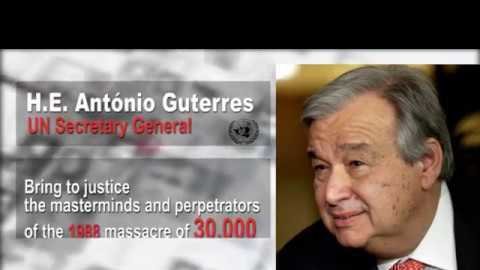
NCRI - Supporters of the People’s Mojahedin Organization of Iran (PMOI or MEK) inside Iran have filmed themselves carrying out brave acts of openly demanding justice over the 1988 massacre of more than 30,000 political prisoners in Iran.
The scenes filmed in various Iranian cities in July 2017 show brave Iranians hoisting banners and distributing fliers about the massacre and calling on the United Nations to launch an independent inquiry and to prosecute the perpetrators of this great crime against humanity.
On the basis of a fatwa by the regime’s Supreme Leader Khomeini in the summer of 1988, more than 30,000 political prisoners were mass executed for refusing to renounce their political beliefs. The overwhelming majority were member of the main Iranian opposition group, the PMOI (MEK).
Young Iranian activists across the country have in recent weeks stepped up their defiant public campaigning for justice over the 1988 massacre.

PRESIDENT TRUMP SIGNS SANCTIONS BILL TARGETING RUSSIA, NORTH KOREA AND IRAN


 By Katie Pavlich
"The multitude of threats posed to our national security by Iran, Russia, and North Korea cannot be understated. These bad actors have long sought to undermine the United States and disrupt global stability. Our job in Congress is to hold them accountable," House Speaker Paul Ryan said last week. "The bill we just passed with overwhelming bipartisan support is one of the most expansive sanctions packages in history.
It tightens the screws on our most dangerous adversaries in order to keep Americans safe. I want to thank Leader McCarthy, Whip Hoyer, Chairman Royce, and Ranking Member Engel for their tireless work on this vital national security issue."
After the sanctions passed the Senate, Russian President Vladimir Putin ordered hundreds of Americans working for the U.S. government in Moscow to be expelled from the country. 
During the State Department press briefing Tuesday, Secretary Rex Tillerson said the sanctions are unhelpful and limit the administration's options. 
"The action by the Congress to put these sanctions in place and the way they did, neither the president nor I are very happy about that," Tillerson said. "We were clear that we didn't think it was going to be helpful to our efforts, but that's the decision they made."
Unlike other signings, the sanctions approval went down without fanfare or cameras.
originally published in the  townhall 

IRAN REGIME'S OFFICIALS EXPRESS THEIR FEAR ABOUT PMOI/MEK ACTIVITIES IN PROPAGATING INFORMATION ON 1988 MASSACRE

 NCRI - In response to “the justice seeking Movement for victims of 1988 massacre” and along with the three-day Iranian Resistance Satellite TV ‘Simay Azadi's’ event on the anniversary of the Massacre, state run Basij News writes," The People's Mojahedin of Iran (MEK/PMOI) has organized the maximum propagandas and military activities against the Islamic Republic of Iran."
Basij News added," The unresolved issue is that how some of the political circles support the MEK’s measures in the current situation and they question the events of the 80s while trying to call the hangman as a martyr."
Basij News also refers to MEK’s disclosures concerning the bomb constructions in Iran, writing, "Disclosing regime's nuclear activities was the pretext for imposing the most extensive sanctions against the Iran regime."
The Head of Regime's Research Center also referred to the advancement of the Justice Seeking Movement, stating, "Some of the regime's enemies have been seriously involved in the Justice Seeking Movement of 1988 during the past two or three years and the number of those executed is rising exponentially by each year."
Mohammad Hossein Zarifian expressed concern about the release of evidence about Khomenei's order on MEK’s genocide in 1988, and stated, "The foreign channels broadcast different documentaries on this matter. The summer is the peak of such broadcasts and these executions are named as a holocaust for MEK."
An expert on political issues, Foad Yazidi in a meeting entitled with "The Islamic Human Rights' Conference" referred to the great gathering of MEK in Paris. He stated," France hosts Iran's enemies whereas it established economic relations with Iran after the Joint Comprehensive Plan of Action (JCPOA)."
Foad Yazidi also stated, "We had a lot of sanctions before Iran Nuclear Deal. However, the question is that who is left out of sanctions after this deal? According to this law even The President could be sanctioned, The U.S. has enlisted us as the enemy country. Consequently it doesn’t make much of difference to give or not to give concessions as long as we are on this list."

PRISONER ARRESTED AT JUST 15 IS HOURS AWAY FROM EXECUTION IN IRAN


The Iranian authorities must halt the imminent execution of Alireza Tajiki, who was arrested as a child, said Amnesty International today, after learning that he was transferred to solitary confinement this morning and is due to be executed in less than 24 hours in Shiraz’s Adel Abad prison.Tajiki was just 15 at the time of his arrest and 16 when he was convicted and sentenced to death.
He was transferred to solitary confinement in Adel Abad prison in Shiraz, Fars Province, on August 9. His family were told to come to prison in order to make their final visit. The authorities did not inform his legal representatives, contrary to Iran’s own laws, which require lawyers to be informed of their clients’ scheduled execution at least 48 hours in advance.
“This is an utterly shameless act by the Iranian authorities. They are keenly aware that using the death penalty against someone who was under 18 years of age at the time of crime is in flagrant breach of Iran’s obligations under international human rights law, including the UN Convention on the Rights of the Child,” said Magdalena Mughrabi, Deputy Director for the Middle East and North Africa at Amnesty International.
“Despite this, time and again Iran’s judicial authorities and lawmakers have failed to take any steps to once and for all end the use of the death penalty against juvenile offenders. The Iranian authorities must immediately halt any plans to execute Alireza Tajiki.”
Tajiki, now 21 years old, was sentenced to death in April 2013 after a criminal court in Fars Province, southern Iran, convicted him of murder and lavat-e be-onf (male on male rape). The trial was grossly unfair and relied primarily on “confessions” which Tajiki has said where extracted through torture, including severe beatings, floggings, and suspension by arms and feet.
Both the lower court in Fars Province and the Supreme Court relied on state forensic opinions stating that Tajiki was “mature” at the age of 15 and thus eligible to receive the death penalty. In a subsequent response to the UN Office of the High Commissioner for Human Rights in October 2016, the representatives of Iran reiterated their outrageous position that Tajiki “had sound intellect and understanding about unlawfulness of the committed acts and their punishment” at the time of the crime when he was 15 years old and therefore could be punished with the death penalty.
Tajiki was first arrested in May 2012 and placed in solitary confinement for 15 days, without access to his family. He was denied access to a lawyer throughout the entire investigation process. He has said that during this period he was subjected to torture and other ill-treatment to “confess” to the crime. He later retracted the “confessions” both before the prosecution authorities and during his trial, and has since maintained his innocence consistently. However, despite this, his “confession” was admitted as evidence during proceedings against him.
“The Iranian authorities are demonstrating once again their callous disregard for children’s rights as well as fair trial standards. This is now the third time since May 2016 that the authorities have scheduled Alireza Tajiki’s execution. Rather than repeatedly tormenting Alireza Tajiki with execution dates, the authorities must once and for all cancel all plans to execute him, and grant him a fair retrial in accordance with the principles of juvenile justice and without recourse to death penalty.”
Iran is one of the last few countries in the world that still executes juvenile offenders. In January 2016, Amnesty International published a report which found that despite piecemeal reforms introduced by the Iranian authorities in 2013 to deflect criticism of their appalling record on executions of juvenile offenders, they have continued to condemn dozens of young people to death for crimes committed when they were below 18, in violation of their international human rights obligations.
As of August 2017, Amnesty International had identified the names of at least 89 individuals on death row who were under the age of 18 when the crime was committed.
originally published  in the   amnestyusa

Iran: Foreign diplomats tour of Evin prison a 'crude PR stunt'

In Iran and around the world, Evin prison is symbolic of Iran’s rampant political repression

In Iran and around the world, Evin prison is symbolic of Iran’s rampant political repression
Amnesty International, 13 July 2017--  Last week the Iranian authorities arranged a rare visit to one of the country’s most infamous prisons for representatives of up to 45 foreign diplomatic missions from Europe, Asia, Africa and South America.
The authorities made no secret of the fact that the tour of Evin Prison in Tehran was designed to counter negative Human rights reports about the prison, and showcase the “excellent facilities” on offer which include an in-house beauty salon, gym, library and restaurant.
In the days that followed, state media outlets were flooded with news stories praising conditions at the prison including congratulatory comments from Indian, Indonesian, Portuguese and South Korean delegates.
In reality, this rosy picture could not be further from the truth.
Research by Amnesty International and other Human rights organizations over the years points to inhumane and unsanitary conditions at Evin Prison. Chronic overcrowding, severely limited hot water, poor ventilation, and infestations of cockroaches and mice, particularly near kitchen areas, are among the most common complaints.
Research by Amnesty International and other Human rights organizations over the years points to inhumane and unsanitary conditions at Evin Prison.
 RahBahreini

Prisoners have described being forced to sleep on the floor, including during cold winter months due to a shortage of beds and being fed “barely edible” meals.  Prisoners who are lucky enough to afford to do so can purchase food at their own expense from the prison shop.
Evin Prison is a vast complex that consists of multiple buildings, generally up to three floors high with two sections on each floor. Conditions across the prison sections vary greatly.
The much raved about beauty salon, gym, library and restaurant are only accessible to prisoners held in building 7.
Unsurprisingly many areas of the prison remained off limits to the foreign delegates. They were only granted access to a handful of sections in buildings 4 and 7, mostly housing wealthier prisoners convicted of financial crimes. In these areas, prisoners have used their own funds to boost conditions, buying carpets, curtains, televisions, air conditioning units, kitchenware and other furnishings.
Amnesty International learned that ahead of the visit the authorities transferred some prisoners from these sections to other areas in order to alleviate overcrowding and painted walls. They also warned prisoners against approaching the diplomats and expressing any criticism.
In Iran and around the world, Evin prison is symbolic of Iran’s rampant political repression. It has held hundreds of peaceful activists, journalists, intellectuals and Human rights lawyers throughout its disgraceful history.

Yet foreign delegates were not allowed to visit areas of the prison that hold dozens of prisoners of conscience including Human rights activists. These include building 350, which holds prominent Human rights lawyer Abdolfattah Soltani and severely ill Human rights defender Arash Sadeghi; building 8, which holds Human rights defender Omid Alishenas,and the women prisoners’ wing which holds Human rights defenders Narges Mohammadi, Golrokh Ebrahimi Iraee and Atena Daemi.
The delegation was also barred from accessing areas controlled by the Ministry of Intelligence and Revolutionary Guards, where detainees are routinely subjected to torture and other ill-treatment.
They were also unable to meet dual nationals held in the prison on spurious charges.


Crude game of deception


The highly publicized visit to Evin prison was clearly a PR stunt orchestrated by the Iranian authorities to cover up the dark truth about the prison.
Speaking after the visit, Kazem Gharibabadi of Iran’s High Council of Human rights made the ludicrous claim that prisoners in Iran enjoy “perfect access to medical care”. This stands in stark contrast to the findings of an Amnesty International report, which highlighted how political prisoners are deliberately denied access to adequate medical care as further punishment.
He also claimed that the conditions at Evin are typical of the high standards of prisons across the country.
The highly publicized visit to Evin prison was clearly a PR stunt orchestrated by the Iranian authorities to cover up the dark truth about the prison
Raha Bahreini
Such false claims by the Iranian authorities are an affront to the hundreds of prisoners over the years who have suffered behind bars at Evin prison.
The foreign delegates who took part in this tour may not have known in advance that they would be getting such a limited, distorted view of conditions in this notorious prison. But it should be very clear to them now that they are
being used by Iranian authorities to validate their crude propaganda. They must speak out against torture and other ill-treatment of prisoners in Iran and the arbitrary detention of peaceful critics and Human rights defenders and demand that the authorities open Evin and other prisons to independent monitors.
If the Iranian authorities are truly interested in improving their reputation, they must urgently address overcrowding, and ensure access to adequate food, water, medical care, hygiene and bedding for all prisoners. They should also end the use of torture and other ill-treatment, treat detainees with dignity and humanity, release unjustly imprisoned peaceful DISSIDENTS, and allow international monitors, including the UN Special Rapporteur on the situation of Human rights in Iran, to conduct independent, unannounced inspections of Evin and other prisons in line with international standards.
Only through such steps and can Iran truly establish confidence in the country’s prison system.

Among the states who took part in the tour are:


Algeria, Australia, Belgium, Benin, Bolivia, Bulgaria, Czech Republic, Croatia, Denmark, Germany, Hungary, India, Indonesia, Japan, Luxemburg, Malaysia, Nigeria, Norway, Poland, Portugal, Romania, Slovakia, South Korea, Sweden, Switzerland, Tunisia, Uganda, Ukraine, United Kingdom, Vatican

N. Korea likely has more plutonium than previously thought: monitor

File , People watch a television news broadcast showing a North Korean announcer reading a statement on the countrys new ICBM test, at a railway station in Seoul on July 4, 2017

File , People watch a television news broadcast showing a North Korean announcer reading a statement on the countrys new ICBM test, at a railway station in Seoul on July 4, 2017
SEOUL, AFP, 15 July 2017 - mNew images of North Korea's main nuclear facility show that the isolated regime has apparently produced more plutonium for its weapons programme than previously thought, a US monitor said, as tensions soar over Pyongyang's ambitions.
The respected 38 North website, a monitoring project linked to Johns Hopkins university, said Friday that thermal imagery of the Yongbyon nuclear complex appeared to show that Pyongyang had reprocessed spent fuel rods at least twice between last September and June this year.

North Korea may have more nuclear bomb material than thought: U.S. think tank

A satellite image of the radiochemical laboratory at the Yongbyon nuclear plant in North Korea by Airbus Defense & Space and 38 North released on July 14, 2017A satellite image of the radiochemical laboratory at the Yongbyon nuclear plant in North Korea by Airbus Defense & Space and 38 North released on July 14, 2017

WASHINGTON (Reuters), July 14, 2017-- Thermal images of North Korea's main nuclear site show Pyongyang may have reprocessed more plutonium than previously thought that can be used to enlarge its nuclear weapons stockpile, a U.S. think tank said on Friday.
The analysis by 38 North, a Washington-based North Korean monitoring project, was based on satellite images of the radiochemical laboratory at the Yongbyon nuclear plant from September until the end of June, amid rising international concerns over North Korea's nuclear and missile programs.
The think tank said images of the uranium enrichment facility at Yongbyon could also indicate operation of centrifuges that could be used to increase North Korea’s stock of enriched uranium, its other source of bomb fuel.
There were signs too of at least short-term activity at North Korea’s Experimental Light Water Reactor that could be cause for concern, 38 North said.
The images of the radiochemical laboratory showed there had been at least two reprocessing cycles not previously known aimed at producing 'an undetermined amount of plutonium that can further increase North Korea’s nuclear weapons stockpile,' something that would worry U.S. officials who see Pyongyang as one of the world's top security threats.
It was unclear if the thermal activity detected at the uranium plant was the result of centrifuge operations or maintenance.
 
 A thermal image of the radiochemical laboratory at the Yongbyon nuclear plant in North Korea is seen which 38 North says was taken in June 2017 and released on July 14, 2017. Courtesy Thermal data available from the US Geological Survey/38 North/Handout via REUTERS

It said the thermal patterns at the plant's isotope/tritium production facility suggested it was not operational and was therefore not producing tritium, an essential isotope used in boosted yield and hydrogen weapons.
North Korea manufactures atomic bombs using uranium and plutonium and has tested five nuclear bombs. Officials and experts say it could test a sixth at any time, despite U.S.-led international efforts to curb its program.
Pyongyang said its penultimate test in January 2016 was of a hydrogen bomb, something experts have treated with skepticism.
North Korea has been working to develop a nuclear-tipped missile capable of hitting the United States and last week tested its first intercontinental ballistic missile, which experts said could hit all of Alaska and parts of the U.S. Pacific Northwest.
Frustrated that China, North Korea's main trading partner, has not done more to rein in Pyongyang, the Trump administration could impose new sanctions on small Chinese banks and other companies doing business with Pyongyang within weeks, two senior U.S. officials told Reuters this week.
U.S. ambassador to the United Nations Nikki Haley has been seeking to overcome resistance from China and Russia to a U.N. Security Council resolution imposing stiffer international sanctions on Pyongyang.
Experts at 38 North estimated in April that North Korea could have as many as 20 nuclear bombs and could produce one more each month.

MEK/PMOI Popularity Threat to Iranian Regime's Existance

By: Jubin Katiraie
For many associated with the Iranian lobby and appeasers of the clerical regime in Tehran, the best way to prop up the regime is to discredit any alternative options presented to the international community. In addition, the lobby and appeasers continue to stress that regime change will lead to war. As an example, they point to the struggles of the Iraq government since the removal of Saddam by the U.S. and its allies.
However, history teaches us that any regime’s existence is limited when it begins with a violent upheaval. The current Iranian regime was born out of a revolution to end the rule of the Shah, but that revolution’s goal was to create a secular, pluralistic, and democratic Iran. However, the mullahs hijacked the revolution, creating a theocracy and suppressing any alternative political voices, including the MEK/PMOI.
Instead, to consolidate their power, the Iranian regime has relied on the typical tools of oppression, including the creation of a paramilitary and judiciary system that touches every section of Iranian society. The regime, using its lobby and appeasers, have been quick in attacking any publication or personalities that dare to speak up about the quest of the Iranian people to achieve their original dream of a democratic Iran.
Anyone who dares to talk about “regime change” is targeted for repressive measures. The MEK/PMOI have been high on the regime’s list, since the MEK/PMOI are the most dedicated and organized opposition with extensive routes and support at home, with the ability to materialize regime change.
The people’s Mojahedin Organization of Iran (PMOI/MEK) has been the subject of propaganda campaigns by the Iranian Ministry of Intelligence and Security (MOIS) at home and by regime lobbies and appeasers throughout the international community. This campaign is focused on discrediting the MEK/PMOI, by saying there is no democratic alternative to the Iranian regime and that regime change will result in war and increased instability within the region.
But why is the MEK/PMOI being targeted so directly? The MEK/PMOI is the oldest, largest, and most popular resistance movement within Iran. They form the core of the National Council of Resistance of Iran (NCRI), which is a coalition of opposition groups from all sectors of Iran. The PMOI/MEK was founded in September 1965 by three Iranian engineers who wanted to replace the Shah’s dictatorship with a democracy.
It is this continued support of democracy that has kept the MEK/PMOI so popular among Iranians. The MEK/PMOI believes that Islam is inherently tolerant and democratic, and fully compatible with the values of modern-day civilization. This vision is the cure to the current spread of extremism, which can be traced back to Iran and its mullahs. Yet, during the time of upheaval after the revolution, the MEK/PMOI leaders witnessed Ayatollah Khomeini’s hijacking of the revolution to create his theocracy.

MEK/PMOI Popularity Threat to Iranian Regime's Existance

By: Jubin Katiraie
For many associated with the Iranian lobby and appeasers of the clerical regime in Tehran, the best way to prop up the regime is to discredit any alternative options presented to the international community. In addition, the lobby and appeasers continue to stress that regime change will lead to war. As an example, they point to the struggles of the Iraq government since the removal of Saddam by the U.S. and its allies.
However, history teaches us that any regime’s existence is limited when it begins with a violent upheaval. The current Iranian regime was born out of a revolution to end the rule of the Shah, but that revolution’s goal was to create a secular, pluralistic, and democratic Iran. However, the mullahs hijacked the revolution, creating a theocracy and suppressing any alternative political voices, including the MEK/PMOI.
Instead, to consolidate their power, the Iranian regime has relied on the typical tools of oppression, including the creation of a paramilitary and judiciary system that touches every section of Iranian society. The regime, using its lobby and appeasers, have been quick in attacking any publication or personalities that dare to speak up about the quest of the Iranian people to achieve their original dream of a democratic Iran.

Massive ‘Free Iran’ Rally Calls for Regime Change

Maryam Rajavi, president-elect of the National Council of Resistance of Iran, greets ex-pats
BY SHAHRIAR KIA Tuesday, July 11, 2017


Maryam Rajavi, president-elect of the National Council of Resistance of Iran, greets ex-pats (Photo: Sean Gallup/Getty Images)
As the number one state sponsor of terrorism and the source of a fundamentalist ideology, the Iranian regime is the principal contributor to the crises that are riddling the Middle East. And the past eight years have proven that appeasing the mullahs ruling Iran will only render a bad situation worse.
It is now more evident than ever that only a free and democratic Iran can help restore peace and stability in the region, not one that is ruled by the current religious fascist regime.
However, contrary to what the proponents of the appeasement policy toward Iran have tried to portray, regime change in Iran does not require another bloody conflict in the region. It is now more possible than ever, and the people of Iran, along with their organized resistance movement (NCRI/MEK), have all they need to bring democracy and freedom to their country.

Iran: Crackdown on women in Hamedan for improper veiling


Groups have been formed in Hamedan to confront improperly veiled women. Hamedan Justice Department’s deputy for prevention said this in an interview.
Saeed Golestani said, “We have identified 17 groups formed by the public. We are encouraging formation of similar groups in the mosques in different neighborhoods in the province.”
Golestani reiterated that those who facilitate or promote dropping the veil, will be dealt with according to Article 638 of the Islamic Punishment Law.

Iran nuclear deal anniversary marks a new global focus on the Islamic Republic

This month marks the second anniversary of the conclusion of the nuclear negotiations between Iran and the permanent members of the UN Security Council. The parties involved now have an opportunity to review the effectiveness of the deal and how well it serves their interests. Iran’s aggressive behavior sharpens the focus on whether the deal is going well.
It is becoming evident that the Joint Comprehensive Plan of Action (JCPOA) has been a rather ineffectual agreement. The deal gave the Islamic Republic tens of billions of dollars worth of sanctions relief and asked for little or nothing in return.
As far as the International Atomic Energy Agency (IAEA) can tell, Tehran is just about complying with the deal in terms of the requisite restrictions on its nuclear enrichment. However, the agreement did not permit comprehensive access for international inspections.
Iran’s nuclear chief, Ali Akbar Salehi has publicly declared that the Islamic Republic is prepared to resume its nuclear enrichment at an even higher level than prior to the implementation of the JCPOA, if the U.S. or other Western powers increase sanctions due to issues such as ballistic missile testing.
The nuclear programme runs in parallel to the ballistic missile programme and should have been addressed by the JCPOA yet was dropped due to Iranian objections. The P5+1 instead resolved to address the ballistic missile issue through the UN Security Council (UNSC) resolution 2231, which Iran has broken repeatedly.
One cannot however be surprised that the Islamic Revolutionary Guard Corps (IRGC) favors expansion of Iran’s ballistic missile program. After all, it was the IRGC that carried out each of the ballistic missile tests that have violated the UNSC Resolution 2231.
The extension of the program has been endorsed by President Hassan Rouhani who is credited to have made the JCPOA possible on the Iranian side. Not long after securing election to a second term, Rouhani himself reiterated his government’s rejection of restrictions on the ballistic missile program, noting that “the Islamic nation has chosen to be strong.”
Last month, the National Council of Resistance of Iran (NCRI) revealed information gathered from its intelligence network inside the Islamic Republic regarding recent escalations of missile activities. Forty two missile manufacturing, development and testing sites were identified throughout the country, all of them under the control of the IRGC. Shockingly, at least one of those sites was coordinating with the Organization of Defensive Innovation and Research, the institution that had been tasked with weaponization aspects of Tehran regime’s nuclear program.
It is crucial that the international community recognize the IRGC as a terrorist organization and blacklist it from all manner of commerce. Although much effort will be needed given the IRGC controls more than half of the Iranian gross domestic product, the benefits will be greater for the Iranian people and the wider world. A change of government in Tehran would be possible and a transition to a true democracy embodied by the leader of the NCRI Maryam Rajavi’s 10-point plan.
At the recent NCRI rally in Paris on July 1, Mrs. Rajavi appealed to the international community to condemn the IRGC as a terrorist organization and break its power. “The ruling regime is in disarray and paralyzed as never before ... Iranian society is simmering with discontent and the international community is finally getting closer to the reality that appeasing the ruling theocracy is misguided,” she said.
Unfortunately, a policy of appeasement was in motion when nuclear negotiations were concluded two years ago without addressing Tehran’s human rights violations and support for terrorism. The fall out of the JCPOA has become apparent and it is up to the world to renew its focus and take firm action against the IRGC and give freedom back to the people of Iran.
Sir David Amess, Conservative MP for Southend West in the UK House of Commons and co-chair of the British Committee for Iran Freedom (BCFIF),www.iran-freedom.org

MEK: The Opposition the Iranian Regime Wants to Silence


By Mahmoud Hakamian
For the Iranian regime, staying power means oppressing all voices that challenge their rule, particularly the human rights abuses and strict laws on everything from who you can socialize with to how you dress in public. Yet, one group has been the main focus of the regime’s efforts to suppress and undermine their voice in support of a free Iran. That group is the MEK.
When the MEK was removed from the U.S. list of terrorist groups, Iranian regime House Speaker Ali Larijni said during his speech on June 23, “Now it’s you (the United States) who are sponsor of terrorism and even mother of terrorism, yet you accuse the Iranian regime of sponsoring terrorism. Your accusations are shameful…Today, the Americans removed the MEK from their list of terrorist groups.”

Iranian dissidents rally in France for the overthrow of Iran’s theocracy

- - Monday, July 17, 2017
VILLEPINTE, France — Thousands of supporters of an Iranian dissident group rallied here Saturday for the overthrow of Tehran’s theocratic regime at an event that featured speeches by several Trump administration allies — including Newt Gingrich and Rudolph W. Giuliani — as well as the former head of Saudi intelligence.The boisterous event, held annually in this town just north of Paris, was organized by the National Council of Resistance of Iran, a France-based group of Iranian exiles that brings dozens of current and former U.S., European and Middle Eastern officials together to speak out in support of regime change in Tehran.

Iran Regime's Senior Mullah: Those Who Massacred MEK Members Must Be Rewarded

This article dre my attention hope you like it too .

NCRI 
- Ahmad Khatami, a member of Iran’s Assembly of Experts’ Board of Chairs, in reaction to the Iranian opposition, The People's Mujahidin Organization of Iran’s (PMOI/MEK) annual gathering in Paris which was held on July 1st. In Tehran’s Friday prayers ceremony stated:
“… I want to discuss my first preach, and that is the [MEK rally in France… the sheer fact that they are permitted to hold a rally there is practical support for terrorism…,”.

US Intelligence Predicts Attack From IranTerrorism 28 September 2018 Iran Focus London, 28 Sep - US intelligence suggests that Iranian-backe...