center> Important News Iran stars: MEK PMOI
div style="margin: 15px 0px 0px; display: inline-block; text-align: center; width: 200px;">
Showing posts with label MEK PMOI. Show all posts

IAEA CHIEF CALLS FOR CLARITY ON DISPUTED SECTION OF IRAN NUCLEAR DEAL Created: 27 September 2017

IAEA CHIEF CALLS FOR CLARITY ON DISPUTED SECTION OF IRAN NUCLEAR DEAL Created: 27 September 2017
Iran
NCRI
Terrorism
Nuclear

VIENNA, Reuters, SEPTEMBER 26, 2017 - The U.N. nuclear watchdog’s chief urged major powers on Tuesday to clarify a part of their nuclear deal with Iran dealing with technology that could be used to develop an atom bomb, an area Russia said the agency should leave alone.The 2015 pact between six major powers and Iran restricts its nuclear activities in exchange for the lifting of sanctions against the Islamic Republic.
Compliance with those curbs is being verified by the International Atomic Energy Agency.

NCRI-US WELCOMES SIGNING INTO LAW OF SANCTIONS ON IRAN, URGES IMMEDIATE ENFORCEMENT


WASHINGTON, Aug. 2, 2017 /PRNewswire-US Newswire/ -- The U.S. Representative Office of the National Council of Resistance of Iran (NCRI-US) welcomes the signing into law of a legislation, which includes a title, ''Countering Iran's Destabilizing Activities Act of 2017.'' The new law imposes sanctions on the Iranian regime for its human rights violations at home and its ballistic missile program.
NCRI-US also welcomes the imposition of terrorism-related sanctions on the Islamic Revolutionary Guards Corps (IRGC), under Executive Order 13224 (50 U.S.C. 1701 note; relating to blocking property and prohibiting transactions with persons who commit, threaten to commit, or support terrorism).
These sanctions are long overdue and should be implemented and enforced immediately and fully. As such, there should be no loopholes allowing the regime and its official and unofficial entities, as well as its domestic and foreign interlocutors to evade the implications of this law.
The IRGC has a large number of associated organizations with extensive resources and funding whose profits end up funding terrorism in the region. For instance, the Khatam al-Anbiya Garrison has some 5,000 contractors, which dominate the Iranian economy, and is already a major sponsor of advancing the nuclear and missile program of Iran, as well as funding terror. This is among many entities, which must be included in the sanctions list of IRGC affiliate organizations under Executive Order 13224.
In addition, the IRGC and its affiliated entities must be expelled from Syria, Iraq, Lebanon, Yemen and elsewhere in the Middle East, as they are the main source of sectarian violence and terrorism.
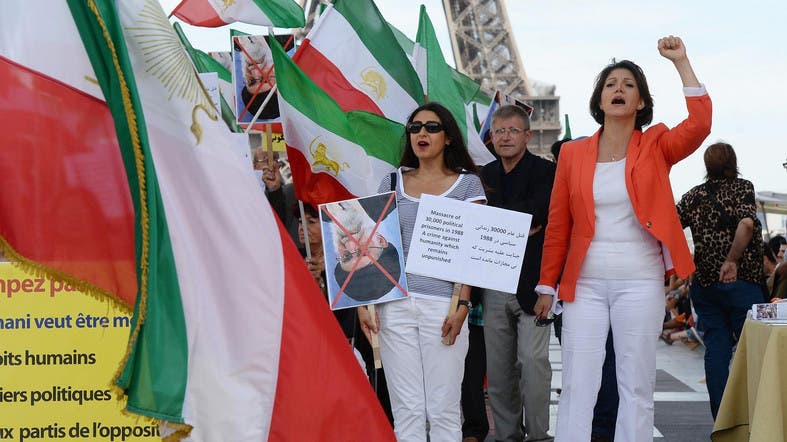
Officials responsible for violating the fundamental human rights of the Iranian people, including those in charge of executions, in particular the 1988 massacre of 30,000 political prisoners, members of the main Iranian opposition movement, the Mujahedin-e Khalq (MEK), must be subject to sanctions and be brought to justice. 
Over the past few years, the Iranian regime has extensively benefited from its access to U.S. technology, market, and academic and other institutions to advance its nuclear and missile program, as well as its agenda in the United States. The Justice Department must fully investigate any U.S. persons who have been providing services, under various pretexts, to the IRGC, the Ministry of Intelligence, Defense Ministry and other agencies of the Iranian regime.
These materials are being distributed by the National Council of Resistance of Iran-U.S. Representative Office. Additional information is on file with the Department of Justice, Washington, D.C.
originally published in the   prnewswire

THE TRUTH ABOUT PRISON CONDITIONS IN IRAN


INU - Recently, ambassadors of 45 countries visited Iran’s Evin prison, and were given a tour of one ward that was recently renovated. They weren’t shown the rest of the prison where the majority of the prisoners are held.On July 5th, 2017 two political prisoners, Golrokh Iraee and Atena Daemi, wrote an open letter to these ambassadors, explaining the intolerable conditions of the rest of Evin prison.
They pointed out the hypocrisy of Iranian officials in showing the delegation that particular ward, and told them of the terrible conditions of Iranian prisons. They wrote that ward four, where the delegation visited, was renovated by the prisoners, who were taken to solitary confinement on the day of the visit.They said that the new ward does not depict the actual conditions of the prisons, that the ambassadors were only shown what the Iranian officials wanted them to see. The true nature of the prison was hidden, and the world needs to see the inhumane conditions under which Iranian prisoners are kept.
The women said that solitary cells have no windows, or ventilation, or a lavatory. They said that the cells resemble graves, because they are dark and look like dungeons.
They asked the delegation why they had not been shown the women’s prison, where female political prisoners like them are held. They elaborated on the conditions of women’s ward, saying that there is a shortage of detergent and disinfectants. Sanitation and hygiene are absent from the prison cells, and prisoners are forced to drink dirty, unhygienic water which is causing kidney problems. Almost all the prisoners held in Evin prison are suffering from kidney issues.
The food provided to prisoners is not nutritional, and they are no female nurses for female prisoners who become ill. There are no regular health checks, and there is no one to administer an electrocardiograph. Iraee and Daemi accused the prison doctor of not checking the patients. They wrote that the doctor prescribes medicine only by looking at them, and does not bother checking them.
Iraee and Daemi explained to the ambassadors by that although the Head of the Prison Organization claimed that prisoners are allowed family visits every week, this is untrue. They said that family visits are allowed only once a month.
They concluded their letter by urging the UNSR on human rights, Ms. Asma Jhanagir, to visit prisons without prior notice, in Tehran and in other cities, as well, so the reality of the conditions in these prisons can be brought to light. The international community, especially the United Nations, must ensure that around the world, prisoners are kept in basic living conditions and are treated humanely.

IRAN REGIME'S AGENTS INTEND TO CREATE RELIGIOUS CONFLICTS AGAINST POLITICAL PRISONERS


NCRI - According to reports, interrogators of the Iranian regime’s ministry of intelligence are trying to create religious conflicts and clash among prisoners in Zahedan prison (South East of Iran) using their own mafia bands there.Reports indicate that on Monday, August 9, 2017, a number of mafia bandits in Ward 3 of Zahedan prison tried to clash with political prisoners but the prisoners particularly the Sunni clerics who are incarcerated in Ward 3 showed patience
and refrained from conflict or clash with the mafia bands to resolve the problem and the issue ended.
However, after a while, a prison guard officer with another agent from the prison inspection office entered Ward 3 and took one of the political prisoners out of the ward. But a few yards away from the ward, a number of prison mafia bands exited the ward at the same time and tried to attack and beat the political prisoner upon the order of the two prison officers.
According to the reports, other political prisoners staged mass protests against the action of the prison officers and mafia bands.
Also, one of the prison authorities has ordered the Mafia Bands of Ward 3 to insult the religious beliefs of political prisoners and Sunni clerics in this ward, in order to prepare the ground for a religious conflict, and ultimately engage in massive repression of the political prisoners.

EUROPE MUST NOT TURN A BLIND EYE TO IRAN’S HUMAN RIGHTS ABUSES


Amnesty International has just published a 94-page report entitled “Caught in a web of repression: Iran’s human rights defenders under attack.” It details 45 specific instances of what the organization has described as a “vicious crackdown” coinciding with the supposedly moderate presidency of Hassan Rouhani, who begins his second term in office this week.
The overall takeaway is that Iranian authorities have repeatedly diminished the standards by which they accuse and convict activists and dissenters of national security crimes, while also increasing the severity of punishments that are meted out to those same people. The abusive nature of those punishments was reinforced by new revelations that emerged alongside the Amnesty International report, mainly regarding the Islamic Republic’s notorious overuse of the death penalty.
Iran has long maintained world-leading rates of execution, and the violence and repression of the past few years have been reflected in a pattern of hangings that includes periodic spikes during which dozens of people are put to death in a single month. Last month saw just such a spike, with at least 101 death sentences being carried out, to say nothing of those that might have gone ahead in secret.
The Iranian Human Rights Organization announced that the Iranian authorities executed over one hundred people during the month of July. (File photo: Reuters)
In Iran, political prisoners are sentenced to hang with some frequency, usually on the basis of vague, religious charges like “enmity against God” or “insulting the sacred.”
Repressive, theocratic regime
Executions speak to the repressive nature of the theocratic regime, which has only grown worse in the era of Rouhani, when the government is fractured between two factions, neither of which represents reform. Maryam Rajavi, the president of the leading coalition of Iranian dissidents, the National Council of Resistance of Iran, responded to the new death penalty figures by saying, “Beset by crises and fearing popular uprisings, Iran’s ruling theocracy has found no other way out but to escalate repression especially by mass and arbitrary executions.”
The NCRI statement went on to recommend that the international community disregard economic and political incentives to expand relations with the Islamic Republic, and instead undertake measures to hold its officials accountable not only for recent crackdowns and executions, but also for long-neglected past crimes, like the massacre of some 30,000 political prisoners in the summer of 1988.
Naturally, being “beset by crises” and the possibility of popular overthrow, the regime is deeply fearful of this sort of pressure, which would imply Western readiness to stand behind a domestic uprising in Iran, and to aid it by making sure that Tehran is not free to carry out reprisals against dissenters as it sees fit.
Absurd claim 
Last month, Iran’s own so-called human rights monitor, Javad Larijani, made the absurd claim that the country does not hold any political prisoners. Immediately thereafter, foreign diplomats in Tehran were taken on a tour of the notorious Evin Prison, but human rights investigators were kept far away from the public relations stunt, while the diplomats were kept far away from wards that are known to house political prisoners almost exclusively.
Iranian Foreign Minister Javad Zarif has made similarly bold, easily ridiculed statements asserting the country’s innocence. But with or without the new Amnesty International report, no one with a modicum of knowledge of the Islamic Republic should ever take such claims seriously. Unfortunately, Zarif and other members of the Rouhani administration appear to be masterful at putting a friendly face on Iran’s clerical regime, even as its domestic abuses and foreign provocations continue to escalate.
 This is the only explanation for the fact that some Western officials, including European Union foreign policy Chief Federica Mogherini, agreed to attend this week’s re-inauguration of President Rouhani. These decisions were profoundly misguided, insofar as any Western presence at an Iranian state function presupposes that the relevant officials are turning a blind eye to human rights abuses that are not only continuing but escalating on Rouhani’s watch.
It is simply inconceivable that any of those officials are unaware of the information being shared by Amnesty and others. The most charitable explanation for their actions is that they do not hold Rouhani personally responsible for the crackdowns and are willing to offer their support to his administration in the hope that it will finally, after four years in office, begin to promote serious domestic reforms.
But if this is their thinking, it is painfully naïve. Rouhani has never been anything other than a loyal servant of the regime that tortures its citizens and imprisons them for upwards of 10 years simply for protesting previous human rights abuses. Soon after taking office in 2013 amidst the applause of Western officials, Rouhani thoroughly turned his back on human rights by appointing Mostafa Pourmohammadi, a leading figure in the 1988 massacre, as his justice minister.
Such officials must be brought to justice, lest the Iranian regime be convinced that it can get away with thousands of unlawful killings and still enjoy the presence of friendly European faces at its state functions. Justice will only be achieved when the international community has the courage to reject Iran’s absurd, anemic denials and to instead respond with new economic and diplomatic pressure to the regime’s human rights abuses.
originally published in the   english.alarabiya

PRISONER ARRESTED AT JUST 15 IS HOURS AWAY FROM EXECUTION IN IRAN


The Iranian authorities must halt the imminent execution of Alireza Tajiki, who was arrested as a child, said Amnesty International today, after learning that he was transferred to solitary confinement this morning and is due to be executed in less than 24 hours in Shiraz’s Adel Abad prison.Tajiki was just 15 at the time of his arrest and 16 when he was convicted and sentenced to death.
He was transferred to solitary confinement in Adel Abad prison in Shiraz, Fars Province, on August 9. His family were told to come to prison in order to make their final visit. The authorities did not inform his legal representatives, contrary to Iran’s own laws, which require lawyers to be informed of their clients’ scheduled execution at least 48 hours in advance.
“This is an utterly shameless act by the Iranian authorities. They are keenly aware that using the death penalty against someone who was under 18 years of age at the time of crime is in flagrant breach of Iran’s obligations under international human rights law, including the UN Convention on the Rights of the Child,” said Magdalena Mughrabi, Deputy Director for the Middle East and North Africa at Amnesty International.
“Despite this, time and again Iran’s judicial authorities and lawmakers have failed to take any steps to once and for all end the use of the death penalty against juvenile offenders. The Iranian authorities must immediately halt any plans to execute Alireza Tajiki.”
Tajiki, now 21 years old, was sentenced to death in April 2013 after a criminal court in Fars Province, southern Iran, convicted him of murder and lavat-e be-onf (male on male rape). The trial was grossly unfair and relied primarily on “confessions” which Tajiki has said where extracted through torture, including severe beatings, floggings, and suspension by arms and feet.
Both the lower court in Fars Province and the Supreme Court relied on state forensic opinions stating that Tajiki was “mature” at the age of 15 and thus eligible to receive the death penalty. In a subsequent response to the UN Office of the High Commissioner for Human Rights in October 2016, the representatives of Iran reiterated their outrageous position that Tajiki “had sound intellect and understanding about unlawfulness of the committed acts and their punishment” at the time of the crime when he was 15 years old and therefore could be punished with the death penalty.
Tajiki was first arrested in May 2012 and placed in solitary confinement for 15 days, without access to his family. He was denied access to a lawyer throughout the entire investigation process. He has said that during this period he was subjected to torture and other ill-treatment to “confess” to the crime. He later retracted the “confessions” both before the prosecution authorities and during his trial, and has since maintained his innocence consistently. However, despite this, his “confession” was admitted as evidence during proceedings against him.
“The Iranian authorities are demonstrating once again their callous disregard for children’s rights as well as fair trial standards. This is now the third time since May 2016 that the authorities have scheduled Alireza Tajiki’s execution. Rather than repeatedly tormenting Alireza Tajiki with execution dates, the authorities must once and for all cancel all plans to execute him, and grant him a fair retrial in accordance with the principles of juvenile justice and without recourse to death penalty.”
Iran is one of the last few countries in the world that still executes juvenile offenders. In January 2016, Amnesty International published a report which found that despite piecemeal reforms introduced by the Iranian authorities in 2013 to deflect criticism of their appalling record on executions of juvenile offenders, they have continued to condemn dozens of young people to death for crimes committed when they were below 18, in violation of their international human rights obligations.
As of August 2017, Amnesty International had identified the names of at least 89 individuals on death row who were under the age of 18 when the crime was committed.
originally published  in the   amnestyusa

North Korea may have more nuclear bomb material than thought: U.S. think tank

A satellite image of the radiochemical laboratory at the Yongbyon nuclear plant in North Korea by Airbus Defense & Space and 38 North released on July 14, 2017A satellite image of the radiochemical laboratory at the Yongbyon nuclear plant in North Korea by Airbus Defense & Space and 38 North released on July 14, 2017

WASHINGTON (Reuters), July 14, 2017-- Thermal images of North Korea's main nuclear site show Pyongyang may have reprocessed more plutonium than previously thought that can be used to enlarge its nuclear weapons stockpile, a U.S. think tank said on Friday.
The analysis by 38 North, a Washington-based North Korean monitoring project, was based on satellite images of the radiochemical laboratory at the Yongbyon nuclear plant from September until the end of June, amid rising international concerns over North Korea's nuclear and missile programs.
The think tank said images of the uranium enrichment facility at Yongbyon could also indicate operation of centrifuges that could be used to increase North Korea’s stock of enriched uranium, its other source of bomb fuel.
There were signs too of at least short-term activity at North Korea’s Experimental Light Water Reactor that could be cause for concern, 38 North said.
The images of the radiochemical laboratory showed there had been at least two reprocessing cycles not previously known aimed at producing 'an undetermined amount of plutonium that can further increase North Korea’s nuclear weapons stockpile,' something that would worry U.S. officials who see Pyongyang as one of the world's top security threats.
It was unclear if the thermal activity detected at the uranium plant was the result of centrifuge operations or maintenance.
 
 A thermal image of the radiochemical laboratory at the Yongbyon nuclear plant in North Korea is seen which 38 North says was taken in June 2017 and released on July 14, 2017. Courtesy Thermal data available from the US Geological Survey/38 North/Handout via REUTERS

It said the thermal patterns at the plant's isotope/tritium production facility suggested it was not operational and was therefore not producing tritium, an essential isotope used in boosted yield and hydrogen weapons.
North Korea manufactures atomic bombs using uranium and plutonium and has tested five nuclear bombs. Officials and experts say it could test a sixth at any time, despite U.S.-led international efforts to curb its program.
Pyongyang said its penultimate test in January 2016 was of a hydrogen bomb, something experts have treated with skepticism.
North Korea has been working to develop a nuclear-tipped missile capable of hitting the United States and last week tested its first intercontinental ballistic missile, which experts said could hit all of Alaska and parts of the U.S. Pacific Northwest.
Frustrated that China, North Korea's main trading partner, has not done more to rein in Pyongyang, the Trump administration could impose new sanctions on small Chinese banks and other companies doing business with Pyongyang within weeks, two senior U.S. officials told Reuters this week.
U.S. ambassador to the United Nations Nikki Haley has been seeking to overcome resistance from China and Russia to a U.N. Security Council resolution imposing stiffer international sanctions on Pyongyang.
Experts at 38 North estimated in April that North Korea could have as many as 20 nuclear bombs and could produce one more each month.

Iran ripe for regime change two years after nuclear deal

President Hassan Rouhani

President Hassan Rouhani

BY: PROF. IVAN SASCHA SHEEHAN
NEW YORK DAILY NEWS, July 14, 2017 - The Iran nuclear agreement — officially known as the Joint Comprehensive Plan of Action — has been in effect for a year and a half, during which time the world has been able to assess the impact of its formal implementation. But it has now had two full years to consider the effects of its negotiation, which concluded on July 14, 2015.
The negotiations themselves were promoted by then-U.S. President Barack Obama and his surrogates as a means of creating a new diplomatic status quo between Iran and the West. It was hoped that following the 2013 election of Iranian President Hassan Rouhani , Tehran would moderate its behavior by demonstrating cooperation with former adversaries.
But internal moderation of the Iranian regime has proven elusive, and Tehran has shown no aptitude to reform from within.
The result? Western powers have learned the same lesson from the Rouhani administration that they learned from Mohammad Khatami, Ali Akbar Rafsanjani, and other Iranian officials similarly labeled as reformers worthy of outreach. Moderation is a mirage Tehran uses to seduce their prey.
Executions have skyrocketed under Rouhani's watch, with his administration overseeing an alarming 3,000 hangings during its first four-year term. Analysts expect the human rights violations to continue as the president commences a second term next month.
Rouhani's tenure is also distinguished by a dangerous continuation of ballistic missile research, development and testing (including evidence of cooperation with North Korea) and a repressive crackdown by the country’s security forces on activists, artists, academics, journalists and anyone accused of having ties to the West. These unfortunate trends have shown no signs of abatement on the second anniversary of the landmark agreement that granted far-reaching concessions in return for constructive engagement.
Neither has Tehran’s regional behavior demonstrated signs of improvement with the regime serving as a driving force behind sectarian conflict and an active participant in the Syrian and Yemeni civil wars.
As Western powers commemorate the two-year anniversary of the nuclear negotiations, a comprehensive Iran policy that addresses the joint plan’s shortcomings is needed. The U.S. must take the lead — as it did when nuclear negotiations began — but this time it must lead the world in confronting Iran over the nature of its repressive, fundamentalist regime by building a global coalition that supports regime change from within.
To its credit, the Trump administration has taken steps in this direction by increasing sanctions on the country’s ballistic missile program and pursuing the blacklisting of Iran’s hardline paramilitary organization, the Islamic Revolutionary Guard Corps. But the Trump administration's willingness to confront Tehran would benefit from clear, overarching policy that more fully embraces the regime’s collapse and replacement.
Secretary of State Rex Tillerson’s strong statement before the House Foreign Affairs Committee was a first step in this direction: “Our policy towards Iran is to push back on (its regional) hegemony, contain their ability to develop, obviously, nuclear weapons and to work towards support of those elements inside of Iran that would lead to a peaceful transition of that government.”
Now Tillerson's rhetoric needs to be backed with clear statements by U.S. officials — including the President himself — that the false narrative of internal moderation has expired and the aspirations of the Iranian people for regime change are within reach.
It is widely believed that the sanctions and diplomatic pressure employed by the White House and Congress are intended to serve the goal of regime change. If so, this needs to be made clear so that interested parties can coordinate their strategies and address questions about the availability of the “elements inside of Iran” that Tillerson referred to.
The regime’s lobby in Washington would have U.S. officials believe no such elements exist, at least none with adequate organization and resources to oust the clerical regime and replace it with a democratic system of government. Such mischaracterizations are as inaccurate as they are well funded.
The accusations were addressed earlier this month when Tehran’s parliament in exile, the National Council of Resistance of Iran, along with the main Iranian opposition movement, the People’s Mojahedin Organization of Iran, held its annual international gathering for democratic change in Paris. The gathering included tens of thousands of Iranian expatriates and hundreds of politicians and foreign policy experts from around the world who embraced regime change by the Iranian resistance.
In her speech at the event, NCRI President Maryam Rajavi praised the international community for rejecting the failed strategy of “appeasement” that the Joint Comprehensive Plan of Action represents and affirmed her movement’s commitment to the replacement of Iran's religious dictatorship, characterizing it as an absolute imperative and “the ultimate solution to the crises in the region.”
Rajavi noted what Iran scholars have long known: 1) Tehran’s vulnerability, domestic unpopularity and international isolation puts its overthrow within reach; 2) this can be achieved by the organized, democratic resistance that exists in the country and is led on the world stage by the NCRI.
The White House can mark the second anniversary of the negotiations that resulted in the Joint Comprehensive Plan of Action by turning the page on the failed Obama policy of capitulation in the interest of concessions and supporting the aspirations of the Iranian people for democratic change. By working with the Iranian opposition to realize regime change in Tehran, U.S. officials send a signal that they are preparing for the regime’s collapse and democratic transition and put Iran on notice that a new Iran policy has been embraced.


prof. Sheehan is director of the graduate programs in Global Affairs & Human Security and Negotiations & Conflict Management in the School of Public and International Affairs at the University of Baltimore.

Purpose and Consequences of Iran Regime's Missile Test

Irans  rocket lifts off  with the countrys  satellite

Irans rocket lifts off with the countrys satellite

Peace be upon those who help the Iranian resistance to overthrow the Iranian regime
By Mahmoud Hakamian
IRAN, AUGUST 2, 2017-- On AUGUST 2, 2017, Iranian regime’s media reported on the launch of a satellite carrier missile. The timing of the launch was arranged in such a way so as to coincide with discussions over US Congress’s passing of sanctions against the Iranian regime.
While the move was widely advertised by regime officials, including regime’s president Hassan Rouhani and state media, it was faced with tough stances and a new wave of condemnations by the international community, so that the US Treasury, among others, sanctioned six more entities related to regime’s ballistic-missile program, following which three European countries, namely France, Germany, and Britain issued a joint statement with the United States, denouncing the regime’s move and calling on the regime to immediately stop any ballistic missile test and related activities.

A Look at Khomeini's Fatwa for PMOI/MEK Massacre + video & photos

Justice for Victims of Irans 1988 Massacre Demanded At Free Iran Rally

Justice for Victims of Irans 1988 Massacre Demanded At Free Iran Rally

By Jubin Katiraie
 IRAN FOCUS, 08 August 2017-- 29 years ago these days, in Iran under the mullahs’ regime, the massacre of over 30,000 political prisoners, mainly members, and supporters of the Iranian opposition People's Mojahedin Organization of Iran (PMOI/MEK) had engulfed all of Iran.
Khomeini
Khomeini''Death Decree' for mass executions of Iranian political prisoners in 1988.

CONTRARY TO IRAN LOBBY CLAIMS, REGIME CHANGE DOES NOT END IN WAR

 Written by Poorang Novak
  Published: 30 July 2017
One of the great falsehoods of the Iran lobby and the appeasers of the clerical regime in Tehran is that any effort at regime change would inevitably lead to war. This by-line can be seen in every article by the Iran lobby and the appeasers attempting to underscore the growing global support for the Iranian opposition (MEK/PMOI) and the Iranian people’s quest for regime change.
History teaches us though that the longevity of any regime born out of violent conquest is ultimately short-lived.
The Iranian regime that was born out of a revolution overthrowing the Shah, which was in turn hijacked by the mullahs and turned into a religious oligarchy. The original aim of the revolution was the formation of a secular, pluralistic democracy. That dream still exists in the hearts and minds of the overwhelming majority of the Iranian people and resonates in the various forms of protest in Iran, despite the repressive measures by the regime. Therefore, the call for “regime change” is primarily the Iranian people’s demand.

LEADING OFFICIALS OF IRANIAN REGIME ADMIT THE MASSACRE OF MEK MEMBERS

 
Written by Jazeh Miller
  Published: 29 July 2017
Iranian regime massacred over 30,000 political prisoners in summer of 1988, and kept silent about this atrocity for three decades. Most of the victims were members and supports of the main opposition group the People’s Mojahedin Organization of Iran (PMOI/MEK). This year in the presidential election as conservative cleric Ebrahim Raisie, one of the perpetrators of the massacre, was selected as one of the main candidates, the issue surfaced, forcing regime officials, one after another, to confess about the carnage.
Last week in an unprecedented interview, Ali Fallahian, the former Iranian intelligence Minister, revealed the mindset behind the mass execution of summer of 1988. Ali Fallahian, who was called as “the most feared mullah in Iran” by the News Week is wanted by Interpol for his involvement in the AMIA bombing that killed 85 people on July 18, 1994 in Buenos Aires, Argentina.
In the interview, Fallahian explained that whoever had any relation with the MEK was condemned to death.

Why Iran Apologists Demonize the MEK?

By Jubin Katiraie
The U.S. Senate voted almost unanimously on Thursday to pass new sanctions on Russia, North Korea and Iran.
The officials of Iranian regime are already afraid of the consequences of the new sanctions. In addition to economic implications of the sanctions, what worries them the most is the actions against the Islamic Revolutionary Guards Corps (IRGC) as a terrorist organization. Designating and imposing sanctions on the IRGC was long overdue because the IRGC serves as the guarantee to preserve the entirety of the regime ruling Iran and is the main entity responsible for domestic suppression, the export of terrorism and extremism, and obtaining weapons of mass destruction such as nuclear weapons and ballistic missiles.
The new bill has added to already shaky regime’s fears. Janati, the head of the Guardian Council announced on Thursday that the main issue which has preoccupied the Supreme leader is his concern over regime change.

Regime change was the main topic of the July 1, 2017 annual gathering of Iranian resistance (The Mujahedin-e-Khalq or MEK) in Paris. Many speakers talked about the regime change and their support for the MEK.MEK
“I’m happiest to be here because I can say, can probably say this with a good deal of authority, that the government of the United States supports you” Rudy Giuliani former mayor of New York City said referring to MEK supporters in the gathering.

Opinion: Couple US sanctions with Middle East expulsion of Iran


By: 

Shahriar Kia * *


2017-08-01 14:38:34

The Iranian regime is attempting to secure a corridor through Iraq, Syria and Lebanon, providing a supply route for its numerous terrorist proxies in the region.
Iran’s clandestine nuclear and ballistic missile drive, support for terrorism and domestic crackdown are all aimed at maintaining the Tehran’s fascist mullahs in power and pursue their regional policies.
This notorious objective, in direct conflict with those of the regional and global coalitions to fight terrorism and extremism, can be stopped. Eviction of Iran’s Revolutionary Guard Corps (IRGC) and all its proxy forces from the Middle East must complete the new US Congress sanctions. With President Donald Trump signaling his approval, this first and foremost step should be taken with hesitation following the sanctions.
The US House of Representatives voted overwhelmingly to rally major new sanctions on Iran, parallel to measures on North Korea and Russia. To impose additional sanctions on Iran’s defense sector, the House voted 419-3. Coming after three weeks of negotiations, this bill “tightens the screws on our most dangerous adversaries,” explained House Speaker Paul Ryan.

How blood of innocents has become an endless nightmare for Iranian regime


People chant slogans and hold pre-revolutionary Iranian flags in Paris, on August 17, 2013, as they take part in a rally marking the 25th anniversary of the 1988 massacre of Iranian political prisoners. (AFP)
By F. Mahmoudi: Special to Al Arabiya EnglishThursday, 27 July 2017
In Iran, 1980s is known as a bloody decade as thousands of political opponents were executed in brutal mass murder.
In the summer of 1988, a massive slaughter took place in Iran’s prisons. Ayatollah Hossein Ali Montazeri, the successor of Khomeini, was dismissed as a result of his objection to this massacre.
In September 2016, an audio tape from a meeting of the late Ayatollah Montazeri with members of the committee of executioners (commonly known by Iranians as death committee) was published by his son, which led to his arrest and prosecution.
In the audio tape, Ayatollah Montazeri described this massacre as the worst crime in the history of the Islamic Republic, and named Ibrahim Raisi, Mostafa Pour Mohammadi, Hossein Ali Nayeri and other coordinators as criminals.

Free Iran Gathering: Regime Change Is Within Reach


Iran Focus
London, 12 Jul - On 1st July 2017, the Iranian Resistance held its annual rally in Paris. There were lawmakers, politicians, dignitaries and former officials from five continents and over 50 countries in attendance, as well as tens of thousands of Iranian people.
The President-elect of the National Council of Resistance of Iran, Mrs. Maryam Rajavi, emphasized that regime change is the only way in which the Iranian people can finally gain the freedom they deserve. This is also important for the ethnic minorities and will end the conflict that has divided Sunnis and Shiites. She also said that the only way for peace and tranquillity to be brought to the region is via regime change. Rajavi emphasized that regime change is possible and is close.
Many of the speakers emphasized that the Iranian Resistance has come a long way. One tangible way of measuring its success is to realise that the thousands of PMOI members that were trapped in Camp Ashraf are finally free. The Resistance has been working for years to free these people and after a long struggle it is one less thing for the Resistance to fight for. Thousands of PMOI members that are now living in Albania joined in the event via satellite.
Gilbert Mitterrand, head of the France Libertés Foundation, welcomed the audience. He said: “Your broad presence here is like a referendum against the clerical regime and it shows the ability of this resistance to a democratic change in Iran. I also have to convey to the organizers of this gathering, the message of gratitude of the French President Francois Hollande (2012-2017). He has said that he will continue to pay attention to the human rights situation in Iran, due to the invitation you have made to participate in this gathering.”

Massive ‘Free Iran’ Rally Calls for Regime Change

Maryam Rajavi, president-elect of the National Council of Resistance of Iran, greets ex-pats
BY SHAHRIAR KIA Tuesday, July 11, 2017


Maryam Rajavi, president-elect of the National Council of Resistance of Iran, greets ex-pats (Photo: Sean Gallup/Getty Images)
As the number one state sponsor of terrorism and the source of a fundamentalist ideology, the Iranian regime is the principal contributor to the crises that are riddling the Middle East. And the past eight years have proven that appeasing the mullahs ruling Iran will only render a bad situation worse.
It is now more evident than ever that only a free and democratic Iran can help restore peace and stability in the region, not one that is ruled by the current religious fascist regime.
However, contrary to what the proponents of the appeasement policy toward Iran have tried to portray, regime change in Iran does not require another bloody conflict in the region. It is now more possible than ever, and the people of Iran, along with their organized resistance movement (NCRI/MEK), have all they need to bring democracy and freedom to their country.

Why the Iranian regime is incapable of reforming from within

Maryam Rajavi holds flowers as she pays tribute during a gathering in Auvers-sur-Oise, near Paris, September 29, 2012. (Reuters)
By F. Mahmoudi 
Thursday, 13 July 2017
Special to Al Arabiya English
The unprecedented strength of the Iranian opposition People’s Mojahedin Organization of Iran (PMOI/MEK) in Paris and Albania has severely alarmed the Iranian regime. It has also raised a pertinent question, can the Iranian regime be reformed within?
The signs so far are not encouraging. Tehran sent its foreign minister, Mohammad Javad Zarif, to Paris to prevent the annual gathering of opposition figures. As French officials found the regime’s position very weak, they ended up signing a contract for the benefit of the French oil giant Total..
Hossein Shariatmadari, editor-in-chief Kayhandaily, known as the mouthpiece of Iranian Supreme Leader Ali Khamenei, wrote an article titled “Humiliated and Rewarded”, which mentioned the Total contract being signed at the same time as the PMOI gathering in Paris.
“The remarks of former French foreign minister Bernard Kouchner at a PMOI meeting one day after Zarif’s return from France is another sign of the French government's insistence on humiliating our nation,” he wrote.

US Intelligence Predicts Attack From IranTerrorism 28 September 2018 Iran Focus London, 28 Sep - US intelligence suggests that Iranian-backe...