By Jubin Katiraie
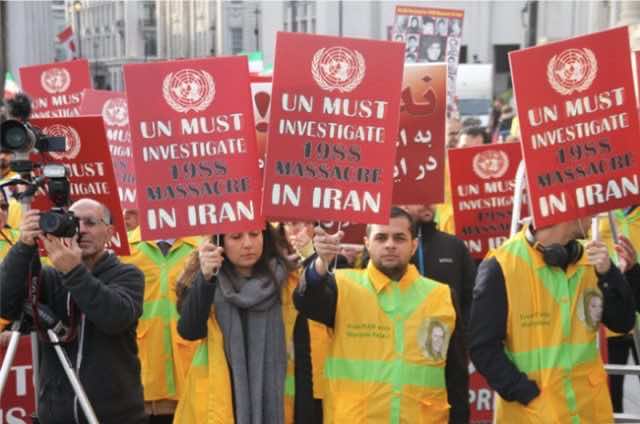
The US Senate voted almost unanimously last Thursday to impose new sanctions on Iran. The legislation cracks down on Iran’s activities including their missile development programs and human rights abuses. This is the first time that Iran has been targeted for violation of Human Rights.
“Not later than 90 days after the date of the enactment of this Act, and annually thereafter, the Secretary of State shall submit to the appropriate congressional committees a list of each person the Secretary determines, based on credible evidence, on or after the date of the enactment of this Act (1) is responsible for extrajudicial killings, torture, or other gross violations of internationally recognized human rights committed against individuals in Iran who seek (A) to expose illegal activity carried out by officials of the Government of Iran; or (B) to obtain, exercise, defend, or promote internationally recognized human rights and freedoms, such as the freedoms of religion, expression, association, and assembly, and the rights to a fair trial and democratic elections; or … “ Reads part of the
bill
For the past 4 decades Iran has been one of the worst violators of Human Rights in the world. Since the 1979 revolution Iranian regime has been condemned 63 times by the UN bodies for violation of Human Rights.
Given the articles of the new bill about violation of human rights, and based on the actions of Iranian authorities in the past 4 decades, all the Iranian officials must be sanctioned.
One case in point is the massacre of
MEK* members and other political prisoners which all of Iranian officials were involved. In 1988, the Iranian regime
massacred more than 30,000 political prisoners, most of whom were members and supporters of the main opposition group, the People’s Mujahedin Organization of Iran (PMOI or MEK). All the current and previous officials of the regime were directly involved in the massacre. Khomeini, the supreme leader of Iranian regime issued a
religious decree ordering the massacre. His intention was to purge the country of any opposition, notably the MEK. Khomeini's decree set up a committee of four men which were tasked with vetting the ideological standing of prisoners. Many prisoners were only questioned for a few minutes by the committee. Those refusing to renounce their affiliation with the MEK were sent to the gallows.
“Whoever at any stage continues to belong to the MEK must be executed. Annihilate the enemies of Islam immediately!…Those who are in prisons throughout the country and remain steadfast in their support for the MEK are waging war on God, and are condemned to execution … It is naive to show mercy to those who wage war on God,” reads part of the decree.
For more than three decades, Iran ignored the slaughter, until this year in the presidential election when
Ebrahim Raisie one of the perpetrators of the massacre and a member of death committee, was selected as one of the main candidates. MEK supporters inside Iran carried out widespread campaigns revealing Raisie and his role in the massacre.
Immediately, the issue of massacre of MEK members surfaced, forcing regime officials, one after another, to confess to the bloodbath.
“Regarding MEK and all the militant groups, the ruling is the death sentence … Imam (Khomeini) has said this … their verdict is death sentence …” Ali Fallahian, the former Iranian intelligence Minister, confessed in an
interview.
“First, you should bear in mind that their (MEK’s) ruling was death punishment; and if the religious judge did not sentence them (MEK) to death, his ruling has been illegal … so all of us should acknowledge that the verdict for a Monafeq [the term used by the regime to call a MEK member or sympathizer] is death sentence, this was both Imam’s fatwa and his verdict …” Fallahian said in the interview.
Last August an
audio tape of a meeting between the late
Ayatollah Montazeri, the former successor to Khomeini, and the death committee was revealed and shed light to the carnage. The news of the revelation was covered in the international media.
“The publication for the first time in Iran of an audio recording from nearly three decades ago has reopened old wounds from the darkest period in the Islamic Republic. In the summer of 1988, thousands of leftists and supporters of the Mujahedin-e Khalq (MEK) organisation were executed in a
massacre of political prisoners.” The
Guardian reported.
“I urge the UN High Commissioner on human rights to immediately set up an independent committee to investigate the 1988 massacre and subsequently put those in charge before justice. I urge the UN Security Council to make the arrangements for prosecution of the regime’s leaders for committing crime against humanity.” said Mrs.
Maryam Rajavi, the president elect of the National Council of Resistance of Iran (NCRI) in her
message on the 29th anniversary of the massacre.
With adoption of the new bill the time has come to hold the mullah’s regime accountable for crimes against humanity.
“Full implementation of these sanctions against the Iranian regime must be completed with urgent actions against officials in charge of executions, torture and particularly the massacre of political prisoners in 1988. Topping the list is Ali Khamenei, the mullahs’ supreme leader.” Said Maryam Rajavi in
another message.
More about MEK:
A Long Conflict between the Clerical Regime and the MEK
The origins of the MEK date back to before the 1979 Iranian Revolution., the MEK helped to overthrow the dictatorship of Shah Reza Pahlavi, but it quickly became a bitter enemy of the emerging the religious fascism under the pretext of Islamic Republic. To this day, the MEK and NCRI describe Ruhollah Khomenei and his associates as having co-opted a popular revolution in order to empower themselves while imposing a fundamentalist view of Islam onto the people of Iran.
Under the Islamic Republic, the MEK was quickly marginalized and affiliation with it was criminalized. Much of the organization’s leadership went to neighboring Iraq and built an exile community called Camp Ashraf, from which the MEK organized activities aimed at ousting the clerical regime and bringing the Iranian Revolution back in line with its pro-democratic origins. But the persistence of these efforts also prompted the struggling regime to crack down with extreme violence on the MEK and other opponents of theocratic rule.
The crackdowns culminated in the massacre of political prisoners in the summer of 1988, as the Iran-Iraq War was coming to a close. Thousands of political prisoners were held in Iranian jails at that time, many of them having already served out their assigned prison sentences. And with the MEK already serving as the main voice of opposition to the regime at that time, its members and supporters naturally made up the vast majority of the population of such prisoners.
As the result of a fatwa handed down by Khomeini, the regime convened what came to be known as the Death Commission, assigning three judges the task of briefly interviewing prisoners to determine whether they retained any sympathy for the MEK or harbored any resentment toward the existing government. Those who were deemed to have shown any sign of continued opposition were sentenced to be hanged. After a period of about three months, an estimated 30,000 people had been put to death. Many other killings of MEK members preceded and followed that incident, so that today the Free Iran rally includes an annual memorial for approximately 120,000 martyrs from the People’s Mojahedin Organization of Iran.
The obvious motive behind the 1988 massacre and other such killings was the destruction of the MEK. And yet it has not only survived but thrived, gaining allies to form the NCRI and acquiring the widespread support that is put on display at each year’s Free Iran rally. In the previous events, the keynote speech was delivered by Maryam Rajavi, who has been known to receive several minutes of applause from the massive crowd as she takes the stage. Her speeches provide concrete examples of the vulnerability of the clerical regime and emphasize the ever-improving prospects for the MEK to lead the way in bringing about regime change.
The recipients of that message are diverse and they include more than just the assembled crowd of MEK members and supporters. The expectation is that the international dignitaries at each year’s event will carry the message of the MEK back to their own governments and help to encourage more policymakers to recognize the role of the Iranian Resistance in the potential creation of a free and democratic Iranian nation. It is also expected that the event will inspire millions of Iranians to plan for the eventual removal of the clerical regime. And indeed, the MEK broadcasts the event via its own satellite television network, to millions of Iranian households with illegal hookups.
MEK’s Domestic Activism and Intelligence Network
What’s more, the MEK retains a solid base of activists inside its Iranian homeland. In the run-up to this year’s Free Iran rally the role of those activists was particularly evident, since the event comes just a month and a half after the latest Iranian presidential elections, in which heavily stage-managed elections resulted in the supposedly moderate incumbent Hassan Rouhani securing reelection. His initial election in 2013 was embraced by some Western policymakers as a possible sign of progress inside the Islamic Republic, but aside from the 2015 nuclear agreement with six world powers, none of his progressive-sounding campaign promises have seen the light of day.
Rouhani’s poor record has provided additional fertile ground for the message of the MEK and Maryam Rajavi. The Iranian Resistance has long argued that change from within the regime is impossible, and this was strongly reiterated against the backdrop of the presidential elections, when MEK activists used graffiti, banners, and other communications to describe the sitting president as an “imposter.” Many of those same communications decried Rouhani’s leading challenger, Ebrahim Raisi, as a “murderer,” owing to his leading role in the massacre of MEK supporters in 1988.
That fact helped to underscore the domestic support for the People’s Mojahedin Organization of Iran, insofar as many people who participated in the election said they recognized Raisi as the worst the regime had to offer, and that they were eager to prevent him from taking office. But this is not to say that voters saw Rouhani in a positive light, especially where the MEK is concerned. Under the Rouhani administration, the Justice Minister is headed by Mostafa Pourmohammadi, who also served on the Death Commission and declared as recently as last year that he was proud of himself for having carried out what he described as God’s command of death for MEK supporters.
With this and other aspects of the Islamic Republic’s record, the MEK’s pre-election activism was mainly focused on encouraging Iranians to boycott the polls. The publicly displayed banners and posters urged a “vote for regime change,” and many of them included the likeness of Maryam Rajavi, suggesting that her return to Iran from France would signify a meaningful alternative to the hardline servants of the clerical regime who are currently the only option in any Iranian national election.
Naturally, this direct impact on Iranian politics is the ultimate goal of MEK activism. But it performs other recognizable roles from its position in exile, not just limited to the motivational and organization role of the Free Iran rally and other, smaller gatherings. In fact, the MEK rose to particular international prominence in 2005 when it released information that had been kept secret by the Iranian regime about its nuclear program. These revelations included the locations of two secret nuclear sites: a uranium enrichment facility at Natanz and a heavy water plant at Arak, capable of producing enriched plutonium.
As well as having a substantial impact on the status of international policy regarding the Iranian nuclear program, the revelations also highlighted the MEK’s popular support and strong network inside Iran. Although Maryam Rajavi and the rest of the leadership of the People’s Mojahedin Organization of Iran reside outside of the country, MEK affiliates are scattered throughout Iranian society with some even holding positions within hardline government and military institutions, including the Iranian Revolutionary Guard Corps.
Drawing upon the resources of that intelligence network, the MEK has continued to share crucial information with Western governments in recent years, some of it related to the nuclear program and some of it related to other matters including terrorist training, military development, and the misappropriation of financial resources. The MEK has variously pointed out that the Revolutionary Guard controls well over half of Iran’s gross domestic product, both directly and through a series of front companies and close affiliates in all manner of Iranian industries.
In February of this year, the Washington, D.C. office of the National Council of Resistance of Iran held press conferences to detail MEK intelligence regarding the expansion of terrorist training programs being carried out across Iran by the Revolutionary Guards. The growth of these programs reportedly followed upon direct orders from Iranian Supreme Leader Ali Khamenei and coincided with increased recruitment of foreign nationals to fight on Tehran’s behalf in regional conflicts including the Syrian and Yemeni civil wars.
In the weeks following that press conference, the MEK’s parent organization also prepared documents and held other talks explaining the source of some of the Revolutionary Guards’ power and wealth. Notably, this series of revelations reflected upon trends in American policy toward the Islamic Republic of Iran. And other revelations continue to do so, even now.
MEK Intelligence Bolstering US Policy Shifts
Soon after taking office, and around the time the MEK identified a series of Revolutionary Guard training camps, US President Donald Trump directed the State Department to review the possibility of designating Iran’s hardline paramilitary as a foreign terrorist organization. Doing so would open the Revolutionary Guards up to dramatically increased sanctions – a strategy that the MEK prominently supports as a means of weakening the barriers to regime change within Iran.
The recent revelations of the People’s Mojahedin Organization of Iran have gone a long way toward illustrating both the reasons for giving this designation to the Revolutionary Guards and the potential impact of doing so. Since then, the MEK has also used its intelligence gathering to highlight the ways in which further sanctioning the Guards could result in improved regional security, regardless of the specific impact on terrorist financing.
For example, in June the NCRI’s Washington, D.C. office held yet another press conference wherein it explained that MEK operatives had become aware of another order for escalation that had been given by Supreme Leader Khamenei, this one related to the Iranian ballistic missile program. This had also been a longstanding point of contention for the Trump administration and the rest of the US government, in light of several ballistic missile launches that have been carried out since the conclusion of nuclear negotiations, including an actual strike on eastern Syria.
That strike was widely viewed as a threatening gesture toward the US. And the MEK has helped to clarify the extent of the threat by identifying 42 separate missile sites scattered throughout Iran, including one that was working closely with the Iranian institution that had previously been tasked with weaponizing aspects of the Iranian nuclear program.
The National Council of Resistance of Iran (NCRI) led by Maryam Rajavi is thus going to great lengths to encourage the current trend in US policy, which is pointing to more assertiveness and possibly even to the ultimate goal of regime change. The MEK is also striving to move Europe in a similar direction, and the July 1 gathering is likely to show further progress toward that goal. This is because hundreds of American and European politicians and scholars have already declared support for the NCRI and MEK and the platform of Maryam Rajavi. The number grows every year, while the People’s Mojahedin Organization of Iran continues to collect intelligence that promises to clarify the need for regime change and the practicality of their strategy for achieving it.


-.jpg?c=4)