center> Important News Iran stars: #FreeIran #MaryamRajavi #Iran #Mek #Iran #BlackListIRGC Opposition
div style="margin: 15px 0px 0px; display: inline-block; text-align: center; width: 200px;">
Showing posts with label #FreeIran #MaryamRajavi #Iran #Mek #Iran #BlackListIRGC Opposition. Show all posts

Ashraf Rajavi

The pioneering women in the struggle of Iranian people

Ashraf Rajavi was one of the pioneering women in the struggle of Iranian people during the regimes of the Shah and Khomeini. She was a student at Sharif Industrial University in Tehran. To join the ranks of the struggle against the regime of the Shah, she quit the university and worked full time for the resistance.
Prior to the 1979 revolution in Iran, she was arrested twice and spent some years in the Shah’s prisons where she was tortured and lost someof her body’s function. However, her resoluteness and belief in the struggle along with her perseverance made her one of the symbols of the pioneering women in Iran.

During the 1979 anti-monarchic revolution of the Iranian people, Ashraf was released from prison on January 20th 1979 along with the last group of political prisoners – including the leader of the Iranian Resistance Mr. Massoud Rajavi – and was embraced by her beloved people. In the first post-revolution parliamentary election, Ashraf was one of the People's Mojahedin Organization of Iran (PMOI) candidates from Tehran. Due to the extensive vote rigging by Khomeini’s supporters, none of the PMOI candidates, including Ashraf, could find their way to the parliament.

She married Mr. Massoud Rajavi in 1980 and continued her political activities as a vanguard of the struggle for freedom within PMOI. Finally, in a savage attack upon a PMOI base in Tehran by Khomeini’s revolutionary guards on February 8th 1981 she was martyred along with Moussa Khiabani, the second in command for the PMOI, as well as a number of other PMOI members.

Years later, Ashraf in Iraq was named in her honor as she was a pioneer and a symbol of PMOI women who led a generation of women that soon found themselves battling Khomeini’s fundamentalism. These women are truly the vanguards of freedom for Iranian women; they have been and are present in all arenas in the battle against religious tyranny from prisons and dungeons in Iran to the pioneers of struggle in Ashraf and Camp Liberty in Iraq.

In her successful revolutionary life, as well as in her unforgettable saga of martyrdom, Ashraf symbolized a “nascent historical being” called a revolutionary Mojahed woman; women who joined the ranks of the struggle in the thousands and brilliantly shined in this resistance.
Prominent revolutionary vanguards are not just a single person, rather, they symbolize the aspirations and values of a people and a revolution; they represent the suffering and the spilled-blood of those who fought for freedom with all they had through all their might. Along with her revolutionary characteristics, Ashraf was full of love for her comrades. In a letter to her husband Massoud Rajavi, she writes:

“…with all our children, with all my beloved ones, with all my most cherished, those who are heroically martyred, I am always with them, I get tortured with them, I cry out with them, I die with them and I come back to life with them. I don’t know what to do with this fire that has engulfed all my body from the head to the deep of my bones; I don’t think this fire will ever die out. In these conditions, dying is easier than to live. When I hear the news of the fallen, believe me, I go to sleep with their memories and wake up with their memories and I live with the hope to avenge them. My tears don’t allow me to write. Forgive me if the handwriting is not good or unreadable. It is as if my body can no longer tolerate this restless soul, I want to fly and go, to go where the children are, to those sisters that had no place to sleep at night and now they are comfortably sleeping in their graves. How can one resolve this contradiction, for how long can one hold the water in a spring? World did not learn what happened to our nation in these months. I believe, in the culture of nations, there are no words to describe what is happening here. It is as if a new culture needs to be invented.”

Ashraf learned martyrdom and the path to struggle and sacrifice one’s life during the years of resistance against the Shah and came to accept it. She even gave up her child in this struggle…that is much harder than sacrificing one’s own life. During the heat of the struggle, in the days that they could have been attacked at any time by Khomeini’s revolutionary guards, in another letter to Massoud about her child Ashraf writes:
“…the child says hello too. I don’t know if you have received his pictures or not. Anyway, he is a healthy child and is now very active and sweet. Too bad that you are not here to see him grow up. It is very pleasant… he is here now and is my good son. I love him very much. His laughter and cry, his health and malady are beautiful to me the same, important and lovely…”

Yes, when Ashraf talks about martyrdom and giving one’s life for her people, contrary to frozen mindsets that are incapable of comprehending the logic of revolution; it is not an ideology of death or passively seeking martyrdom, it is in fact a love for humanity, love for freedom, love for life, and a deep love for her compatriots, especially the Iranian women and children that bring her to resist and sacrifice for them. It is so that Ashraf Rajavi is truly an eternal symbol for the Iranian woman who has chosen the path of struggle.

The Breeze of Saba’s Breath

Saba Haft-Baradaran’s last journey
By Reza Haft-Baradaran


Ever since April 8, 2011, the day when I accompanied my daughter Saba* in her one-way journey, the color of spring has become of a different color to me. On that day, when I rushed to her aid at 9 am, I found Saba lying calm and patiently in an Iraqi ambulance. Deep down, I was very tense.

- “Saba, what happened?” I asked.
- “It’s nothing Dad, just a bullet in my leg,” she answered.

She was the one comforting me. On that day, I was not aware of the journey I had started with her and what was awaiting us. I also didn’t know that before my arrival, she had once gone to the brink of death, uttering with her last breath, “We will stand steadfast till the very end;” a message that has now turned to an inspiration for millions around the world.

Thanks to the sacrifice of a number of many Saba’s friends and other Ashraf residents who donated blood on the scene, our physicians were able to prolong her life for a few more hours.

From that day on, the color of spring is no longer the same in my perception. It is green, but of a mystical nature. To this day, after four years, Saba’s last words have gained a much deeper meaning for me.

Today, I also remember the message of four executed PMOI legends, including Nasser Sadegh, who once said, “We see the prow of victory in the vast ocean of nations.”

Saba’s words also lay heavily on my soul, and make me wonder how I did not understand that day, despite all her suffering, that she never said “I”, but “we”?  “We will stand… We are standing…” These words were not just a renewal of her oath to the People's Mojahedin Organization of Iran; in fact, they were a vision of a distant future.

On that day, we were attacked in Camp Ashraf, located north of Baghdad, surrounded by a sea of conspiracies of the Iranian regime and its Western appeasers. For example, there was a barrage of deadlines imposed by former Iraqi Prime Minister Nouri Al-Maliki – on the orders of his godfather Khamenei in Tehran – and arrangements had been made to annihilate Ashraf once and for all. However, it is a miracle that today, four years later, we are still “standing” and seeing not only the “prow of victory”, but its entirety in the ocean of our nation and the nations of the regions. People across the Middle East are now rising against the mullahs in Iran like never before.

Today, I very much sense the presence of all of our martyrs, from the PMOI founders executed over 40 years ago, to the brave women who have sacrificed everything to fight against the misogynist mullahs in Tehran.

And each time, overwhelmed with this passion, I wonder if this is not the very meaning that our martyrs “are very much alive alongside God Almighty”?

The PMOI leadership, relying on the pledge of “Honesty and Sacrifice”, has shown the path and directed a resilient generation in Iran to stand against tyranny, a generation which is role model not just for its fellow countrymen, but also for all nations throughout the Middle East.

It is because of this feeling that on April 8, 2011 spring took on a different color for me. Persevering, standing with our heads high, and unshackling the chains of countless plots and conspiracies! Truly, is there anything more precious?

On that last journey with my wounded Saba heading to Baghdad, an Iraqi agent affiliated to the Iranian regime called me over and tried to take advantage of my fatherly emotions: Quit the PMOI along with Saba to save her life and place her under urgent surgery …

However, it was Saba who answered the man: “What did he say?” she asked. I told her the truth, on purpose, because at that point both the “Father” and the “Child” had to make a decision. In my utmost surprise Saba said, “Dad, why didn’t you slap him in the face?!”

I took a deep breath and stared proudly at her who had devoted her life to the freedom of her country. I saw that in her deep but sound eyes, she was envisioning something much farther in the horizon, or she would not have been able to give up her life so “easily”.

In the four years since that day, I saw that this “easiness” is truly God’s gift to us, Iranian freedom fighters in the PMOI. Now, it has been three years that we have been transferred to Camp Liberty, a deserted former US military compound near Baghdad International Airport. With all the bombs, missiles, and conspiracies targeting us, our vision remains focused on the prow of victory, and the sacrifice we make each and every day is the source of our energy. We have learned this from our predecessors and PMOI founding fathers, as we are “standing”, “standing to the very end.”

Nearly two years ago, on 1 September 2013, 52 other slain PMOI members stood strong against the Iranian regime’s Iraqi soldiers. They once again showed how we stand to the very end on our principles to bring freedom and democracy to our nation, Iran.

Today, I do not only see Saba, but all of them, all the 120,000 PMOI martyrs fallen in our 36-year long struggle against the mullahs, being very much “alive” and inspiring us to “stand to the very end”, to continue this glorious fight for the most precious of all God given rights to mankind: Freedom.

* (Saba Haft-Baradaran was killed in Camp Ashraf, Iraqi along with 35 others following a deadly massacre by Iraqi forces who attacked Ashraf at the behest of the Iranian regime. She was born in the Iranian regime's prisons because both of her parents opposed the Iranian regime and joined the ranks of the Iranian Resistance when she grew up so that other children would not have to witness prison walls like she did. On the morning April 8, 2011, she was shot by a sharp-shooter in the thigh. She could have been saved if she received medical care and blood, however, under the direct order of Maliki, she was denied this urgent care. Her father was willing to give his daughter his blood but he was encouraged to leave the resistance if he wanted his daughter to survive. Worst, the US had promised her and her colleagues protection, the UN was even monitoring yet, Iraq's former Prime Minister, Maliki obeyed the Iranian regime's commands.)

Rouhani’s cabinet comprised of torturers, executioners, IRGC members & hostage takers

The cabinet introduced by Iranian President Hassan Rouhani to the regime’s parliament on Tuesday is a slate of Revolutionary Guards members, hostage takers, executioners and torturers who have played the most active role in wars, crackdown, massacring, exporting terrorism and fundamentalism, and killing the region’s nations.
A look at the report card of a number of Rouhani’s new ministers proves what the Iranian Resistance said in its May 20th statement following the sham presidential election. “In Rouhani’s second term massive economic and social destructions along with political suppression would continue. Rouhani neither wants, nor is able to seriously alter the foundations, structure or behavior of this historically backward regime… And indeed it should never be expected from him, who for the past 38 years has held the highest positions in the regime’s security and military apparatus in domestic suppression and war mongering. And as his rivals have noted, he was the one who called for public hanging of conspirators during Friday prayers right from the beginning.”
Mohmmad Javad Azari Jahromi, the Minister of Communications and Technology, is one of the new members of Rouhani’s cabinet. He has been a Ministry of Intelligence (MOIS) agent since the age of 21, known for his interrogations, torturing and censorship. During the 2009 uprising he was appointed to the MOIS Technical Department and Director of Surveillance to control and cut off communications by the protesters. He expanded the surveillance branch, and played a special role in arresting demonstrators and quelling the uprising.
By appointing Azari Jahromi, Rouhani is desperately attempting to confront the Iranian Resistance’s growing influence amongst the Iranian people. As Deputy Minister of Communications and Technology, Jahromi said on July 17, “We are blocking 3,300 Telegram channels each week and around 13,000 each month. For two years now we have been surveilling these channels, including pornography, religious, beliefs and even political material… It is true that the channel of the People's Mojahedin Organization of Iran (PMOI/MEK) is open, and as the leader has said these people have murdered our youth. The PMOI/MEK are using Telegram and other social media platforms to quickly publish their desired material.” (Youth Journalists Club website, associated to the IRGC)
Coincidently, the director of the Working Group on Criminal Material Determination made similar remarks in this regard.
“The PMOI/MEK are freely spreading propaganda inside the country through social media and providing material for our youth? In fact, these very channels have disrupted our order… We have been humiliated in social media…” he said. (Youth Journalists Club website, associated to the IRGC)
Rouhani’s new defense minister is Amir Hatami, a member of the IRGC paramilitary Bassij with a criminal past, according to state media. He has been an active Bassij member from the early days of the mullahs’ regime, meaning at the age of around 12, and participated in crackdown and killings. He was amongst the IRGC and Bassij members who the regime ordered to enter the army to gain full control over this entity. He therefore quickly rose the army’s ranks. Hatami also played an active role in quelling, arresting and executing the army’s patriotic personnel.
Rouhani’s new defense minister also played an active role in confronting the PMOI/MEK during the 1988 Operation Eternal Light.
He had “active and effective role in the struggle against anti-revolution groups and the PMOI/MEK, along with infiltration teams in the country’s northwest and western regions,” according to state media. This is exactly why Iranian Supreme Leader Ali Khamenei sent him a letter of gratitude.
In 1999 Khamenei appointed the 32-year-old as a brigadier general and deputy army intelligence chief of the Islamic Republic of Iran.
Habibollah Bitaraf is Rouhani’s new Labor Minister. He was a member of the six-man central council of the students in support of former Iranian Supreme Leader Ruhollah Khomeini, and one of the officials in charge of raiding the US Embassy and taking its hostage in 1979. He was one of the initial organizers of the Construction Jihad foundation and a member of the IRGC who ordered Iranian children and teenagers onto minefields during the Iran-Iraq War of the 1980s.
Mohammad Shariatmadari, the new Minister of Industry, Mining and Trade, has from the first days of this regime been a senior official involved in crackdown and plundering ordinary people’s assets. He played an active role in establishing and organizing the so-called “Revolution Committees” and the MOIS in 1985. He was then appointed as the Deputy Intelligence Minister.
He was also the deputy chief of supervision and accountability in Khamenei’s office, a member of the supreme leader’s asset’s delegation, in charge of the “Setad Ejraiye Farmane Hazrate Emam" – Headquarters for Executing the Order of the Imam,” a member of the Astan Quds Hazrat Abdulazim council, and a member of the Marty Foundation Council.
The Headquarters for Executing the Order of the Iman is a massive economic cartel controlled directly by Khamenei himself. Its assets are worth $95 billion, mainly from confiscating assets belonging to regime dissidents.
Alireza Avaie is Rouhani’s new Justice Minister. During the 1988 massacre he was in charge of executions in Khuzestan Province, southwestern Iran. He replaced another executioner, Mostafa Pourmohammadi.
Secretariat of the National Council of Resistance of Iran
August 9, 2017

SENIOR U.S. SENATE DELEGATION, MARYAM RAJAVI MEET IN TIRANA, THE ALBANIAN CAPITAL

Masoud Dalvand –TDO- (AMERICA) On Saturday, August 12, 2017, a senior delegation from the United States Senate meet with Maryam Rajavi, in the Albanian capital, Tirana, and discussed the situation of the members of the People’s Mojahedin Organization of Iran (PMOI/MEK) in Albania, the latest developments in Iran and the Middle East as well as solutions to end the current crisis in that region.
The Senate delegation was comprised of Senators Roy Blunt, Vice President of the Republican Conference, and member of the Appropriation, Select Intelligence, Rules and Administration, and Commerce, Science, and Transportation Committees; John Cornyn, the Majority Whip, and a member of the Judiciary, Select Intelligence, and Finance committees; and Thom Tillis, a member of the Armed Services, Judiciary, Banking, Housing and Urban Affairs and Veterans’ Affairs committees.
The meeting, at one of the centers of the MEK in Albania, was initiated by Senator Roy Blunt, as the delegation was on a visit to Albania.
Led by Senator Blunt, the delegation congratulated the safe and secure relocation of all Camp Liberty residents outside of Iraq and wished them success in their struggle for democracy and human rights in Iran. Having undertaken extensive efforts to ensure the security of MEK members in Camp Liberty, Iraq, and their transfer outside that country in previous years, Senator Blunt described the relocation as a major victory for the Iranian people and Resistance and lauded the efforts of Maryam Rajavi and the Iranian Resistance for the success of this major mission.
Maryam Rajavi thanked the Senators for their decisive position vis-à-vis the Iranian regime, especially the adoption of a new resolution which imposed sanctions on the clerical regime and the Islamic Revolutionary Guards Corps (IRGC) for human rights abuses, the ballistic missile program, and the export of terrorism. She expressed gratitude for the efforts of the U.S. Senate, particularly Senator Blunt, regarding the protection of thousands of MEK members in Camp Liberty, Iraq, and their safe relocation to Albania.
Maryam Rajavi emphasized that contrary to the propaganda by the Iranian regime’s apologists, the ruling theocracy was rotten to the core and very fragile. Without foreign support, especially the policy of appeasement pursued in the U.S. and Europe, it would not have survived so long. She added that regime change in Iran is necessary and within reach because a viable and democratic alternative exists. Maryam Rajavi said equating regime change by the Iranian people for democracy with war and instability in the region is a sheer lie, the source of which is the Iranian regime’s lobby in western capitals. They demagogically turn the truth on its head, she noted, adding that the overthrow of the Tehran regime was a prerequisite to ending crisis and war in the Middle East.
Maryam Rajavi underscored the need for imposing comprehensive sanctions on the Iranian regime’s banking and oil sector, expelling the IRGC and its affiliated militias from Syria, Iraq, and other regional countries, taking urgent steps to punish the regime for widespread political executions, especially the 1988 massacre of 30,000 political prisoners, setting up a commission of inquiry to investigate this major crime against humanity with the aim of bringing to justice the perpetrators, and recognizing the aspirations of the Iranian people and Resistance to overthrow the ruling religious tyranny and to establish freedom and democracy, and a republic based on the separation of religion and state, gender equality, and a non-nuclear Iran.
The Senate delegation also met with a number of MEK members as well as witnesses to, and victims of, the Iranian regime’s atrocities in Iran and camps Ashraf and Liberty.
Secretariat of the National Council of Resistance of Iran
August 12, 2017

    Iran: Call to Save 7 Prisoners on the Verge of Execution


    One of the prisoners was 17 when he committed the alleged "crime"

    Seven prisoners sentenced to death in Gohar Dasht (Rajaieh Shahr) Prison in Karaj, have been transferred to solitary confinement. These victims are faced with an imminent death threat. Mehdi Bohlouli, who is now on the verge of execution after serving 15 years of imprisonment, was only 17 when arrested and this is the fourth time he has been transferred to solitary confinement for implementation of the death sentence.
    Taking prisoners to the gallows to witness the shocking scene of the execution of other prisoners is a common practice of torture in the prisons of Iranian regime.
    Transferring the young prisoner, Mehdi Bohlouli for execution is taking place while the execution of Alireza Tajiki, a young prisoner who was 15 years old at the time of his arrest, sparked a wave of hatred inside and outside of Iran, and international human rights organizations called it shameful and shocking. Alireza Tajiki was hanged on August 10 after serving six years in prison under torture for compulsory confessions, and while his family's repeated requests for a retrial was ignored.
    The execution and torture machine of the regime, which is a world record holder, on the number of executions per capita and one of the few juvenile executioners, has accelerated after the sham presidential election. Only in July 2017 there has been a rare record of 101 recorded hangings. The actual number of executions is likely to be higher, since it does not include the number of secret executions.
    The Iranian resistance calls for urgent intervention and action of the international bodies and human rights organizations to stop the death sentences of these seven victims and the abolition of their death sentences, as well as the protest and condemnation of governments to the new wave of executions in Iran.
    Secretariat of the National Council of Resistance of Iran
    August 14, 2017

    WHAT IRAN REALLY WANTS FROM THE NUCLEAR DEAL

     by Dr. Majid Rafizadeh
    Iran’s ruling clerics frequently complain, without evidence that the US is not complying with the Joint Comprehensive Plan of Action (JCPOA), the nuclear deal reached in 2015 between Tehran and six world powers. Since Iran continues to receive significant sanctions relief under the agreement, and is also conducting an increasing amount of business with the West, what exactly are they complaining about, and why?

    The accusations that the US is not complying with the deal are part of a strategy that Tehran has employed since the agreement was signed, and which has three major objectives. The first is to coerce the agreement’s other signatories, by threats and tough language, into continuing sanctions relief. The second is to divert attention from Tehran’s own non-compliance with the nuclear agreement. The third is to project a strength that does not exist by bolstering the pretense that Tehran is not desperate for the nuclear agreement to remain in place.
    The reality is that Iran needs the nuclear agreement more than the West does. Tehran is hemorrhaging billions of dollars on Bashar Assad in Syria and its Shiite militia proxies there and elsewhere in the region. The continuation of sanctions relief under the nuclear agreement is critical to Tehran.
    The US has not violated the nuclear agreement, as Iranian leaders claim. Washington’s unilateral sanctions are a response to Tehran’s ballistic missile program. Since the nuclear agreement was signed, Tehran has fired at least 10 ballistic missiles, some of them into Syria, in violation of UN Security Council Resolution 2231. US sanctions also targeted the Iranian Revolutionary Guard Corps (IRGC), the main player in Iran’s ballistic missile activities and the backbone of its support for terrorist groups in the region. These sanctions have nothing to do with the nuclear agreement, which was signed by several participants, not just Washington and Tehran, and addressed only Tehran’s nuclear program.
    In fact, it is Tehran that has breached the deal, and more than once. As US President Donald Trump has pointed out: “They are not in compliance with the agreement and they certainly are not in the spirit of the agreement, and I think you’ll see some very strong things taking place if they don’t get themselves in compliance.”
    The Iranian government has not only defied the terms of the nuclear agreement, but has also tried to bypass its restrictions. The Institute for Science and International Security reported that Iran’s Atomic Energy Organization had recently made an attempt to purchase tons of controlled carbon fiber. “This raises concerns over whether Iran intends to abide by its JCPOA commitments,” the institute said. “In particular, Iran may seek to stockpile the carbon fiber so as to be able to build advanced centrifuge rotors far beyond its current needs under the JCPOA, providing an advantage that would allow it to quickly build an advanced centrifuge enrichment plant if it chose to leave or disregard the JCPOA during the next few years.”
    Tehran has also twice exceeded the amount of heavy water it is permitted to hold under the terms of the JCPOA. Heavy water is used for the development of nuclear weapons.
    Another intelligence report, this one from the German state of Baden-Wurttemberg, states: “Regardless of the number of national and international sanctions and embargoes, countries like Iran, Pakistan and North Korea are making efforts to optimize technology... products and scientific knowhow in the field of developing weapons of mass destruction as well missile technology.”
    Another state intelligence report revealed: “German companies in Rhineland-Palatinate were contacted in illegal procurement attempts by Pakistan, North Korea and Iran. The procurement attempts involved goods that were subject to authorization and approval on account of legal export restrictions and UN embargoes. These goods, for example, could be used for a state’s nuclear and missile programs.”
    Any expert who has studied Iran’s nuclear file for over a decade knows it is filled with clandestine nuclear activities and defiance of the International Atomic Energy Agency. The nuclear agreement is simply another stage in Iran’s pursuit of regional domination.
    • Dr. Majid Rafizadeh is a Harvard-educated, Iranian-American political scientist. He is a leading expert on Iran and US foreign policy, a businessman and president of the International American Council. He serves on the boards of the Harvard International Review, the Harvard International Relations Council and the US-Middle East Chamber for Commerce and Business. He can be reached on Twitter @Dr_Rafizadeh
    originally published in the   arabnews

    Why is Tehran terrified of US senators meeting with the Iranian opposition?


    The Iranian regime has constantly tried to downplay the role and influence of the opposition coalition, the National Council of Resistance of Iran, and its main constituent, the People's Mojahedin Organization of Iran (PMOI/MEK), by portraying them as marginal and insignificant. Yet, its mainstream media and top officials are constantly betraying the regime's real feelings and fear of the group.
    The latest episode came after U.S. senators visited the organization's headquarters in Tirana, Albania. Sens. Roy Blunt, R-Mo., John Cornyn, R-Texas, and Thom Tillis, R-N.C., met with NCRI President Maryam Rajavi and members of the MEK, and discussed the latest developments in Iran and the Middle East as well as solutions to end the current crisis in that region.
    dozens of mainstream media outlets representing all factions and branches of the Iranian regime expressed concern about the lawmakers' visit, calling it a provocative move meant to cause instability in Iran.
    The visit comes as the Trump administration is reviewing its policy toward Iran's nefarious activities, and cabinet officials have hinted at supporting regime change, a goal that the MEK and NCRI have been calling for since 1981.
    The Iranian regime and its backers in the West try to portray support for regime change as a path that will lead to another military invasion in the region, and a possible repeat of the Iraq and Afghanistan conflicts. However, the NCRI believes that the Iranian people and their resistance movement are fully capable of achieving regime change without the need for a foreign intervention.
    In her meeting with the senators, Rajavi emphasized that contrary to the propaganda by the Iranian regime's apologists, the ruling theocracy is rotten to the core and very fragile. Without foreign support, especially the policy of appeasement pursued in the U.S. and Europe, it would not have survived so long.


    The EU disregards human rights in Iran

    EU foreign policy chief Federica Mogherini greets Iranian President Hassan Rouhani. Tehran, 5 August. [European Commission]
    Federica Mogherini should be asked how she manages to continue relations with the Iranian officials despite reports of Tehran’s declining respect for human rights, writes Hamid Bahrami.
    Hamid Bahrami is a former political prisoner from Iran. Based in Glasgow, he is a human rights activist and works as a freelance journalist. Bahrami tweets at @HaBahrami.
    The formal inauguration ceremony of Rouhani’s second presidential term was held earlier this month. The High Representative of the Union for Foreign Affairs and Security Policy, Federica Mogherini, attended the event as a special guest.
    The Italian Commissioner is known to be one of the EU officials who supports a policy of appeasing the Iranian regime.
    The EU’s foreign policy chief also met President Hassan Rouhani, Foreign Minister Javad Zarif and the Foreign Policy Advisor of the Supreme Leader, Ali-Akbar Velayati.
    Mogherini’s presence at the ceremony sends a shameful message and gives a green light to the Iranian government to continue its suppression of human rights in the country.
    Economically, it is a fact that Iran presents a tempting opportunity for the EU. But aside from Iran’s malign actions in the Middle East and continued support for terrorism, one should ask the following question: Is the EU concerned about the human rights situation in Iran?
    In reality, the EU has never put serious pressure on the Iranian government over human rights. Experts, human rights activists and members of the Iranian opposition have consistently asked the EU to make any economic relations with the regime in Tehran contingent upon verifiable improvements of the human rights situation and an end to executions, but the EU has always preferred trade.
    It is a fact that since the revolution in 1979, the Iranian people have suffered greatly due to systematic human rights violations by the government.
    In its new 90-page report Caught In A Web Of Repression, Amnesty International describes and documents a vicious crackdown on human rights activists under President Rouhani. The report draws the conclusion that the “Iranian authorities laid the foundations of a repressive state apparatus,” revealing the catastrophic human rights situation in the country.
    One particular case in this regard, among many highlighted in the Amnesty report, is that of Maryam Akbari-Monfared, who is serving 15 years in prison on bogus charges.
    According to Amnesty International, Akbari-Monfared is facing additional hardship in prison for filing a formal complaint to seek justice over a 1988 massacre in Iran in which tens of thousands of political detainees, a majority from the opposition, the PMOI, were executed en masse in prisons across the country.
    Indeed, during the massacre, two of her siblings were executed. The Iranian government has punished Ms Akbari-Monfared by denying her medical treatment vital to her health and by threatening to stop her family visits.
    The activist’s courage has given momentum to the global campaign calling for an end to the impunity and prosecution of the perpetrators of this horrific massacre.
    The experience of Hassan Rouhani’s first term in office shows that there is a correlation between a policy of appeasement and an increasing number of executions and public hangings in Iran. This fact was proven in 2015 when nearly 1000 persons were executed in the country exactly as the world powers were negotiating a nuclear deal with Tehran.
    Federica Mogherini should indeed be asked how she managed to persuade herself to continue relations with the Iranian officials despite constant reports of the deteriorating human rights situation and an increasing number of hangings in the country.
    Considering the regime’s weak position in both domestic and foreign affairs, it is high time to pressure Iran to improve its respect for human rights.
    Today, human rights defenders in Iran are in a grievous condition. They are the primary victims of the EU’s policy of appeasing the mullahs.
    To end this crisis, oil traders must recognise and acknowledge the right and need to defend human rights in Iran.

    ANALYSIS: Is this the beginning of a new era for Iraq without Iran?

    Iraq was known as a melting pot where Arabs, Kurds and Turkmens lived alongside and in mixed societies for centuries. Prior to Iran gaining its disastrous sway across Mesopotamia, this was a land where the majority of Shiites lived and prospered with their Sunni, Christian, Yazidi and all other religious minority brothers.
    Has not the time arrived for Iraq to regain its true position as part of the Arab world, and rid its soil of the meddling of Iran’s clerics?

    Long-awaited developments

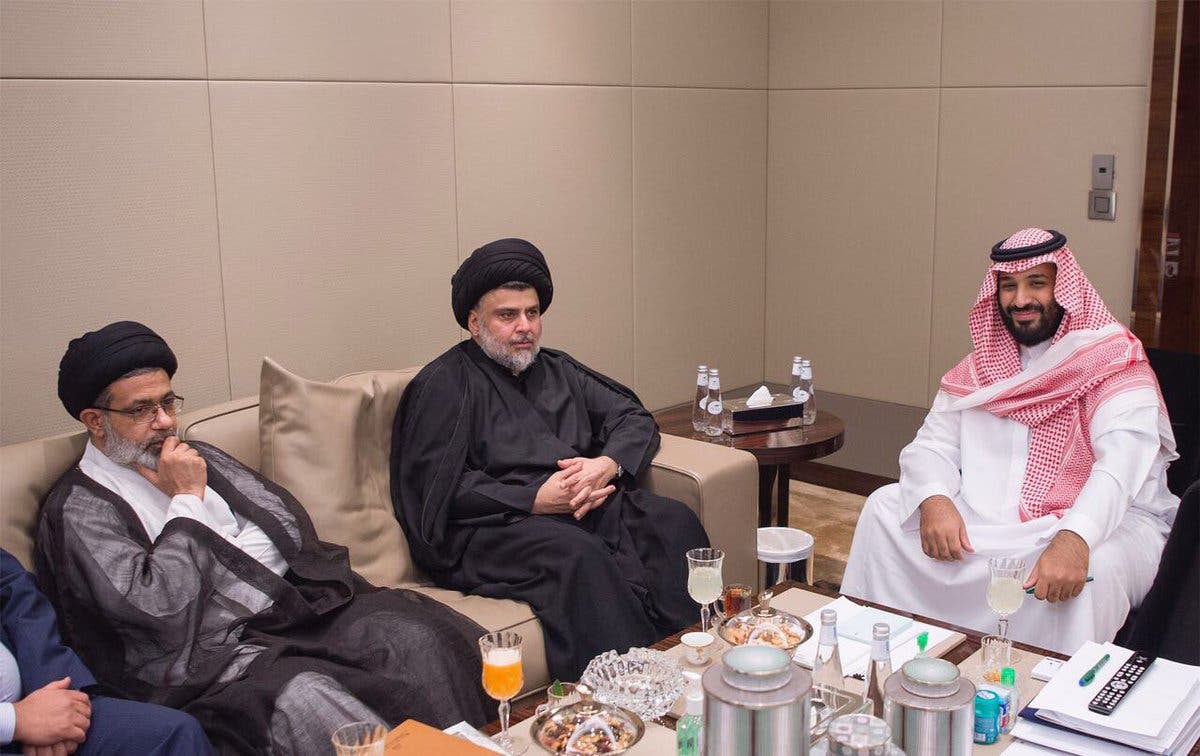
    Iraqi officials have embarked on a new campaign of visiting Saudi Arabia and other Arab Sunni states, signaling long-welcomed changes. The influential Sadrist leader Muqtada was seen in the final days of July meeting with Saudi Crown Prince Mohamed bin Salman.
    Only days later Sadr paid a visit to the United Arab Emirates, another critic of Iran’s policies, where he was welcomed as an Iraqi leader by a slate of leading politicians and clerics.
    Sadr’s visit rendered a variety of measures by Riyadh, including launching a Saudi Consulate in Sadr’s hometown of Najaf, one of the two holiest Shiite cities in Iraq. Grand Ayatollah Ali al-Sistani, known as Iraq’s most senior Shiite cleric, his distance from Tehran’s viewpoints and calling for Iraq to practice openness in establishing relations, did not block such a proposition.
    Muqtada al Sadr with Saudi Crown Prince Mohamed bin Salman in Riyadh. (Al Arabiya)
    Iran, however, resorted to strong remarks against Sadr for his visits to Saudi Arabia and the UAE. The visit was even described by a local wire as an act of betrayal to the Houthis in Yemen.
    Iran’s support for the Shiite proxy militias, through arms, logistics and finances, parallel to advisors dispatched by the Revolutionary Guards (IRGC) and Lebanese Hezbollah, have resulted in the humanitarian catastrophe Yemen finds itself today.
    Sadr is also planning a visit to Egypt, adding to the list of senior Iraqi officials, including Prime Minister Haider al-Abadi and the ministers of foreign affairs, interior, oil and transportation who are set to visit Saudi Arabia. Despite investing in Iraq for the past 14 years, Iran has been deprived of visits of such high stature.

    No future

    Iran’s proxies, while taking the credit for much of the fight against ISIS on the ground, have been accused of law violations and refusing to obey the state of Iraq. Iraqi authorities affiliated to Iran have a very poor report card of being involved in corruption and sacrificing Iraqi national interest in Tehran’s favor.
    This became a major issue during the second term of former Iraqi prime minister Nouri al-Maliki, who some have even described as Iran’s “puppet.” Maliki is known to have close relations with Tehran and Iranian Supreme Leader Ali Khamenei himself.
    To make matters even worse, the recent departure of Majid al-Nasrawi, governor of the oil-rich city of Basra located at the southern tip of Iraq, has recently left for Iran. His departure followed being accused of numerous corruption offences by a government transparency committee. Choosing Iran as a destination has left further impression of him fleeing to a safe haven, and Tehran having a hand in Iraqi corruption.
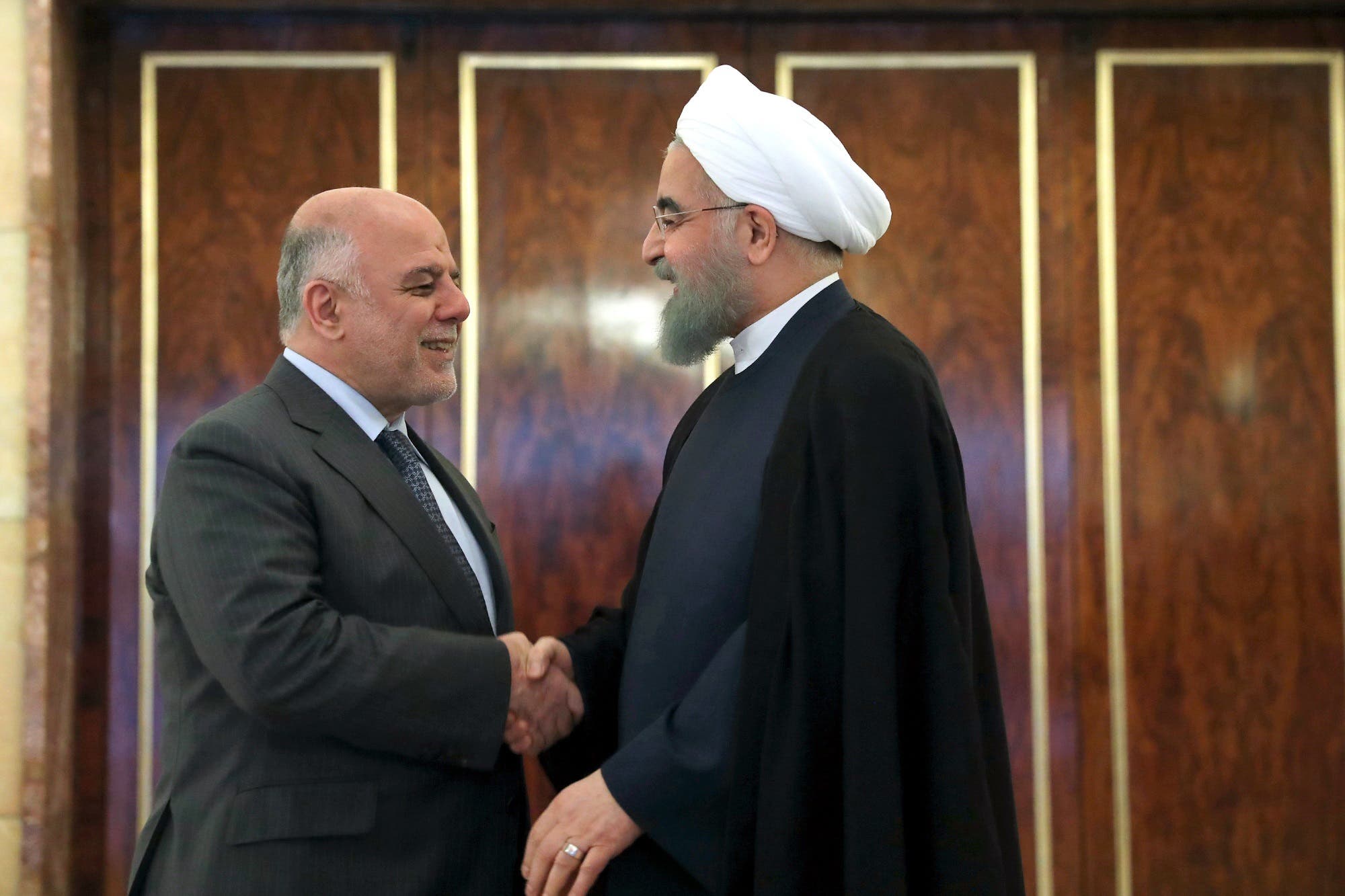
    Iranian President Hassan Rouhani with Iraqi Prime Minister Haidar al-Abadi in Tehran on June 20 2017. (AFP)

    Rebuilding cities

    As Sadr and other Iraqi officials continue their meetings with senior Arab officials of the region, there are also major talks under way between Baghdad and Riyadh to establish a new alliance that would provide Saudi Arabia a leading role in rebuilding war-torn cities across Iraq.
    On August 14th the Cabinet of Saudi Arabia announced a coordination committee to spearhead a variety of health care and humanitarian projects, including building hospitals in Baghdad and Basra, and providing fellowships to Iraqi students in Saudi universities. Opening border crossings and establishing free trade areas between the two countries is also on the agenda.
    Riyadh should lead the Arab world in tipping the balance of power against Tehran’s interests in Iraq. The truth is Iran has not carried out any major economic project in Iraq from 2003 onward, due to the fact that the mullahs do not seek the prosperity of their western neighbor.
    Saudi Arabia and the Arab world should provide the support Iraq needs after suffering from Iran’s menacing influence that has brought nothing but death and destruction. Evicting Iran from Iraq must come parallel to efforts of ending its presence in Lebanon, Syria and Yemen.
    The main obstacle before the Arab world in establishing a coalition against Iran’s clerics is this regime’s meddling and the IRGC presence across the region. With Iran evicted from Iraq, the void should be filled by economic support by the Arab world for Iraq.
    And with the US Congress adopting a bill against the IRGC, Riyadh must take the lead to have all IRGC members, proxies and Iran-related elements expelled from the region. Only such a policy will allow the Middle East to one day experience tranquility and peaceful coexistence.
    Last Update: Monday, 21 August 2017 KSA 10:17 - GMT 07:17

    Senior US Senators Meet Iran Opposition Leader In Albania


    Dr. Majid Rafizadeh, ContributorPresident of the International American Council and board member of the US-Middle East Chamber of Business and Commerce and Harvard IR.
    08/12/2017 05:11 pm ET Updated Aug 16, 2017

    NCRI
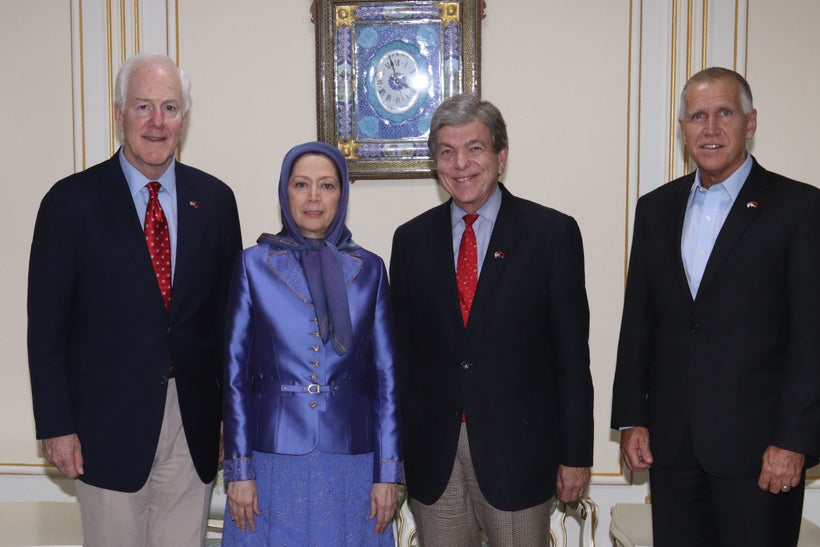
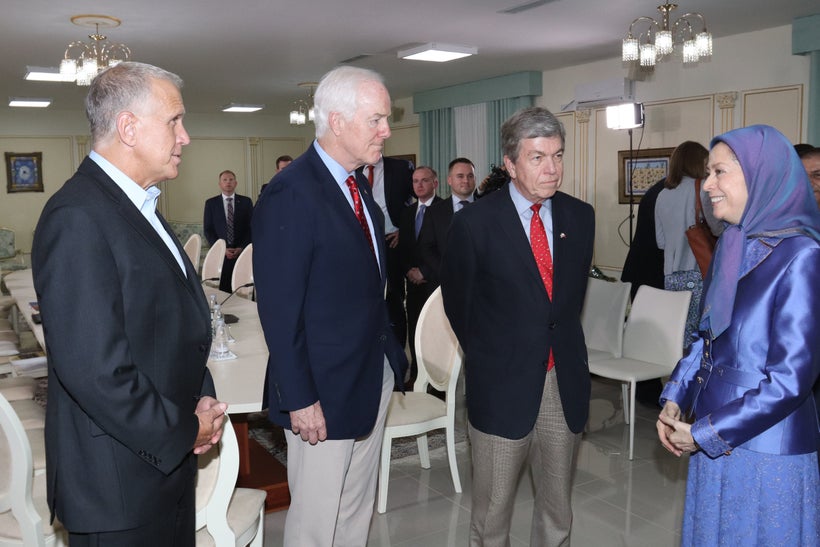
    Tirana, Albania, August 12, 2017 - Mrs. Maryam Rajavi (left), the President-elect of the National Council of Resistance of Iran meeting a senior delegation from the United States Senate. The two sides discussed the situation of members of the Mujahedin-e Khalq in Albania and the recent developments in Iran and the Middle East.
    While August seems usually a passive time of the year in politics, it has been quite the opposite for Iran and the wide variety of developments around this controversial international dossier.
    A senior delegation of United States Senators travelled to Tirana, the capital of Albania, today, August 12, 2017, to meet the Iranian opposition leader Maryam Rajavi, who heads the National Council of Resistance of Iran.
    The delegation, Senators Roy Blunt, Vice President of the Republican Conference, and member of the Appropriation, Select Intelligence, Rules and Administration, and Commerce, Science, and Transportation committees; John Cornyn, the Majority Whip, and a member of the Judiciary, Select Intelligence, and Finance committees; and Thom Tillis, a member of the Armed Services, Judiciary, Banking, Housing and Urban Affairs and Veterans’ Affairs committees, also visited members of the People’s Mojahedin Organization of Iran (PMOI/MEK) in the Albanian capital.
    NCRI
    Tirana, Albania, August 12, 2017 - Mrs. Maryam Rajavi (center), the President-elect of the National Council of Resistance of Iran meeting a senior delegation from the United States Senate. From right: Senators Thom Tillis (R-NC), Roy Blunt (R-MO), and John Cornyn (R-TX).
    The NCRI is a political coalition calling for regime change in Iran and considered the main threat to Tehran’s mullahs. The MEK is the main member of this coalition of a variety of Iranian dissident groups and individuals.
    “Led by Senator Blunt, the delegation congratulated the safe and secure relocation of all Camp Liberty residents outside of Iraq and wished them success in their struggle for democracy and human rights in Iran,” according to an NCRI statement.
    Rajavi expressed her gratitude for the tireless efforts of the U.S. Senate, particularly Senator Blunt, regarding the protection of thousands of MEK members in Iraq, and their safe relocation to Albania.
    Senator Blunt was among several American dignitaries, including senior former officials, who at a July 2014 Senate briefing strongly condemned Iran’s highly destructive role in Iraq. While describing Tehran as part of the problem plaguing Baghdad and the entire country, Senator Blunt joined the initiative in demanding the urgent transfer of PMOI/MEK members stationed in a former US military base known as Camp Liberty near the Iraqi capital.
    Senator Blunt and his colleagues John McCain (R-AZ) and Jeanne Shaheen (D-NH), and former Senator Carl Levin had urged former Secretary of State John Kerry to “press for the protection of Camp Liberty and to expedite the resettlement of the Camp Residents to countries outside Iraq, including the United States.”
    NCRI
    Tirana, Albania, August 12, 2017 - Mrs. Maryam Rajavi (center), the President-elect of the National Council of Resistance of Iran meeting a senior delegation from the United States Senate. From right: Senators Roy Blunt (R-MO), John Cornyn (R-TX), and Thom Tillis (R-NC).
    Earlier in April, Senator McCain, a long supporter of the Iranian opposition and a staunch critic of Tehran’s policies, also visited the MEK in Albania and met with Rajavi. MEK members were able to depart Iraq after a long 4½ year ordeal in Camp Liberty following a forced transfer from their 26-year home in Camp Ashraf, northeast of Baghdad. From 2009 following the transfer of their security from the US military to the Iraqi government, the MEK came under eight major ground and missile/rocket attacks staged by Iran-backed proxies against Ashraf and Liberty. This was parallel to a seven-year logistical and medical siege closing them off from the outside world. After losing over 160 of their colleagues to the attacks and blockade, MEK members were finally able to transfer out of Iraq to a variety of European countries, mainly Albania.
    The Morning Email
    Wake up to the day's most important news.
    Saturday’s high-profile visit by the senior U.S. Senators comes at a time when Washington has slapped major new sanctions against Iran for its ballistic missile drive, support for terrorism and human rights violations. Iran’s Revolutionary Guards is now subject to sanctions under Executive Order 13224, and Specially Designated Global Terrorists. Considering the Guards control over 40% of Iran’s economy, these new sanctions come as a heavy blow to Tehran’s future ambitions. Analysts believe this visit sends a strong signal to Tehran over how the NCRI is gaining momentum through a growing consensus in Congress over the necessity of adopting a policy of regime change vis-à-vis Iran. This time last year Iran’s ruling clerics appeared determined on weakening or dismantling the PMOI/MEK. Only a year later, the tides have turned and it is the Iranian opposition that is now on the offensive. More such developments threatening the very pillars of Iran’s rule are most likely set to come in the near future.
    ——————————————————————————————————————
    You can order Dr. Rafizadeh’s books on Here. You can sign up for Dr. Rafizadeh’s newsletter for the latest news and analyses on Here. You can contact him at Dr.rafizadeh@post.harvard.edu or follow him at @Dr_Rafizadeh.
    Harvard-educated, Dr. Majid Rafizadeh is a world-renowned businessman, a leading Iranian-American political scientist, president of the International American Council on the Middle East, and best-selling author. He serves on the advisory board of Harvard International Review.
    Dr. Rafizadeh is frequently invited to brief governmental and non-governmental organizations as well as speak, as a featured speaker, at security, business, diplomatic, and social events. He has been recipient of several fellowships and scholarships including from Oxford University, Annenberg, University of California Santa Barbara, Fulbright program, to name few He is regularly quoted and invited to speak on national and international outlets including CNN, BBC World TV and Radio, ABC, Aljazeera English, Fox News, CTV, RT, CCTV America, Skynews, CTV, and France 24 International, to name a few. . He analyses have appeared on academic and non-academic publications including New York Times International, Los Angeles Times, CNN, Fareed zakaria GPS, The Atlantic, Foreign Policy, The Nation, The National. Aljazeera, The Daily Beast, The Nation, Jerusalem Post, The Economic Times, USA Today Yale Journal of International Affairs, Georgetown Journal of International Affairs, and Harvard International Review. He is a board member of several significant and influential international and governmental institutions, and he is native speaker of couple of languages including Persian, English, and Arabic. He also speaks Dari, and can converse in French, Hebrew. More at Harvard. And You can learn more about Dr. Rafizadeh on HERE.

    US Intelligence Predicts Attack From IranTerrorism 28 September 2018 Iran Focus London, 28 Sep - US intelligence suggests that Iranian-backe...