center> Important News Iran stars: #FreeIran #MaryamRajavi #Iran#IranOutOfSyriaIranian Opposition
div style="margin: 15px 0px 0px; display: inline-block; text-align: center; width: 200px;">
Showing posts with label #FreeIran #MaryamRajavi #Iran#IranOutOfSyriaIranian Opposition. Show all posts

Shahla Shahdoost (Fardoost)

Champion of the Iranian Women's National Table Tennis Team

Birth Place: Shiraz
Employment: Ministry of Education
Age: 26
Place of martyrdom: Tehran
Date of martyrdom: 1981
Shahla was a law student at Tehran University and a prominent member of Iranian women’s national table tennis team. She played for a table tennis team in Isfahan and for IRANA Club in Tehran
Shahla was executed in 1981 by a firing squad, because of her belief in people’s freedom and her commitment to the values of the People’s Mojahedin of Iran (PMOI). To break her, torturers tortured her infant in front of her eyes, but she remained steadfast and broke the morale of the executioners with her strength.
Although there are only a few pictures left of this Iranian heroine and sportswoman, Shahla and other martyrs will be remembered by the Iranian people on the day of their freedom.
“The little bird, peach colored,
With a band on the leg,
Flown towards the sun, with its little fragile wings
If you look at it once, it will smile at you
Look at it again and again
And you will start singing"
Yannis Ristos

Gity Naziri

My sister Gity was 24 when she was executed in Iran

The second and third sequel in the Al Arabiya TV program “Hellish Era” was devoted to an interview with Mr. Behzad Naziri, member of NCRI Foreign Affairs Committee. He talks about the martyrdom of his sister itei and his escape from regime’s prison and the arrest of his father.
Al Arabiya: Behzad has kept a few pictures of him and his sister Giti who was executed 40 days before the arrest of Behzad at age 24. Despite the passage of 30 years and his escape from Iran, the hardship in the prison and the sadness in his eyes looking at his sister are still with him. The story of revolution in Iran, before all else, is the story of Behzad and Guity.
Behzad Naziri: Khomeini began taking away the freedoms that were gained in the revolution. For example, women were very active in the Iranian revolution. We two were supporters of the People's Mojahedin Organization of Iran (PMOI/MEK) at the time.
When the Iran-Iraq war began, my sister was sent as a reporter to the scenes and even to the war front. She prepared video clips and even held photo exhibitions in Tehran of the condition of the people who were hurt by the war. She was culturally very active and loved music. She was a poet. In February 1982, she was taken to the renowned Evin Prison. I was still a reporter at the time and when my sister was in prison I accompanied French reporters in various activities. Five weeks after the arrest of my sister, I too was arrested. I was arrested on 25 June 1982. My sister was executed in May 1982.
Forty days after the execution of my sister, when my mother was psychologically disturbed due to the execution of her daughter who was only 24, an arrest warrant was issued for me and I was arrested by the revolutionary guards and subsequently transferred to Evin Prison. Just five weeks earlier, I had been to this prison but as a reporter along with a team from a TV station.
I knew at that time that my sister, along with thousands of other prisoners were behind closed the doors and we could not see them. I saw one of the tortures that I had read about in the books.
There was this prisoner by the name of Shams-ed-din Moqadasi. I could not see him as I was blindfolded; I just asked his name. He said that he had been forced to drink a lot of water such that his stomach had bulged out. Then the revolutionary guards stepped on his stomach with their boots so that the water would come out while he was close to suffocation.
I escaped Khomeini’s prison after three years. They were relocating me for a medical treatment where they had to temporarily bring me out of the prison and I escaped. The Iranian regime arrested my father as a hostage. I quickly left Iran with the assistance of the resistance network and the PMOI. I went to Karachi in Pakistan via the Sistan and Baluchistan border.
Al Arabiya: Behzad Naziri was arrested in Tehran in 1982 when he was working for the Agence France Presse. He tries his best to tell the story of others and not his. He feels that they are the ones that can tell the story and thi reopens his wounds at every moment.
Behzad Naziri: It was in 1982 that the regime decided to showcase some prisoners for the reporters. At the time in France there were many stories of atrocities, massacres, executions and tortures in Iran’s prisons. The National Council of Resistance was established in Paris and Mr. Rajavi was in France. PMOI was very active in disclosing the atrocities of Khomeini.


Regime wanted to conduct a show for the reporters and portray as if nothing is happening inside Evin Prison; that everything is normal. So as a group of reporters from the French TV channel TF1 (TFone ) and Agence France Presse (AFP) we went to Evin Prison in February 1982. They showed us to halls in Evin Prison where we conducted interviews.


Someone by the name of Lajevardi, who later became known as the “butcher of Evin” and one of Khomeini’s most brutal and bloodthirsty elements was playing the role of prosecutor at that time. We interviewed him and he said: “Here, everything is normal. Prisoners come here for a period and receive training.” He showed us a group of young men whom he said were prisoners.
On page 953 of this book [of 20,000 Iranian martyrs] there is a picture of my sister in the Iran-Iraq war front. She was a reporter and was sent there with a group of people from Iranian National TV to prepare reports. Here is another picture of her, Guity Naziri at age 24. As you see, it is just one picture among many. Here there are pictures of just the employees of various departments and government organizations or NGOs. In this book I can see the pictures of many who were my friends who were with me in prison.
This is of course just 20,000 of the 120,000 that were executed by this regime during those years. This is my friend Mahmoud Bani Naj’jarian. Many of them were buried in unknown graves.
Here is Khomeini’s fatwa that says the PMOI, all its members and supporters, are Mohareb (enemy of God) and condemned to death. With this fatwa 30,000 were executed.
Of the 120,000 that were executed in those years, the names and particulars of 20,000 of them were gathered by PMOI’s social network. They are from various strata of the society. I will show this to you, including a picture of my sister, as well as many of my cellmates. One of them was a lawyer, another a student, another a former military man, one was a track and field champion, another was a simple laborer, one was a merchant from bazaar. They were all my cellmates.

I still remember all their names. These are glimpses of the crimes of those years and I am still carrying the scars of that on my body and in my heart. It is still new. My scars will heal only when the perpetrators of these crimes face justice.

Many of my cellmates never came out of the prison and were executed in the 1988 massacre when Khomeini slaughtered 30,000 PMOI members. Many were my friends, many of my friends.

Forozan Abdipour

member of Iran national volleyball team

to all volleyball fans: In memory of Forozan Abdipour, member of national volleyball  team who was executed in 1988 by the Iranian regime

Ms. Abdi was born in Tehran in 1957. She was the captain of the National Volleyball team and a sympathizer of the PMOI. According to her cellmate, Ms. Abdi was very popular among other inmates.
Her cellmates remember her for her open-mindedness and tolerant attitude towards other political prisoners. In one instance, her cellmate recalls, when a repenting prisoner who was in charge of the cell ordered another prisoner to separate her dishes from the others (because prison authorities treated prisoners who did not believe in God as “unclean”), Ms. Abdi had intervened and stressed that “no one considers the prisoner as ‘unclean’ and whoever does, should separate her own dishes from others”. Ms. Abdi had also kept her athletic spirits during her years of imprisonment and organized volleyball games during the short period when female prisoners had access to a volleyball court at Qezelhesar prison.

Arrest and detention
She was arrested in 1981.
One of her cellmates saying: "I saw her in section 8 of Qezelhesar in 1982. It was a section for special punishment and sometimes there were 25 to 30 people in a cell [that was meant to fit 3]... They placed Foruzan and some others in a restroom in early 1983. The place was so dirty that all of them contracted skin diseases. Then, they were transferred to solitary confinement at both Gohardasht and Qezelhesar prisons where they stayed until early 1986."

Ms. Abdi was protesting against the inhuman rules and behaviour of prison guards. As a result, for almost a year and half (fall 1983 - winter 1984), she was held in solitary confinement and was deprived from recreation time outside, from having contacts with others, reading newspapers, and having regular visits from her family.

Sometime in 1986, Ms. Abdi was transferred from Gohardasht to Evin prison where she was detained until her execution. During this period, she also spent most of her imprisonment in the closed section of the ward that prison authorities used for punishing prisoners. Those held in this section were held in closed cells and were allowed to leave their cells 3 times a day (for 30 minutes), during which time they could use the bathroom, wash their dishes and their clothes.

Forozan Abdipour was executed along with 30 000 other prisoners, mostly PMOI, when the Iranian regime carried out the massacre of political prisoners in the summer of 1988.

Today, women are fighting to enter volleyball stadiums to watch games. Forozan Abdipour, member of national volleyball team was executed in 1988 by the Iranian regime for wanting all women to live in freedom and democracy.

Is Regime Change Truly The Correct Iran Policy?

 Opinions expressed by Forbes Contributors are their own.
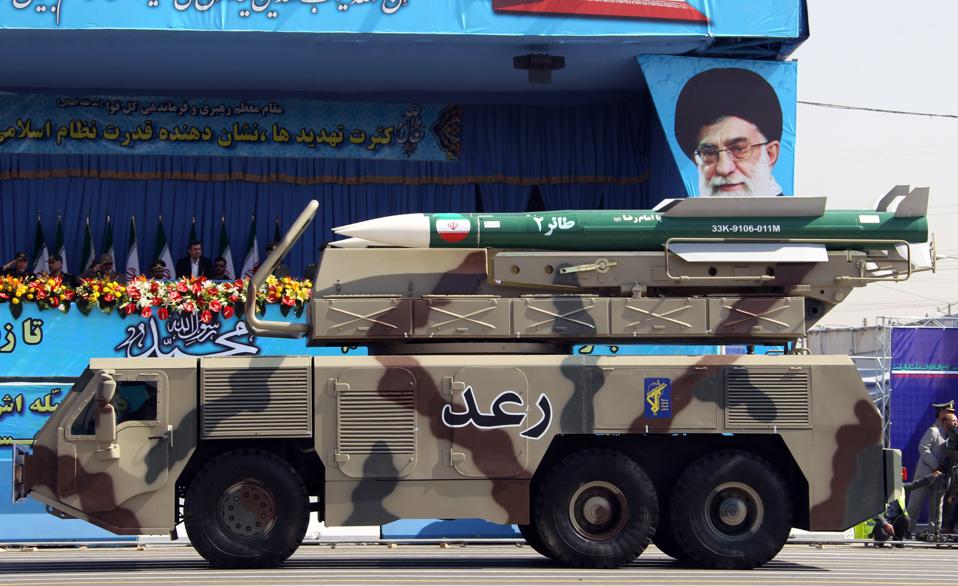
(FILES) A picture dated September 21, 2012, shows a Raad air defense system carrying Taer missiles being displayed by Iran's Revolutionary Guard, during an annual military parade which marks Iran's eight-year war with Iraq, in the capital Tehran. Iranian forces have carried out what they called cyber warfare tactics for the first time as the Islamic republic's naval units staged manoeuvres in the key Strait of Hormuz, media reports said on December 31, 2012. AFP PHOTO/ATTA KENARE (Photo credit should read ATTA KENARE/AFP/Getty Images)
Following the recertification of Iran’s compliance with a nuclear deal aimed at curbing its controversial nuclear program, there is quite a stir over the Trump administration possibly adopting a regime change policy in the face of Tehran’s belligerence.
There are those who favor such a trajectory, while Iran lobbyists and apologists have promptly argued otherwise, saying war should not be an option and citing ongoing campaigns in countries across the region to back their opinions.
Secretary of State Rex Tillerson’s strong position of supporting regime change in a hearing of the House Foreign Affairs Committee sent shockwaves in Tehran and beyond.
“Our policy towards Iran is to push back on (its regional) hegemony, contain their ability to develop, obviously, nuclear weapons and to work towards support of those elements inside of Iran that would lead to a peaceful transition of that government,” he said.
Secretary of Defense James Mattis, known for his “Iran, Iran, Iran” description of the source of Middle East dilemmas, followed suit.
“Until the Iranian people can get rid of this theocracy, these guys who think they can tell the people even which candidates they get a choice of. It’s going to be very, very difficult,” Mattis said in a special interview.
It is broadly assumed that the diplomatic pressure and sanctions initiative embarked upon by the White House and Congress are aimed at serving a regime change objective in Iran. The next necessary step would be to make this policy crystal clear to Tehran and all relevant parties.

I am a political/rights activist focusing on Iran & the Middle East. I also write in Al Arabiya English, and contributed to The Hill, Algemeiner and Raddington Report. I tweet @HeshmatAlavi

In solidarity with Iran’s young generation on International Youth Day


In solidarity with Iran’s young generation on International Youth Day
August 12 marks International Youth Day to recognize and draw attention to the issue of “Youth Building Peace”. It celebrates young people’s contributions to conflict prevention and transformation as well as inclusion, social justice, and sustainable peace.
In Iran, however, the atmosphere of growth and advancement for the younger generations have been eliminated by the Iranian regime’s suppression of their freedom of speech and the press, closure of universities, sending young people to war, and plundering the public’s wealth. Thus Iranian youths have found no opportunity for contributing to global peace.
A population of 23 million people between 15 to 29 years of age has made Iran one of the world’s largest young nation.
This young nation, however, faces soaring unemployment as one of its main problems. Almost 15 million people have no jobs, at least 4.5 million of whom are university graduates.[1] In 1986, almost 70% of university graduates could find jobs shortly after leaving school. By 2011, that rate dropped to less than 50%.[2]
That is, more than 50% of Iran’s educated are unemployed while the rest are employed in menial jobs such as construction workers, street peddlers, repairmen, etc. which are not compatible with their professional training and studies.
Under such hopeless circumstances, the majority of Iran’s at least 14 million[3] drug users are young men and women. The average age of addiction in Iran has dropped to 20, according to reports published by state media. [4]
The number of people suffering from drug addiction has more than doubled since 2011, according to a survey by a drug control group.[5]
However, the figures published by the state should be considered as minimum with the actual figures being considerably higher. Disappointingly, the Iranian regime has no short or long-term plans to contain the unbridled spread of addiction especially among the young populace.
Experts argue that easy access to cheap narcotic drugs has contributed to the horrific number of drug addicts in Iran. It is common knowledge that narcotics can be purchased much faster than a loaf of bread.
Unfortunately, the regime in Iran and specifically its Islamic Revolutionary Guards Corps (IRGC) are actively involved in drug trade and distribution as they find this as one of the most effective ways to quell and paralyze the country’s disgruntled and rebellious youth, posing an existential threat.
In addition, the human rights situation in Iran has been constantly deteriorating over the past 39 years. The clerical regime has a long history of crackdown on youths for demanding their basic rights. Atena Daemi, Arash Sadeghi, Majid Assadi, Golrokh Iraei, Ramin Hosseinpanahi are amongst the countless people who have been suffering long years in jail for daring to stand up for their own and their people’s rights.
Iran holds the highest rate of per capita executions in the world. Despite increasing international censure, executions are carried out relentlessly on a daily basis hitting an unprecedented record by hanging 101 prisoners in July 2017, alone.
The majority of those executed were under 30 years old including two young men, 24 and 27, who were hanged in public. In a controversial act of execution, a man who was arrested as a minor was hanged in Adelabad Prison of Shiraz, southern Iran. Execution of Alireza Tajiki was carried out despite wave of international criticism at Iran’s human rights violations.
In a recent study, a third of all 16 to 25-year-olds said they would leave the country, if given the opportunity. Iran ranks world’s first in brain drain with the flight of 150,000 elites per year.
Those who cannot escape the inferno created by the mullahs in Iran, however, are awaiting any opportunity to settle their score with the mullahs.
In a recent case, Asghar Nahvipour, a young Iranian athlete, beat up a mullah who was disturbing a young woman in a metro station in south Tehran. Eyewitnesses say he was fired at point blank range by the police while he was crying out, “We don’t want these mullahs. We don’t want this Islam. What kind of a country is this? What kind of Islam is this?”
The news of this arbitrary murder outraged the nation and aroused great sympathy.
Tributes to the victim poured in on social media, with many youths writing, “The heroes do not die”, “Fly high hero, you will be never forgotten” or “we will continue your path.”
These mottos bespeak of the determination of Iran’s courageous youth to realize a humane future for themselves and the whole nation. The International Youth Day is an appropriate opportunity to call on the international community to support their demands and help them reach the peaceful society they deserve.
As we celebrate the young people building peace across the world, lest forget the young men and women who dream of a world with equal human rights.
foot notes:
[1] Unemployment rate for graduates. (Hamshahri state-run Website – Jun. 17, 2017)
[2]  Employment and unemployment statistics for students and graduates. (Mehr state-run News Agency – Jun. 16, 2017)
[3] Statistics behind the scenes of addiction in the country. (Asre-Iran state-run Website – Jun. 23, 2015)
[4] The average age of drug addiction in Iran. (Mehr state-run News Agency – Jun. 1, 2016)
[5] 100% increase in the number of addicts. (Armane-Emrouz state-run Website – Jun. 25, 2017)

New sanctions on Iran, now it's time for a new US policy too

Alireza Jafarzadeh
On the second anniversary of the Joint Comprehensive Plan of Action (JCPOA), or the Iran nuclear deal, some argue that the agreement succeeded in slowing Iran’s progress toward a nuclear weapon. However, the restrictions on the Iranian nuclear program are only limited, as is the international inspectors’ access to the country’s illicit facilities.
In addition, in areas unrelated to the nuclear agreement, the Iranian regime’s behavior has only gotten worse over the past two years. The Islamic Revolutionary Guard Corps (IRGC), has escalated its nefarious activities in Syria, Iraq, and Yemen, has deliberately sought out close encounters with American warships, and has boasted of new Iranian military equipment.
Trending Articles

Cops bust subway thief with Find My iPhone app

New York City police officers now are using the latest technology from…
 
The White House’s efforts to enforce a harder line on Iran policy is well justified and the president’s signing into law of H.R. 3364, which included a title, “Countering Iran’s Destabilizing Activities Act of 2017” is a step in the right direction.
In June, the National Council of Resistance of Iran revealed details of the escalation of the Iranian missile program, proving the nuclear threat to be real. The opposition coalition identified more than 40 sites for missile development, manufacturing, and testing, all of which were under the control of the IRGC. What’s more, at least one of those sites was known to be collaborating with the Organization of Defensive Innovation and Research, known by its Farsi acronym SPND, the institution tasked with weaponization activities related to the Iranian nuclear weapons program. SPND activities have continued since the JDPOA.
The Iranian regime must be more isolated and financially handicapped by the United States. It must also be subject to pressure not just over its nuclear program but also over a range of current and past crimes.
Such revelations clarified what should already be common knowledge: Iran’s nuclear weapons activities have continued. Even worse, myopic focus on the nuclear issues has distracted attention from the Iranian regime’s terrorism sponsorship, regional intervention, and human rights abuses.
If the IRGC continues to acquire more wealth through its large-scale control of the de-sanctioned Iranian economy, combined with continued lack of access to the nuclear sites of SPND, Iran will undoubtedly deliver a nuclear weapon.
To its credit, the US. has taken steps toward addressing the underlying problem of the IRGC’s expanding control over Iranian affairs. Soon after taking office, Mr. Trump urged the administration to review designating the IRGC as a terrorist organization. With the new Iran sanctions bill now signed into law, the administration should expand all anti-terror sanctions to the whole of the IRGC, including its affiliate entities and associated financial and economic arms.
This is a meaningful start to a new Iran policy that is comprehensive in its aims and in its enforcement. Toward that end, the US should work with the UN and EU to evict the IRCG from the combat zones in Syria, Iraq, and Yemen. This will help protect the West and its allies, as well as empower the Iranian people, who are seeking regime change and are more than capable of bringing it about on their own.
Without serious sacrifice, Western powers must do their part. The Iranian regime must be more isolated and financially handicapped by the United States. It must also be subject to pressure not just over its nuclear program but also over a range of current and past crimes, including illicit missile testing, escalating regional and sectarian conflicts in the Middle East, and the 1988 massacre of political prisoners. The United States should subject all major human rights violators of the Iranian regime, including dozens involved in the horrific 1988 massacre of 30,000 political prisoners. Many of the perpetrators of this crime currently hold key positions in the Iranian regime.
These pressures will make a profound difference in the future of Iran, if coupled with reaching out to the people of Iran and their organized opposition. They will succeed in diminishing the power and influence of the IRGC; bolster the Iranian people and the prospect of the emergence of a truly democratic Iranian government. 
Alireza Jafarzadeh, the deputy director of the Washington office of the National Council of Resistance of Iran, is credited with exposing Iranian nuclear sites in Natanz and Arak in 2002, triggering International Atomic Energy Agency inspections. He is the author of "The Iran Threat" (Palgrave MacMillan: 2008). His email is Jafarzadeh@ncrius.org, and is on twitter @A_Jafarzadeh.

NEW SANCTIONS ON IRAN, NOW IT'S TIME FOR A NEW US POLICY TOO

By Alireza Jafarzadeh
On the second anniversary of the Joint Comprehensive Plan of Action (JCPOA), or the Iran nuclear deal, some argue that the agreement succeeded in slowing Iran’s progress toward a nuclear weapon. However, the restrictions on the Iranian nuclear program are only limited, as is the international inspectors’ access to the country’s illicit facilities.In addition, in areas unrelated to the nuclear agreement,
the Iranian regime’s behavior has only gotten worse over the past two years. The Islamic Revolutionary Guard Corps (IRGC), has escalated its nefarious activities in Syria, Iraq, and Yemen, has deliberately sought out close encounters with American warships, and has boasted of new Iranian military equipment.
Three ways to find the real deals on Amazon
Here’s some trivia for you: Amazon, the largest and most versatile…
 The White House’s efforts to enforce a harder line on Iran policy is well justified and the president’s signing into law of H.R. 3364, which included a title, “Countering Iran’s Destabilizing Activities Act of 2017” is a step in the right direction.
In June, the National Council of Resistance of Iran revealed details of the escalation of the Iranian missile program, proving the nuclear threat to be real. The opposition coalition identified more than 40 sites for missile development, manufacturing, and testing, all of which were under the control of the IRGC. What’s more, at least one of those sites was known to be collaborating with the Organization of Defensive Innovation and Research, known by its Farsi acronym SPND, the institution tasked with weaponization activities related to the Iranian nuclear weapons program. SPND activities have continued since the JDPOA.
Such revelations clarified what should already be common knowledge: Iran’s nuclear weapons activities have continued. Even worse, myopic focus on the nuclear issues has distracted attention from the Iranian regime’s terrorism sponsorship, regional intervention, and human rights abuses.
If the IRGC continues to acquire more wealth through its large-scale control of the de-sanctioned Iranian economy, combined with continued lack of access to the nuclear sites of SPND, Iran will undoubtedly deliver a nuclear weapon.
To its credit, the US. has taken steps toward addressing the underlying problem of the IRGC’s expanding control over Iranian affairs. Soon after taking office, Mr. Trump urged the administration to review designating the IRGC as a terrorist organization. With the new Iran sanctions bill now signed into law, the administration should expand all anti-terror sanctions to the whole of the IRGC, including its affiliate entities and associated financial and economic arms.
This is a meaningful start to a new Iran policy that is comprehensive in its aims and in its enforcement. Toward that end, the US should work with the UN and EU to evict the IRCG from the combat zones in Syria, Iraq, and Yemen. This will help protect the West and its allies, as well as empower the Iranian people, who are seeking regime change and are more than capable of bringing it about on their own.
Without serious sacrifice, Western powers must do their part. The Iranian regime must be more isolated and financially handicapped by the United States. It must also be subject to pressure not just over its nuclear program but also over a range of current and past crimes, including illicit missile testing, escalating regional and sectarian conflicts in the Middle East, and the 1988 massacre of political prisoners. The United States should subject all major human rights violators of the Iranian regime, including dozens involved in the horrific 1988 massacre of 30,000 political prisoners. Many of the perpetrators of this crime currently hold key positions in the Iranian regime.
These pressures will make a profound difference in the future of Iran, if coupled with reaching out to the people of Iran and their organized opposition. They will succeed in diminishing the power and influence of the IRGC; bolster the Iranian people and the prospect of the emergence of a truly democratic Iranian government. 
Alireza Jafarzadeh, the deputy director of the Washington office of the National Council of Resistance of Iran, is credited with exposing Iranian nuclear sites in Natanz and Arak in 2002, triggering International Atomic Energy Agency inspections. He is the author of "The Iran Threat" (Palgrave MacMillan: 2008). His email is Jafarzadeh@ncrius.org , and is on twitter @A_Jafarzadeh.
originally published in the   foxnews

Iran: The Lives of the Political Prisoners on Hunger Strike in Danger


The Iranian Resistance expresses grave concern over the health and security of political prisoners on hunger strike in solitary confinement of ward 4 in Gohardasht Prison of Karaj, west of Tehran. All international human rights organizations, especially the United Nations High Commissioner for Human Rights and the Special Rapporteur of Human Rights in Iran, Special Rapporteur on Torture are called upon to take urgent action to save the lives of these political prisoners.
Misters Abolqassem Fouladvand, Hassan Sadeghi, Saeed Masouri, Reza Akbari Monfared, Jafar Eqdami, Amir Qaziyan, Khaled Heradani, Zaniyar and Loqman Moradi who are in solitary confinement. A number of other ward 4 prisoners, including Misters Mohammad Banazadeh Amir Khizi, Pirouz Mansouri, Majid Assadi and Payam Shakiba are amongst the inmates who are also on hunger strike protesting repressive measures against ward 4 political prisoners in Gohardasht Prison. The authorities have banned these political prisoners from any family visits and placed them under pressures to end their hunger strikes.
The protesting political prisoners are amongst the inmates of hall 12 of ward 4 in Gohardasht Prison who were attacked on Sunday, July 30, insulted and beaten by prison guards, and forcefully transferred to hall 10 of this ward (NCRI Statement – August 1). Prison authorities have deprived these political prisoners of minimum hygiene products and decent clothing.
The religious fascism ruling Iran exerts its authority through executions, torture and detentions. Iranian Supreme Leader Ali Khamenei and President Hassan Rouhani, with his “moderate” mask, are two sides of this medieval regime’s coin.
Senior Iranian regime officials must be placed before justice for their continuous and increasing crimes against the Iranian people. Any relation with Tehran must hinge on the mullahs’ improving the disastrous human rights situation and releasing all political prisoners without any preconditions.
Secretariat of the National Council of Resistance of Iran
August 10, 2017

Before Anyone Further Appeases Iran...

 Opinions expressed by Forbes Contributors are their own.
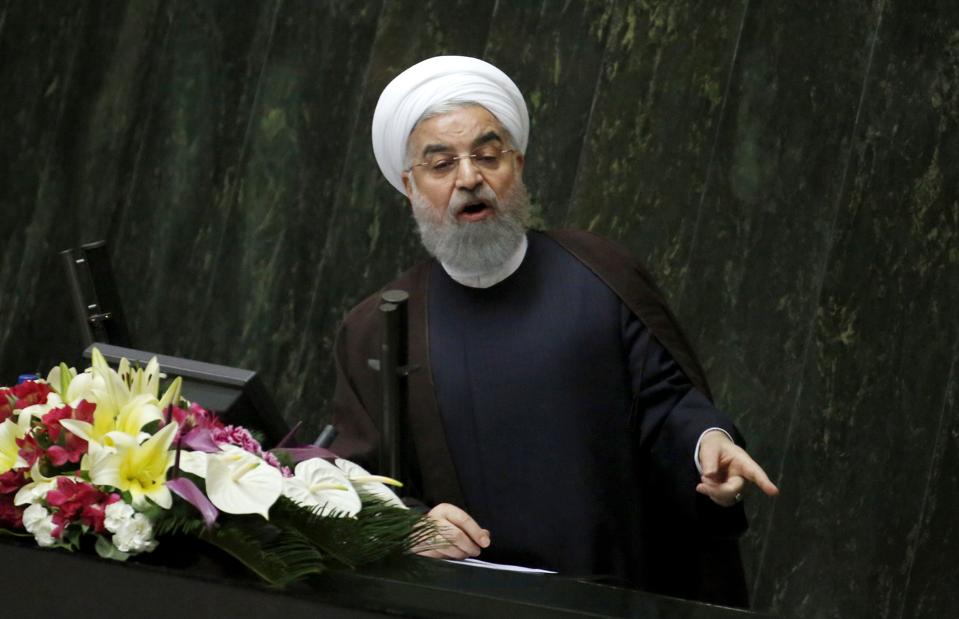
Iranian President Hassan Rouhani addresses the parliament in Tehran on August 15, 2017. Rouhani warned that Iran could abandon its 2015 nuclear deal with world powers within hours if the United States keeps on imposing new sanctions as he outlined plans for his new term. / AFP PHOTO / ATTA KENARE (Photo credit should read ATTA KENARE/AFP/Getty Images)
The pro-Iran deal camp is recently making much noise about how the Trump administration and critics of the pact, known as the Joint Comprehensive Plan of Action (JCPOA), are making rightful complaints of the text failing to address Iran’s destructive belligerence in the Middle East.
These are valid concerns, considering the fact that even if the deal remains intact come October’s decision by President Donald Trump to find Iran in compliance or not, the mullahs are hell-bent to continue wreaking havoc and expanding influence across the region.
The pro-Iran deal camp claim Washington has no evidence to hold Tehran in violation of the JCPOA terms. Not true.
  • Tehran has exceeded its heavy water production cap, necessary for a plutonium nuclear bomb,
  • testing more advanced centrifuges,
  • illicitly procuring highly sensitive nuclear and ballistic missile technology in Germany, according to Berlin’s intelligence services,
  • surpassing its uranium enrichment cap, another key non-compliance factor
The pro-JCPOA camp also argues this deal has prevented Iran from becoming the next North Korea. This is partially true and misleads only the uninformed reader. A deal very similar to the JCPOA, led by the Clinton administration, was signed with North Korea and ended up in dismal failure. This left the world with a rogue state now equipped with at least 20 nuclear bombs, intercontinental ballistic missiles and the technology to miniaturize a nuclear warhead in its payload.
While the JCPOA was intended to keep Iran away from nuclear weapons, why shouldn’t Washington lead the West in demanding Iran curb its further belligerence, such as advances in its ballistic missile drive, increasing executions and atrocious human rights violations, and stirring mayhem in the Middle East?
Iran must be held responsible for "its missile launches, support for terrorism, disregard for human rights, and violations of U.N. Security Council resolutions," U.S. Ambassador to the U.N. Nikki Haley saidTuesday.
Speaking of this flashpoint region, legitimate concerns exist over Iran establishing a “Shiite crescent” stretching from Afghanistan to the Mediterranean. Important to note is the fact that JCPOA flaws, and the Obama administration’s desperate nature to sign a deal as a foreign policy legacy, provided Iran a windfall of billions to stoke its support for the Assad regime in Syria.
“Iran has been helpful in Iraq by fighting the Islamic State,” is how The New York Times describes Tehran’s campaign in its western neighbor, failing to even mention how Iran-backed Shiite militias and death squads have launched massacres, killing sprees and forced displacements targeting Iraq’s Sunnis and other minorities. While Iraq was a melting pot of peoples of different backgrounds living intertwined in peace and for centuries, Iran’s fueling of sectarian wars has created a dangerously wide rift of hatred.

I am a political/rights activist focusing on Iran & the Middle East. I also write in Al Arabiya English, and contributed to The Hill, Algemeiner and Raddington Report. I tweet @HeshmatAlavi

US Intelligence Predicts Attack From IranTerrorism 28 September 2018 Iran Focus London, 28 Sep - US intelligence suggests that Iranian-backe...