center> Important News Iran stars: #MaryamRajavi #Mek #Iran #Mek Opposition
div style="margin: 15px 0px 0px; display: inline-block; text-align: center; width: 200px;">
Showing posts with label #MaryamRajavi #Mek #Iran #Mek Opposition. Show all posts

ANALYSIS: Congress is taking the lead on Iran policy

A visit by a high-profile delegation of American Senators to Albania, home to members of the Iranian opposition, is sending major signals and messages to Tehran about growing consensus in Washington over the necessity to adopt regime change policy in the face of the mullahs’ belligerence.
The Senate delegation consisted of Senators Roy Blunt, Vice President of the Republican Conference, and member of the Appropriation, Select Intelligence, Rules and Administration, and Commerce, Science, and Transportation committees; John Cornyn, the Majority Whip, and a member of the Judiciary, Select Intelligence, and Finance committees; and Thom Tillis, a member of the Armed Services, Judiciary, Banking, Housing and Urban Affairs and Veterans’ Affairs committees.
The delegation met with Iranian opposition Maryam Rajavi, President of the National Council of Resistance of Iran (NCRI) in Tirana, discussing recent developments in the Middle East and Iran’s menacing role.
“Maryam Rajavi thanked the Senators for their decisive position vis-à-vis the Iranian regime, especially the adoption of a new resolution which imposed sanctions on the clerical regime and the Islamic Revolutionary Guards Corps (IRGC) for human rights abuses, the ballistic missile program, and the export of terrorism. She expressed gratitude for the efforts of the U.S. Senate, particularly Senator Blunt, regarding the protection of thousands of MEK members in Camp Liberty, Iraq, and their safe relocation to Albania,” according to a NCRI statement.
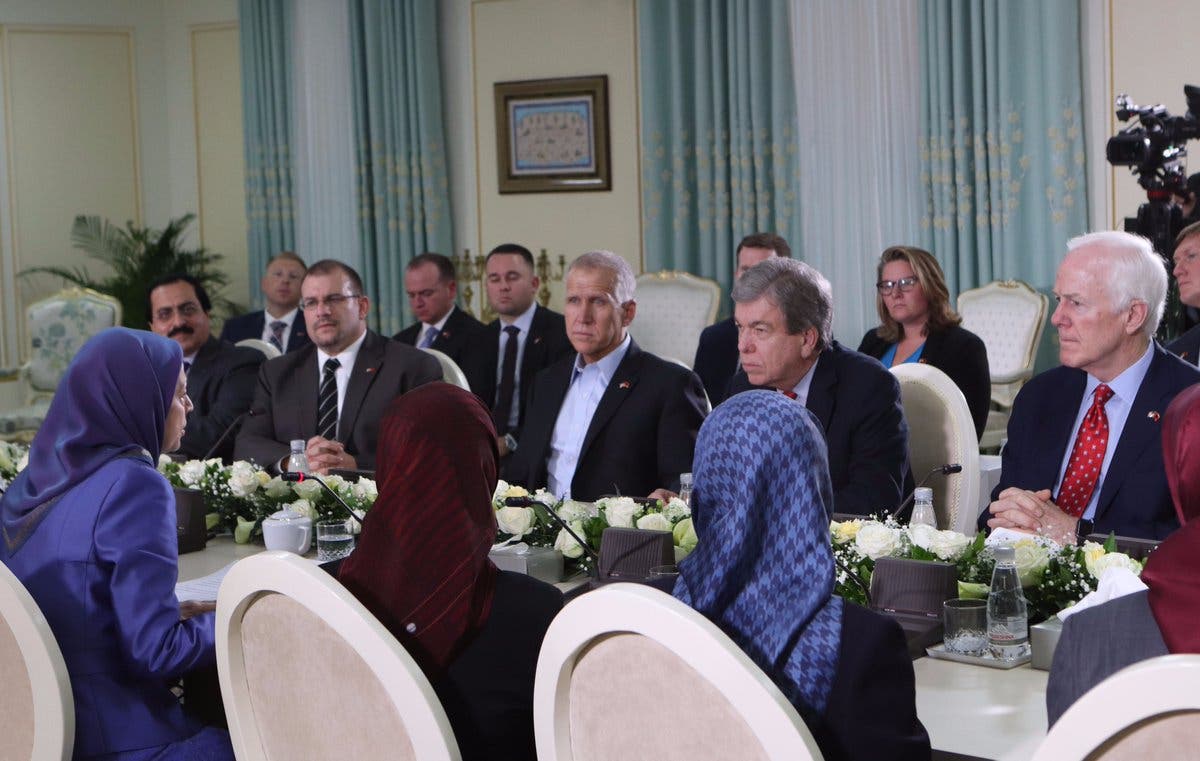
US Senators with Maryam Rajavi in Tirana, Albania. (Supplied)

Destructive meddling

Back in July 2014 several senior American figures, including Senator Blunt, staged a Senate briefing strongly condemning Iran’s destructive meddling in its western neighbor, Iraq. Characterizing the Iranian regime as part of the problem and not the solution, Senator Blunt emphasized on his demand for the PMOI/MEK members’ urgent and speedy transfer from Camp Liberty – a ransacked and deserted former US base near Baghdad International Airport west of the capital – to countries abroad in an effort to save their lives.
Senators John McCain and Jeanne Shaheen, joined by then Senator Carl Levin, former chairman of the Armed Forces Committee, issued a strong letter to former Secretary of State John Kerry seeking “protection of Camp Liberty and to expedite the resettlement of the Camp Residents to countries outside Iraq, including the United States.”
Senator McCain himself had back in April became the most senior US official to visit the PMOI/MEK in Albania. McCain is known to be a very vocal critic of the Iranian regime’s policies and actions, and a staunch supporter of the Iranian opposition in their struggle for regime change to establish freedom and democracy.
During his visit to Tirana McCain met with Iranian opposition leader NCRI President Maryam Rajavi, evaluating issues in relations to Iran’s belligerence across the Middle East and the struggle of the PMOI/MEK’s residency in Albania. His participation in a PMOI/MEK event sent alarm bells across Tehran, terrifying of the mullahs Washington coming in line with the Iranian opposition was receiving after their departure from Iraq.
Comprehending fully the potential threats posed by their opposition, the Iranian regime had long sought to annihilate the PMOI/MEK during their stay in Iraq. These Iranian opposition members were stationed in Ashraf, a city north of Baghdad, which they had built from scratch from 1986 onward. Ashraf residents were, however, forced to transfer to Camp Liberty following three ground attacks by Iraqi government forces and a logistical/medical siege from 2009 onward, all at the best of Tehran.
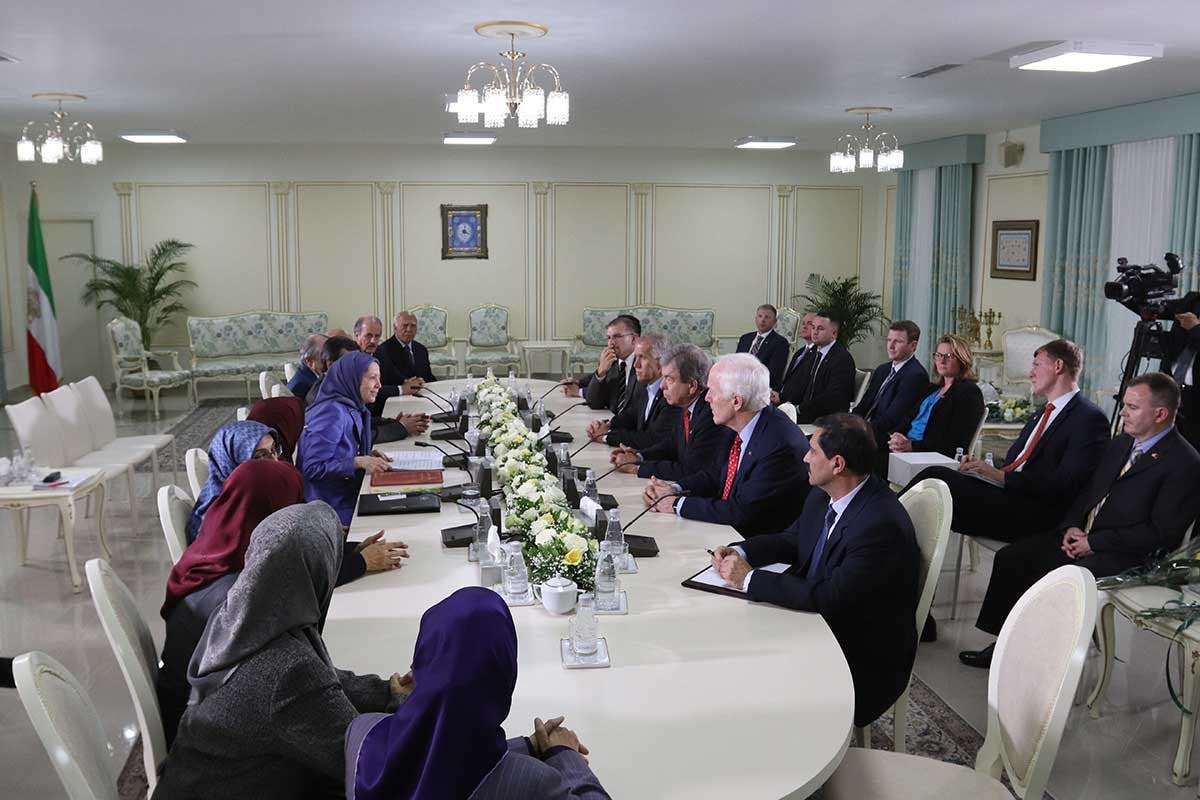
The delegation consisted of Senators Roy Blunt, John Cornyn, and Thom Tillis. (Supplied)

Tehran’s proxies

Tehran’s proxies continued their onslaught by launching five rocket and missile attacks targeting Camp Liberty, parallel to the Iraqi government continuing its blockade. More than 160 Ashraf and Liberty residents lost their lives and over 1,000 others injured. These attacks prompted the international community to support the PMOI/MEK in their transfer from Iraq to safe havens in numerous European countries. Most have currently settled in Albania.
Saturday’s significant meeting comes at a major turning point in US-Iran relations. Congress recently adopted new and comprehensive sanctions and President Donald Trump immediately signed the measures into law.
Tehran is extremely concerned over the NCRI and PMOI/MEK gaining growing recognition, especially considering the fact that the Trump administration is in the midst of weighing its comprehensive Iran policy. More than ever before regime change is becoming the most likely option for Washington’s Iran dogma.
Only a year ago the Iranian regime was placing its entire weight behind measures aimed at having its opposition – then seeking to pull out its last remaining members from Iraq – completely annihilated.
Many consider the progress made by the NCRI and PMOI/MEK as unprecedented and the necessary campaign to turn the tide against Tehran’s regime. After nearly 40 years of rendering havoc and destruction, it is high time the international community acknowledge the Iranian people and their organized opposition in their endeavor to bring about change in Iran with the objective of establishing freedom and democracy in Tehran.
Last Update: Monday, 14 August 2017 KSA 11:19 - GMT 08:19By Heshmat AlaviSpecial to Al Arabiya EnglishMonday, 14 August 2017

A Look at Iran's Hospitals and Quality of Their Services

NCRI - As part of each country’s infrastructures, hospitals and quality of their services indicate in some ways how developed each country and its healthcare services are. In Iran, however, hospitals and the quality of their services are in a horrible state, a fact acknowledged by regime’s own officials as well.
A serious problem in this regard is related to hospital buildings. Many of Iran’s hospital buildings have fallen into disrepair, so much so that in some cases there’s a danger of them collapsing so that it would be quite unsafe to stay inside. The situation is so terrible that even regime officials and media are forced to acknowledge parts of this reality.
“Many hospitals built over the past years lack even the basic structural design requirements. Many of them were not supposed to be hospitals, but are now used for presenting healthcare services. Well, it’s no surprise to see them lacking even the least engineering standards for hospitals”, confesses Amir Saki, Construction Manager in Rouhani’s Healthcare Ministry, in his interview with state TV last month
Also in this regard, a member of regime Parliament’s Social Committee ‘Mohammad Vahdati’ pointed out in his interview with Parliament’s news agency that many of country’s healthcare centers and hospitals have reached the end of their useful life years ago, adding “unfortunately, most hospitals are dilapidated and their renovation is an absolute necessity. Besides, such healthcare centers lack the necessary safety measures.” (Parliament’s news agency, June 28, 2017)
Earlier, regime’s Deputy Healthcare Minister ‘Mohammad Aghajani’ had said “60 percent of our hospitals are in a state of disrepair, which should be regarded as a serious threat.”
The critical conditions of Iran’s dilapidated hospitals are despite the fact that Iran is a natural-disaster-prone country, with more than 90 percent of its population being subject to earthquake and widespread flooding.

Regime’s Health Minsiter ‘Seyed-Hassan Ghazizadeh-Hashemi’ recently acknowledged that the capital’s hospitals are not resistant to earthquake. While confirming the minister’s remarks, Homayoun Hashemi, member of Parliament’s Healthcare Committee, pointed out that the studies show that many public hospitals date back to 1950’s and 60’s, adding “renovation of such hospitals must be put on the agenda as soon as possible. Besides, many of such hospitals need to be completely wrecked and rebuilt.” (Parliament’s news agency, August 14, 2017)
In addition to dilapidated hospitals, the conditions of hospital beds are also not appropriate, so that many of them are out of service.
“We are short of 46 thousand hospital beds”, says Health Ministry’s Construction Manager ‘Amir Saki’, adding “and of the available beds, 50 thousand are out of service, meaning we need somewhat between 90 to 100 thousand hospital beds so we can replace the outdated ones and develop our healthcare services. (Regime’s Khabar TV network, July 14, 2017)
The average age of a hospital bed in developed countries, European ones for instance, is 7-10 years. In Iran however, with age of hospitals being 35 and higher, hospital beds are in such terrible conditions that even regime officials have been forced to acknowledge part of this mess. Currently, Iran is ranked among the lowest in the Middle East in terms of the number of hospital beds, with its situation being catastrophic even compared to such countries as Tajikistan and Kazakhstan.
While Iranian patients have to spend their times of illness in such places, the mullahs’ regime is plundering country’s wealth, pouring them right into the pockets of regime leaders and officials or spending them over regime’s warmongering policies and exporting terrorism and reactionarism to regional countries.

Qassem Suleimani Expresses Anger Over Indifference of Iranians Toward Regime's Rhetoric

NCRI - The commander of the Iranian regime’s Revolutionary Guard's Quds Force, Major General Qassem Suleimani, has acknowledged the Iranian regime’s failure in mobilizing the youths for dispatching them to Syria to fight in support of Assad regime.
Speaking on the occasion of “International Day of Mosques” Suleimani warned that “the cultural invasion today is more complicated” than ever and urged that more attention be made to the Supreme Leader Ali Khamenei’s warnings in this regard.
“Today, the confrontation with the cultural invasion is more complicated and more unstable than yesterday, and the demands of leadership (Ali Khamenei) should be taken into consideration in this regard”, Suleimani said, according to a report by the state-run ISNA news agency published on Sunday, August 20, 2017.
The commander of the terrorist Quds Force expressed his anger over the growing “indifference” to the regime’s rhetoric among the Iranian people and warned about its consequences.
He said: “Who is responsible for the growth of indifference in the country? Have we all been doing our job? We should know that we should not just keep our own front. If this is the case, other fronts will fall. The mosque is a base and has an impact on the whole society. The one who fails to keep his soldiers, his line has fallen.”
Suleimani described the mission of mosques in Iran training of “defender of the shrine” a reference to those being dispatched to fight against the Syrian people.
Facing difficulty to dispatch Iranians to fight in Syria, IRGC’s Quds Force has coerced tens of thousands of Afghan refugees in Iran – many of them minors –into fighting in Syria. They were threatened with deportation if they refused.

ITUC Calls for Immediate Release of Iranian Labor Prisoner


NCRI - International Trade Union Confederation (ITUC) General Secretary Sharan Burrow, has demanded the immediate and unconditional release of Reza Shahabi, a member of the board of directors of Iran’s Syndicate of Workers of Tehran and Suburbs Bus Company (UWTSBC).
Burrow, while referring to what she has described as years of torture and inappropriate treatment of Shahabi behind bars, reiterated, “[Reza] the labor rights activist was on medical furlough but Tehran’s prosecutor-general refused to extend his parole.”
According to the letter, written to Iran regime's President Hassan Rouhani, Reza Shahabi was forced to return to the Rajai Shahr (Gohardasht) prison in Karaj, where he found that the time he spent on medical leave was considered as “absence” and his jail term has been extended for another 968 days.
In a statement published on August 12, UWTSBC condemned Shahabi’s extended prison term.
ITUC Secretary-General also wrote that Mr. Shahabi joined the hunger strike that was already started in Rajaii Shahr prison in protest to the “inhumane condition” of the prison.
Sharan Burrow noted that imprisonment of Reza Shahabi is in contradiction with Iran's international obligations.
“Keeping Reza Shahabi behind bars is against Iran’s international commitments, which prohibit detaining labor activists who are peacefully campaigning for workers’ rights”.
Earlier, the International Transport Workers' Federation (ITF) issued a statement expressing their deep concern about the imprisonment of Reza Shahabi.
Also, five labour union syndicates in France condemned Reza Shahabi's arrest called for his immediate release.
Amnesty International has expressed concern about the health condition of Mr. Shahabi.
Iran Focus
London, 29 Jul - During the summer of 1988 a fatwa was issued that resulted in massive executions within Iran’s prisons. Estimates place the number of victims at around 30,000, most of whom had affiliations with the People’s Mojahedin Organization of Iran (PMOI/MEK).
The proposed successor of Khomeini, Ayatollah Hossein Ali Montazeri, was dismissed and sentenced to house arrest because of his objections to this massacre. Last year, an audio tape was published by Montazeri’s son. On it, you can hear the late Ayatollah Montazeri addressing members of the committee of executioners (commonly known by Iranians as The Death Committee). He describes this massacre as the worst crime in the history of the Islamic Republic, and named Ibrahim Raisi, Mostafa Pour Mohammadi, Hossein Ali Nayeri and other coordinators as criminals.
Ali Fallahian, who was the minister of intelligence during the Rafsanjani government, said in a recent television interview, “The view of Mr. Montazeri, who disagreed with Imam (Khomeini), was that these executions will ultimately cause a “historical judgment” against us, a judgement against Islam, so it is to our benefit not to conduct these executions, but Imam said that you must perform your religious duty and don’t wait for the judgment of history.”
Thanks to the Iranian opposition, a call for justice was started last year, and families of the victims of the 1988 massacre are seeking justice for their loved ones. The mass executions were carried out in secret and the dead were buried in mass graves at night.

US Intelligence Predicts Attack From IranTerrorism 28 September 2018 Iran Focus London, 28 Sep - US intelligence suggests that Iranian-backe...